
Building a Future-Proof Global Payroll Strategy for Enterprise Growth
As organizations expand across borders, enterprise payroll becomes far more than an administrative function. It becomes a critical part of financial operations, compliance management, employee experience, and business growth. A fragmented payroll environment can slow expansion, increase risk, and make it difficult for leadership to maintain visibility across different markets.
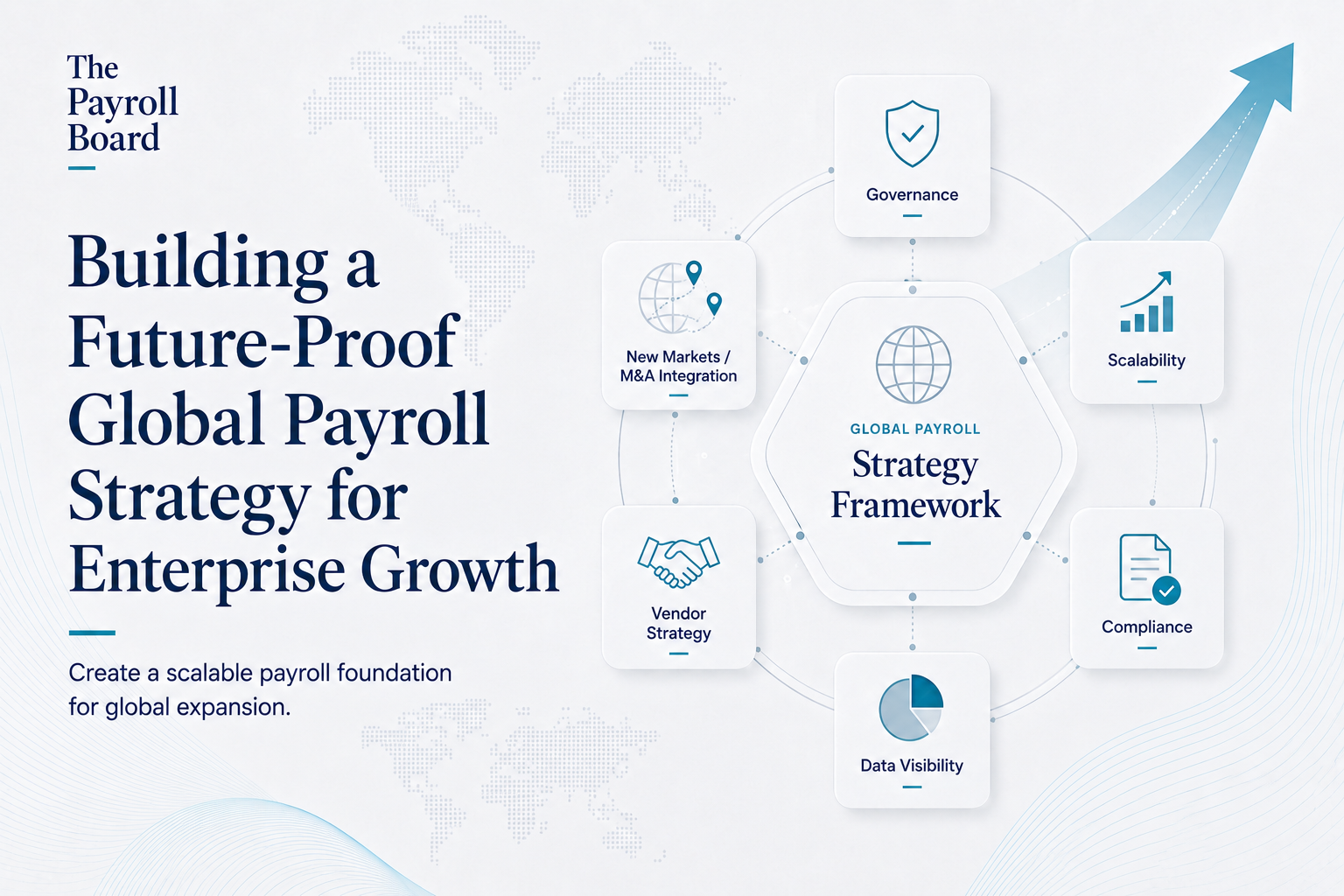
A future-proof strategy should therefore focus on long-term scalability rather than simply solving today's operational problems. Enterprise organizations need a payroll model that can support new countries, changing workforce structures, acquisitions, and evolving regulatory requirements without requiring a complete redesign every time the business changes.
Why Payroll Strategy Matters for Enterprise Growth
Many companies expand internationally through a combination of local entities, acquisitions, and new market entries. As a result, payroll environments often develop organically rather than through a long-term strategic plan.
Different countries may use different systems, providers, processes, and reporting structures. Over time, this creates limited visibility, duplicated activities, inconsistent controls, and increasing operational costs.
A well-designed strategy helps leadership understand how the current environment supports future growth and where transformation may be required.
Build a Strong Foundation for Transformation
Before changing systems or vendors, organizations should understand the current state of their payroll environment. This includes reviewing operating costs, processes, technology, governance, provider performance, and compliance risks.
A detailed assessment can identify where fragmentation is creating unnecessary complexity. It can also help distinguish between problems caused by technology and those caused by unclear responsibilities or inefficient processes.
When evaluating global payroll solutions, organizations should look beyond individual technology features. The right approach should support the wider operating model and provide the flexibility needed for future business changes.
A successful strategy should also define which capabilities should be standardized globally and which should remain flexible to accommodate local regulatory and operational requirements.
Create a Clear Global Operating Model
Technology alone cannot create a future-proof payroll environment. Organizations also need clear governance, defined responsibilities, and effective decision-making structures.
A global operating model should establish how payroll activities are coordinated between corporate teams, regional stakeholders, local teams, and external providers.
Key areas to define include:
ownership and accountability;
governance and decision-making;
reporting requirements;
vendor management;
compliance responsibilities;
data and technology standards;
escalation procedures.
This structure allows the organization to maintain consistency without ignoring the realities of local markets.
Standardize Without Ignoring Local Requirements
One of the biggest challenges for international organizations is finding the right balance between global consistency and local flexibility.
A completely centralized approach may struggle to address country-specific requirements. However, a fully decentralized model can create unnecessary duplication and limited visibility.
Organizations developing an international payroll strategy should therefore identify common processes that can be standardized while maintaining flexibility where local regulations require different approaches.
For example, global governance, reporting standards, performance metrics, and vendor management practices can often be standardized. Local payroll calculations, tax requirements, and statutory reporting may need to remain country-specific.
The goal is to create a controlled global framework rather than force every market into an identical operating model.
Strengthen Governance and Accountability
Strong governance is essential for managing payroll complexity as an organization grows. Without clear accountability, even well-designed technology and processes can become inefficient.
Organizations should define who owns strategic decisions, operational performance, vendor relationships, compliance oversight, and transformation priorities.
Governance should also include regular performance reviews and escalation mechanisms. This allows leadership to identify issues early and take action before they affect payroll delivery or employee experience.
Clear governance becomes particularly important when multiple providers and internal stakeholders are involved in payroll delivery.
Improve Visibility Across the Payroll Ecosystem
Enterprise growth requires leadership teams to make decisions based on reliable and comparable information. Fragmented payroll environments often make this difficult because data is spread across different systems and providers.
A future-proof strategy should improve visibility into payroll costs, operational performance, compliance risks, and vendor outcomes.
Organizations should establish common reporting standards that allow leadership to compare performance across countries while still accounting for local differences.
Well-managed global payroll services can provide stronger operational visibility when they are supported by consistent governance, reliable data flows, and clearly defined reporting responsibilities.
Better visibility also helps organizations identify inefficiencies and prioritize transformation initiatives based on business impact rather than assumptions.
Design the Right Vendor Strategy
Vendor strategy is a critical part of building a sustainable payroll model. Many organizations work with providers that were selected years ago and may no longer align with current business requirements.
As the organization grows, the existing provider landscape should be reviewed regularly. Companies should assess service quality, commercial competitiveness, geographic coverage, technology capabilities, and long-term scalability.
A vendor strategy should not focus only on whether to consolidate providers. In some cases, a multi-provider model may remain appropriate if it is supported by strong governance and consistent standards.
Regular benchmarking can help organizations understand whether current contracts remain competitive and whether service models continue to support business objectives.
Prepare for Mergers, Acquisitions, and New Markets
Enterprise growth often involves acquisitions and rapid international expansion. These changes can quickly introduce new payroll systems, providers, processes, and compliance requirements.
A future-proof strategy should define how new countries and acquired businesses will be integrated into the broader payroll ecosystem.
Organizations should avoid treating every new market as a completely separate project. Instead, they need a structured framework that supports integration while allowing for necessary local variations.
A well-designed multinational payroll model can provide a consistent approach for assessing new markets, selecting providers, integrating data, and establishing governance.
This reduces the risk of additional fragmentation and helps organizations scale more efficiently.
Use Technology as an Enabler, Not the Entire Strategy
Payroll technology can support automation, reporting, data visibility, and integration. However, technology should be selected based on strategic requirements rather than becoming the starting point for transformation.
Before implementing new platforms, organizations should understand which problems they are trying to solve and how technology will support the desired operating model.
Important considerations include:
integration with HR and finance systems;
data quality and accessibility;
reporting capabilities;
automation potential;
implementation complexity;
future scalability;
vendor and country coverage.
Technology should simplify the payroll environment rather than introduce additional complexity.
Build Scalability Into the Operating Model
A future-proof payroll strategy should support growth without requiring continuous restructuring. Organizations should be able to enter new markets, change workforce models, or integrate acquisitions using established principles and processes.
This requires an operating model that is flexible enough to adapt but structured enough to maintain consistency.
Building scalable payroll capabilities means designing processes, governance frameworks, and technology environments that can grow alongside the organization.
Scalability should also be considered from a people perspective. Payroll teams need the right expertise, responsibilities, and decision-making authority to manage increasing complexity.
Measure and Continuously Improve Performance
A payroll strategy should not remain static after implementation. Business requirements, regulations, technology, and provider capabilities continue to evolve.
Organizations should regularly review payroll performance using meaningful operational and strategic indicators.
Useful measures may include:
payroll accuracy and error rates;
processing efficiency;
compliance performance;
cost per employee or country;
employee query volumes;
vendor service levels;
automation rates;
reporting quality.
These insights allow organizations to identify emerging problems and prioritize improvement opportunities before operational complexity becomes a major barrier to growth.
Conclusion
Building a future-proof global payroll strategy requires more than implementing new technology or consolidating providers. Enterprise organizations need a clear understanding of how payroll supports growth, governance, compliance, employee experience, and long-term operational performance.
The strongest strategies combine global standards with local flexibility. They define clear responsibilities, improve visibility, establish effective vendor management practices, and create an operating model that can adapt as the organization enters new markets.
By treating payroll as a strategic business capability rather than only an administrative process, enterprises can reduce fragmentation, manage risk, and create a stronger foundation for sustainable international growth.
