
How Payroll Consultancy Supports Better Technology Decisions
Choosing the right technology and service providers has become one of the most important decisions for organizations managing complex payroll environments. The right payroll software can improve automation, reporting, integration, and operational visibility, but technology alone does not guarantee better outcomes. Organizations also need a clear strategy for selecting solutions, defining requirements, assessing vendors, and aligning technology decisions with their long-term operating model.
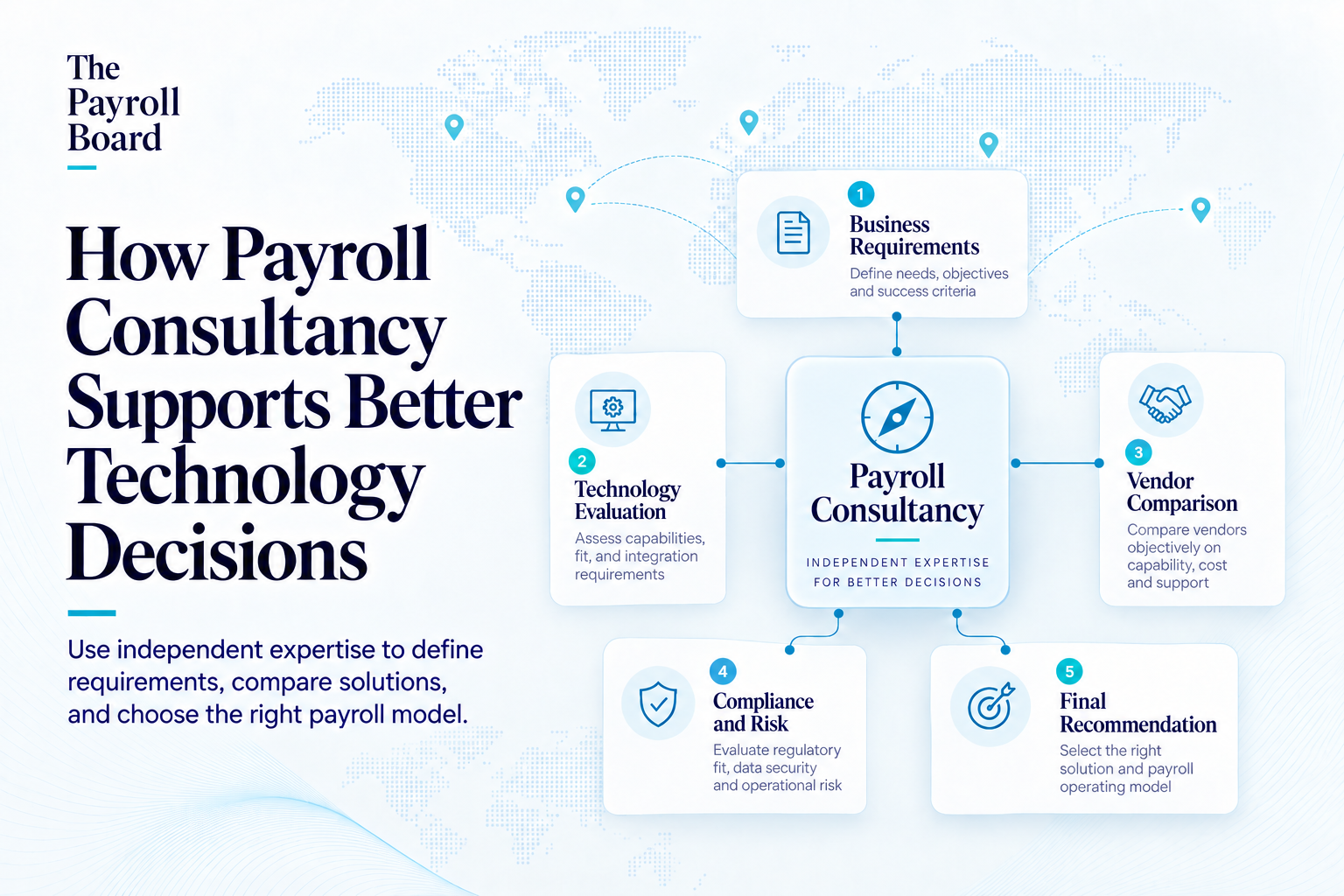
Payroll transformation projects often involve significant financial commitments and affect multiple departments. HR, finance, IT, procurement, payroll teams, and local business units may all have different priorities. Without a structured decision-making framework, organizations can select solutions based on incomplete requirements, vendor presentations, or short-term operational concerns rather than their broader business objectives.
This is where independent strategic guidance can add significant value. A well-structured approach helps organizations understand their current environment, define what needs to change, and establish objective criteria for evaluating technology and service providers.
Why Payroll Technology Decisions Are Becoming More Complex
The payroll technology market has evolved considerably. Organizations can now choose from dedicated payroll platforms, integrated HCM suites, regional solutions, global platforms, managed services, and increasingly sophisticated automation capabilities.
While this provides more options, it also makes decision-making more complicated. Different platforms may offer similar features while using very different operating models, integration approaches, pricing structures, and implementation methodologies.
A technology solution that works well for one organization may be unsuitable for another. Company size, geographic footprint, workforce complexity, existing HR technology, internal capabilities, regulatory requirements, and future growth plans all influence the right technology strategy.
Organizations should therefore avoid starting the selection process by asking which software is the most advanced. The more important question is which capabilities the organization actually needs and how those capabilities should fit into the broader payroll operating model.
Start With the Business Requirements
Technology selection should begin with business requirements rather than vendor demonstrations. Before approaching the market, organizations should understand what is working today, where the major inefficiencies exist, and what the future operating model should look like.
A structured requirements assessment can cover:
payroll processes and workflows;
country and employee coverage;
HR and finance integrations;
reporting requirements;
compliance controls;
data and security requirements;
automation opportunities;
employee self-service;
governance and ownership;
implementation requirements;
scalability and future expansion.
This process helps separate essential capabilities from features that may look attractive during a sales presentation but provide limited practical value.
It also creates a common framework for discussions between business stakeholders, IT teams, procurement, and potential providers.
Understanding International Compliance Requirements
Technology and vendor decisions become even more complex when organizations operate across multiple jurisdictions. A solution must support local payroll requirements while also providing appropriate global governance and visibility.
This is particularly important when assessing international payroll compliance. Regulations can vary significantly between countries, covering taxation, social contributions, reporting, employee classification, data protection, payment requirements, and record retention.
A technology platform may appear highly capable from a functional perspective while still creating challenges in specific jurisdictions. Organizations therefore need to understand how a potential solution handles local requirements and how responsibility for compliance is divided between the client, technology provider, and payroll service provider.
Compliance should not be treated as a technical checkbox during vendor selection. It should be evaluated as part of the overall operating model, including governance, controls, accountability, and ongoing regulatory support.
Evaluate Technology Beyond the Feature List
A common mistake during technology selection is comparing platforms primarily through feature checklists. While functionality is important, it represents only one part of the decision.
Organizations should also assess usability, integration capabilities, data architecture, security, reporting, implementation complexity, support models, and the ability to adapt to future business requirements.
The long-term value of payroll technology depends heavily on how well it integrates into the broader business environment. A platform with extensive functionality may still create operational problems if it requires excessive customization or cannot integrate effectively with existing HR, finance, time management, or workforce systems.
Technology decisions should therefore consider the entire ecosystem rather than evaluating the payroll platform in isolation.
A strong evaluation also considers the organization's ability to operate and maintain the solution after implementation. Internal skills, governance responsibilities, support requirements, and future configuration needs can all affect the total cost and sustainability of the investment.
The Role of Independent Payroll Consultancy
Organizations frequently face a potential conflict when technology vendors are also responsible for recommending the technology approach. Providers naturally present their own solutions in the strongest possible way, which can make independent comparison difficult.
Independent payroll consultancy can provide an additional layer of strategic objectivity. Rather than promoting a particular platform or service model, an advisor can help establish requirements and evaluation criteria before vendors are assessed.
This approach allows organizations to compare solutions against their actual business needs instead of allowing vendor capabilities to define the requirements.
An experienced consultant can also challenge assumptions, identify gaps in the current operating model, benchmark existing arrangements, and help leadership understand the long-term implications of different technology choices.
The objective is not simply to identify a technically capable solution. It is to determine whether the proposed technology and service model support the organization's strategic direction.
How to Compare Payroll Vendors
Vendor selection requires more than comparing prices. Two providers can offer apparently similar services while having very different contractual structures, service levels, governance models, technology capabilities, and implementation approaches.
Organizations should assess payroll vendors across a range of operational, technical, commercial, and strategic criteria. This includes the provider’s geographic coverage and ability to support the required countries and jurisdictions, as well as the capabilities of its technology platform and available integrations. The service model should also be reviewed carefully, including the scope of responsibilities and how services will be delivered.
Compliance is another critical area, particularly the level of local regulatory support and the controls available across different markets. Organizations should also examine reporting capabilities, including both standard and customized reporting, together with service levels such as response times, issue resolution processes, and overall performance.
Commercial considerations should cover pricing structures, fees, and contract terms, while implementation should be assessed based on the proposed migration methodology and timeline. Governance is equally important, including escalation procedures, accountability, and ongoing oversight. Finally, organizations should consider scalability and whether the provider can continue to support future business growth and expansion.
This broader assessment helps organizations understand the actual value offered by each provider rather than comparing vendors on price or technology features alone.
Look Beyond the Payroll Vendor Sales Process
Vendor presentations can provide useful information, but they should not become the primary source of decision-making. Sales demonstrations naturally emphasize strengths and may not fully reveal operational limitations.
Organizations should request evidence wherever possible. This may include implementation examples, service-level data, customer references, reporting samples, security documentation, escalation processes, and detailed commercial assumptions.
The role of the payroll vendor should also be clearly defined before contract negotiations begin. Organizations need to understand which responsibilities remain internal and which are transferred to the provider.
Ambiguous responsibilities can create significant problems after implementation. Issues may move between internal teams and vendors without clear ownership, increasing resolution times and creating unnecessary operational effort.
Clear accountability should therefore be established as part of the vendor evaluation rather than after the contract has already been signed.
Conduct a Structured Payroll System Evaluation
Once requirements and evaluation criteria have been established, organizations can compare potential solutions using a consistent methodology.
A structured payroll system evaluation should consider both current requirements and future business needs. This means assessing not only whether a platform can support today's payroll environment, but also whether it can accommodate future countries, workforce changes, acquisitions, regulatory developments, and technology integration requirements.
A useful evaluation process typically includes several stages:
Current-state assessment – document existing systems, processes, vendors, costs, and pain points.
Future-state definition – establish the desired operating model and strategic objectives.
Requirements development – define functional, technical, compliance, and commercial requirements.
Market assessment – identify relevant technology and service providers.
Vendor evaluation – compare providers against consistent criteria.
Commercial assessment – analyze pricing, contract terms, and total cost of ownership.
Risk assessment – identify implementation, operational, compliance, and technology risks.
Recommendation and roadmap – determine the preferred direction and define implementation priorities.
This structure reduces the risk of making a decision based on a single factor, such as price or functionality.
Consider Total Cost of Ownership
The initial software or service price rarely represents the full cost of a payroll technology decision.
Organizations should consider implementation, integration, configuration, data migration, training, support, upgrades, customization, internal resources, and potential future changes.
A solution with a lower initial price may become more expensive over time if it requires significant customization or extensive internal support.
Total cost of ownership should therefore be evaluated over an appropriate timeframe. This provides leadership with a more realistic understanding of the financial implications of different options.
Commercial benchmarking can also help identify whether existing contracts remain competitive. Payroll markets change, and agreements that were appropriate several years ago may no longer reflect current pricing or service expectations.
Align Technology With the Future Operating Model
Technology should support the operating model rather than dictate it.
Before selecting a platform or provider, organizations should determine how payroll responsibilities will be divided between internal teams, regional operations, external providers, HR, finance, and technology functions.
Questions should include:
Who owns payroll governance?
Who manages vendor relationships?
Who is responsible for compliance oversight?
Which activities should remain internal?
Which processes should be standardized?
Where is local flexibility necessary?
How will performance be measured?
Who owns data and reporting?
How will future changes be managed?
Answering these questions helps organizations select technology and vendors that reinforce the desired operating model rather than creating additional complexity.
Why Governance Matters After Selection
Technology and vendor selection is only the beginning. Once a solution has been implemented, organizations need effective governance to ensure that the expected value is actually delivered.
Governance should cover service performance, compliance, issue management, commercial performance, continuous improvement, and strategic alignment.
Regular reviews can identify whether service levels are being achieved and whether the technology continues to meet business requirements.
Vendor contracts should also be reviewed periodically. Organizations should not assume that the original commercial or operating model will remain appropriate indefinitely.
As business requirements change, the relationship with technology and service providers may need to evolve as well.
Avoid Technology-Driven Transformation
Technology can be a powerful enabler of payroll transformation, but it should not become the transformation strategy itself.
Implementing a new platform without addressing fragmented processes, unclear responsibilities, weak governance, or poor data quality can simply transfer existing problems into a new system.
The strongest transformation programs begin with the business problem and then determine how technology can help solve it.
This approach allows organizations to distinguish between problems that require new technology and those that can be addressed through process redesign, governance improvements, vendor management, or clearer accountability.
How Strategic Advisory Improves Decision-Making
Independent advisory support can help organizations navigate the entire decision-making process, from current-state assessment through implementation planning.
A strategic advisor can provide an external perspective on technology capabilities, vendor positioning, market practices, commercial structures, and operating models.
This is particularly valuable for complex global organizations where decisions involve multiple countries and stakeholders.
The objective is not to make the decision on behalf of the organization. Instead, the role of strategic advisory is to provide the analysis, benchmarks, frameworks, and expertise required for leadership teams to make informed decisions.
Conclusion
Payroll technology and vendor decisions can have long-term consequences for operational efficiency, compliance, cost, employee experience, and scalability. Choosing a platform or provider based solely on functionality or price can therefore create significant risks.
A structured decision-making approach begins with the organization's business requirements and future operating model. From there, technology capabilities, vendors, commercial structures, compliance requirements, implementation risks, and total cost of ownership can be evaluated systematically.
Independent payroll advisory can provide valuable support throughout this process by introducing objective evaluation criteria, market knowledge, benchmarking, and strategic expertise.
Ultimately, the goal is not simply to select a new system or provider. It is to build a payroll ecosystem that supports the organization's current needs while remaining scalable, governable, and adaptable as the business evolves.
