
A payroll compliance audit UK review is an important part of managing payroll responsibilities for organisations operating across several countries. While UK employers must comply with HMRC requirements and local employment legislation, multinational businesses face additional challenges when managing different tax systems, reporting obligations, and employee regulations. A structured approach helps identify compliance gaps, improve internal controls, and reduce the risk of costly payroll errors.
Global payroll operations often involve multiple providers, different payroll platforms, and local teams working under separate regulations. Without consistent oversight, organisations may struggle to identify errors before they create financial or legal consequences.
Why Global Payroll Compliance Audits Are Important
Payroll compliance involves more than calculating salaries correctly. Organisations must also manage statutory deductions, employment requirements, reporting deadlines, employee classifications, and personal data protection.
For international businesses, the challenge is maintaining consistent governance while respecting the different legal requirements of each jurisdiction.
A regular audit helps organisations identify:
Incorrect tax calculations or statutory deductions.
Inconsistent payroll procedures between countries.
Missing or incomplete employee documentation.
Weak internal approval and reconciliation processes.
Unclear responsibilities between payroll teams and external providers.
Delays in implementing regulatory changes.
Maintaining international payroll compliance requires visibility into local payroll activities and a clear understanding of the responsibilities assigned to internal teams and external partners.
Rather than treating compliance as a separate administrative task, businesses should integrate it into their wider payroll governance and risk management framework.
How to Conduct a Global Payroll Compliance Audit
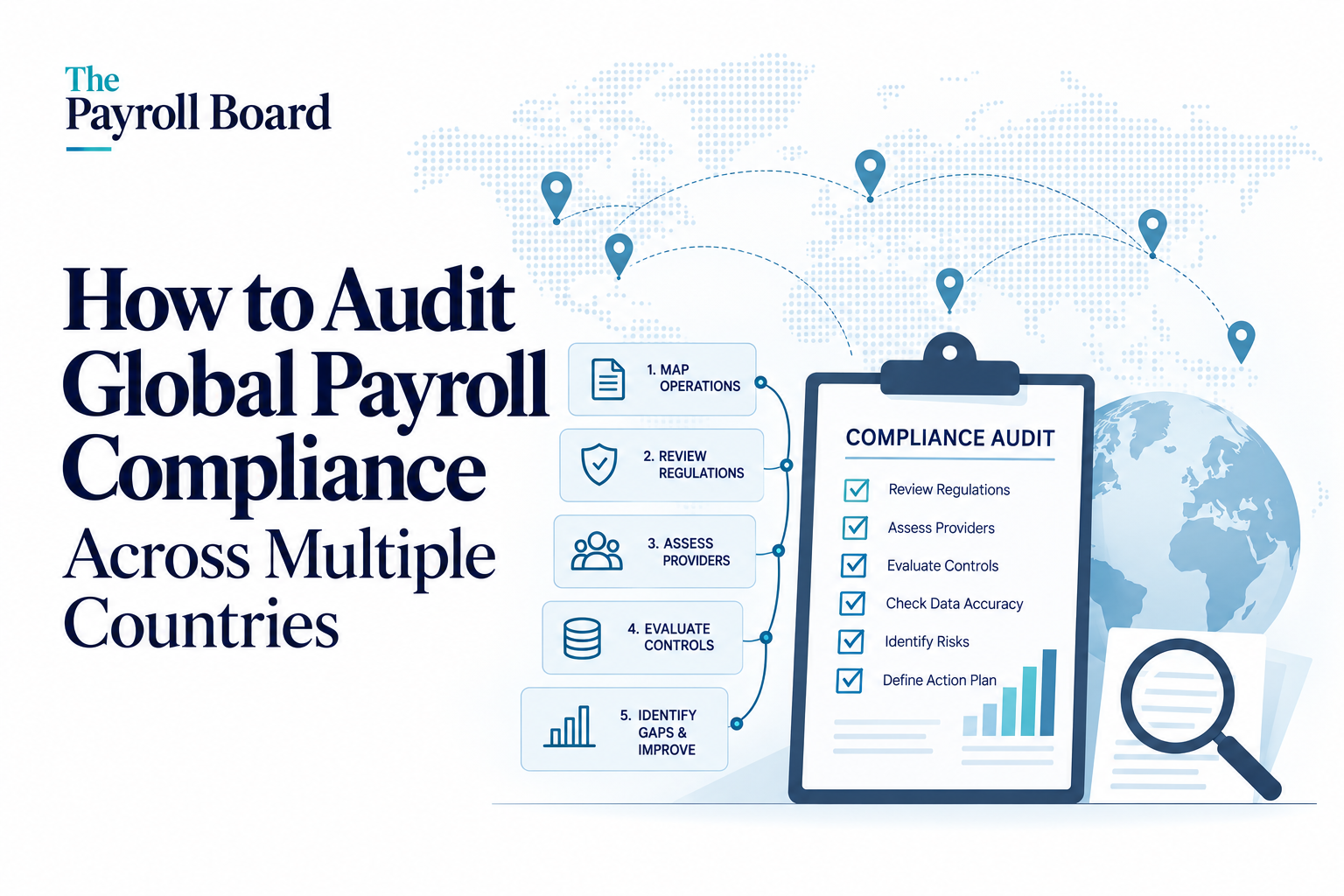
An effective audit should combine global governance standards with country-specific regulatory reviews. The following steps provide a practical framework for organisations managing payroll across multiple jurisdictions.
1. Map Payroll Operations Across All Countries
The first step is to document how payroll operates in every country where the business has employees or payroll obligations.
This includes identifying legal entities, payroll providers, technology platforms, internal process owners, and reporting responsibilities.
Organisations should establish which teams manage payroll inputs, approve calculations, submit statutory reports, and monitor local regulatory developments.
This exercise often reveals gaps in accountability, particularly when international payroll operations have expanded through acquisitions or rapid business growth.
2. Review Local Payroll Regulations
Understanding how to ensure global payroll compliance begins with reviewing the legal and regulatory requirements applicable to each jurisdiction.
Each country has its own employment legislation, tax obligations, social security rules, and statutory reporting requirements.
A country-specific review should cover:
Income tax withholding and reporting.
Employer and employee social security contributions.
Minimum wage and overtime regulations.
Statutory leave and holiday payments.
Pension obligations and employee benefits.
Employment classifications and termination payments.
Payroll record retention requirements.
For example, UK employers must assess compliance with PAYE reporting, National Insurance contributions, and workplace pension requirements.
Similar reviews should be conducted for other countries using the applicable local legislation and reporting standards.
The objective is to verify that payroll calculations, policies, and reporting procedures meet current requirements rather than relying on outdated processes.
3. Assess Payroll Providers and Contractual Responsibilities
Multinational organisations frequently rely on external payroll providers to manage local calculations, reporting, and administrative processes.
However, outsourcing payroll activities does not automatically transfer every legal or regulatory responsibility to the provider.
Businesses should examine service-level agreements, contractual obligations, escalation procedures, and compliance reporting arrangements.
An independent payroll consultancy can help organisations evaluate whether their existing providers, governance structures, and internal processes adequately support international payroll requirements.
Important questions include:
Are responsibilities clearly defined between the employer and provider?
Who monitors and implements changes in local legislation?
Are statutory submissions reviewed and documented?
How are payroll errors identified and resolved?
Does the organisation receive sufficient reporting and performance information?
Reviewing these areas helps organisations identify weaknesses that may not be visible through routine payroll reporting.
4. Evaluate Internal Payroll Controls
Strong internal controls are essential for maintaining accurate and compliant payroll operations.
The audit should examine how payroll data is collected, validated, processed, approved, and reconciled.
Particular attention should be given to employee master data changes, payment authorisations, system access permissions, and the segregation of duties.
For example, the same employee should not be able to modify payroll records and independently approve payments without additional verification.
Consistent controls help reduce operational errors, unauthorised changes, and dependence on individual team members.
They also provide a foundation for improving payroll transparency across different countries and service providers.
Identifying Global Payroll Risks
Effective global payroll risk and compliance management requires organisations to understand both regulatory exposure and operational weaknesses.
Payroll risks may arise from incorrect calculations, inconsistent data, outdated procedures, or insufficient oversight of third-party providers.
Businesses should assess these risks according to their potential impact, likelihood, and the number of employees or jurisdictions affected.
A practical risk assessment can divide findings into three categories:
High priority: Issues involving statutory reporting failures, significant underpayments, incorrect tax deductions, or potential breaches of employment legislation.
Medium priority: Weak approval procedures, inconsistent documentation, or insufficient monitoring of provider performance.
Lower priority: Administrative inefficiencies, duplicated processes, or reporting inconsistencies that do not create immediate regulatory exposure.
This approach helps payroll leaders prioritise corrective actions and allocate resources effectively.
5. Review Payroll Data Security and Documentation
Payroll departments process sensitive employee information, including personal identification details, compensation records, and bank account information.
For international businesses, this information may move between countries, payroll providers, and technology systems.
An audit should therefore examine access controls, data-sharing arrangements, retention policies, and cross-border data transfers.
Organisations subject to GDPR or other applicable privacy regulations must ensure that employee information is processed and transferred lawfully.
Maintaining accurate documentation and audit trails also makes it easier to investigate discrepancies, demonstrate compliance, and support future reviews.
6. Document Findings and Create an Action Plan
A payroll compliance audit should conclude with a clear summary of identified issues, their business impact, and recommended corrective actions.
The audit report should explain which processes meet requirements, where weaknesses exist, and what changes are necessary.
Each finding should include:
A description of the compliance issue.
The affected country, entity, or payroll process.
An assessment of risk and potential consequences.
Recommended corrective actions.
An assigned person or team responsible for implementation.
A target completion date.
Documenting findings in a consistent format allows global payroll leaders to compare risks across countries and monitor improvement over time.
How Often Should Global Payroll Compliance Be Audited?
The appropriate audit frequency depends on the organisation's size, geographic presence, regulatory exposure, and operational complexity.
An annual comprehensive review can provide a useful baseline, but high-risk processes may require more frequent monitoring.
For example, organisations can introduce monthly payroll reconciliations, quarterly compliance control reviews, and periodic assessments of payroll provider performance.
Additional reviews may be necessary when entering new markets, changing payroll systems, switching providers, or implementing significant organisational changes.
Continuous monitoring helps businesses identify emerging issues before they become larger compliance problems.
Common Mistakes During International Payroll Audits
Even organisations with established payroll operations can make mistakes when reviewing compliance across multiple jurisdictions.
Focusing only on payroll accuracy. Correct salary payments do not necessarily confirm that statutory reporting, record retention, and approval requirements are being met.
Applying the same procedures everywhere. Global standards support consistency, but local legal requirements must determine specific compliance obligations.
Relying entirely on external providers. Employers still need appropriate oversight and a clear understanding of their responsibilities.
Ignoring documentation gaps. Missing records and unclear audit trails can make it difficult to demonstrate compliance during regulatory reviews.
Failing to monitor corrective actions. Identifying weaknesses is only valuable when organisations implement and verify the necessary improvements.
Avoiding these mistakes supports a more effective audit process and stronger long-term payroll governance.
Building a Sustainable Global Payroll Compliance Framework
A successful international payroll audit should do more than identify existing problems. It should help organisations establish processes that reduce the likelihood of future compliance failures.
This requires a combination of centralised governance, clear accountability, reliable technology, and local regulatory expertise.
Global payroll leaders should define consistent reporting standards, risk assessment procedures, and internal controls. Local teams and specialists should ensure that payroll activities reflect the requirements of each jurisdiction.
Regular communication between payroll, HR, finance, legal teams, and external providers is equally important.
By integrating these responsibilities into a structured operating model, organisations can improve transparency, reduce operational risk, and maintain greater control over international payroll activities.
Conclusion
Auditing payroll compliance across multiple countries requires a systematic approach to local regulations, payroll processes, provider responsibilities, and internal controls.
Organisations that regularly review these areas can identify compliance gaps, improve accountability, and strengthen the reliability of their international payroll operations.
The goal is not simply to complete an audit but to establish a sustainable compliance framework that supports business growth, regulatory readiness, and effective global payroll governance.
