
Understanding payroll compliance by country is essential for businesses employing people in more than one jurisdiction. Tax withholding, social contributions, employment protections and reporting deadlines vary, even between neighbouring markets. An approach that works in one country can create risk in another. International expansion therefore calls for local checks supported by consistent global oversight.
Why Payroll Rules Differ Between Countries
Payroll obligations depend on the employing entity, where work is performed and the employee's circumstances. Local rules may determine registration, payslip content, holiday pay, benefits and how long records must be kept. Some obligations arise before the first salary is paid. Others change when an employee relocates or works across borders.
Maintaining international payroll compliance means identifying these obligations rather than assuming a single worldwide policy is sufficient. A central payroll team can establish approval standards, but local specialists should validate tax, labour and social security requirements. Clearly document who owns each decision, including how legislative changes reach payroll systems and providers.
Build a Practical Country-Level Review
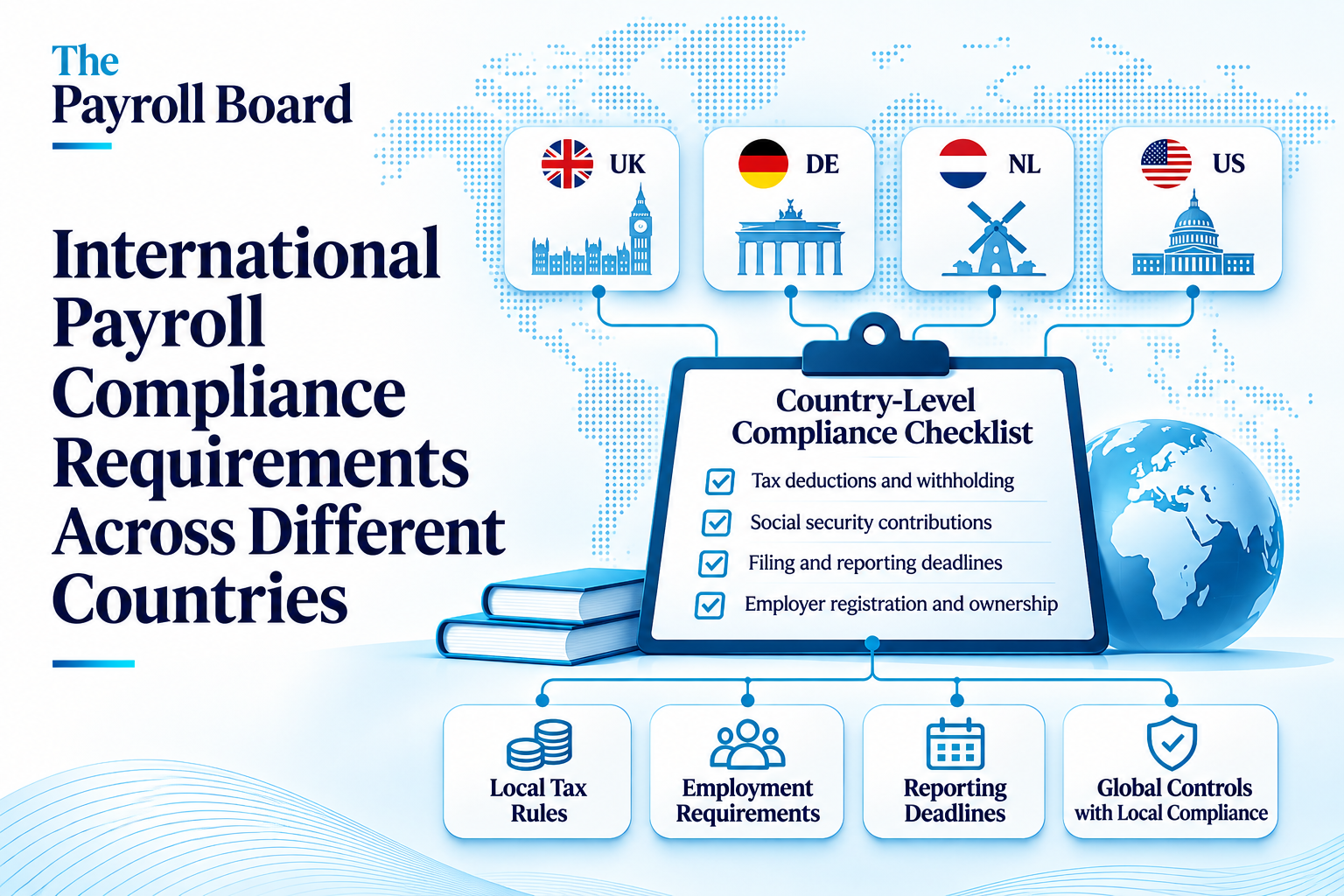
A reliable payroll compliance checklist should be completed for every location where the organisation has payroll responsibilities. It should cover both legal obligations and the controls used to meet them.
Employer setup: confirm registrations, legal entities and local reporting accounts.
Employee data: validate work location, classification, contractual pay and statutory identifiers.
Calculations: check taxable benefits, deductions, contributions and leave entitlements.
Reporting: identify submission formats, payment dates and record-retention rules.
Governance: assign approvers, escalation contacts and evidence requirements.
Treat this as a live working document. Update it following a change in law, provider, hiring model or employee circumstances. Record the owner and the date of each check.
Apply Global Standards Without Ignoring Local Law
The challenge with global payroll compliance requirements is deciding what to standardise. Shared controls can cover data validation, segregation of duties, exception reports and provider reviews. However, statutory calculations and employment protections must reflect each jurisdiction's rules.
For example, UK employers generally operate PAYE and report payroll information to HMRC through Real Time Information submissions. Across the EU, social security obligations for mobile workers depend on coordination rules and individual working arrangements. An employee's country of residence alone may not determine where contributions are due.
These differences should be reviewed before changing payroll configurations or transferring employees. Where rules interact, obtain advice from qualified local specialists and document the reasoning behind decisions.
Clarify Responsibility for Local Providers
Outsourcing monthly calculations does not remove the need for employer oversight. Providers may handle statutory filings and payslips, while internal teams remain responsible for supplying accurate data, authorising payments and checking service performance.
Independent payroll consultancy can help businesses review their operating model, compare suppliers and establish governance across countries. This is especially useful when mergers, acquisitions or rapid expansion leave responsibilities divided between several vendors. Contract terms should state who monitors legal changes, resolves incidents and supplies evidence of completed submissions.
Monitor Changes and Emerging Risks
International payroll regulations do not remain static. Tax thresholds, reporting systems and employment requirements can change independently in each market. An annual audit alone may miss problems that arise between reviews.
Create a calendar of statutory deadlines and periodic control checks. Track late filings, corrections, rejected payments and unresolved provider issues. Require local teams to flag changes that affect calculations or employee rights, then test updates before the next payroll cycle.
Cross-border work deserves particular attention. Remote working, short-term assignments and permanent relocations may change tax or social security obligations. Build an early notification process so HR, payroll and advisers assess each situation before it becomes a compliance incident.
Conclusion
Managing payroll across countries is not about forcing identical procedures on different legal systems. Reliable delivery combines country-level expertise, accurate employee data, clear provider responsibilities and central visibility of risk. Businesses that document requirements, review controls and respond promptly to regulatory changes can support expansion without losing control of payroll compliance.
