
Managing Statutory Payroll Reporting Across Multiple Jurisdictions
Managing payroll across several countries requires a structured approach to payroll reporting. Organizations must coordinate employee data, tax information, filing calendars, local regulations, and internal controls while ensuring statutory obligations are completed accurately and on time.
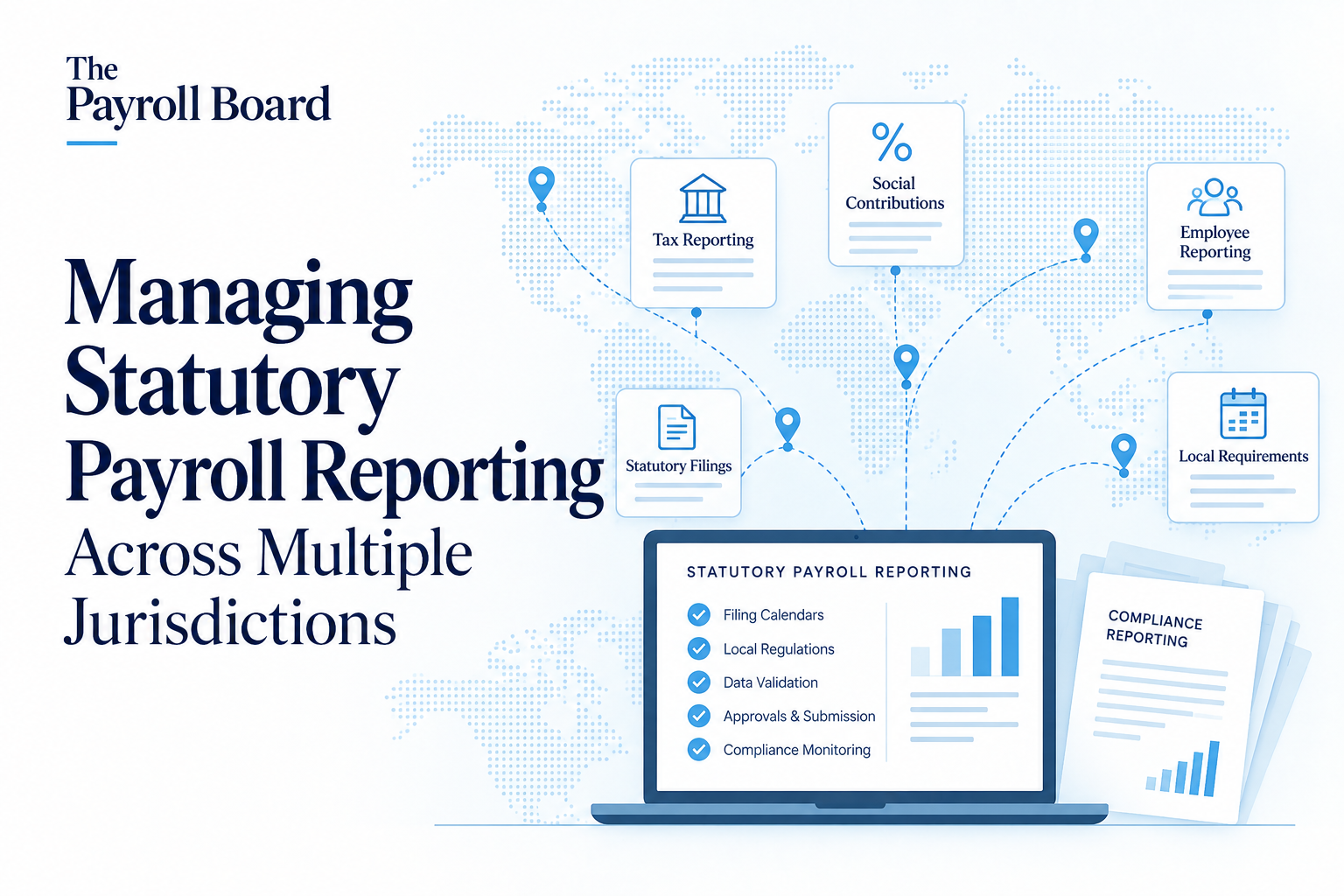
Organizations need clear ownership, documented controls, and a reliable compliance calendar. These foundations help coordinate obligations while giving leadership visibility into risk. A strong framework should define who prepares each report, who reviews it, which authority receives it, when it is due, and what evidence must be retained. Central teams can define minimum controls while local specialists interpret country-specific rules.
Why Multi-Jurisdiction Payroll Reporting Is Complex
Managing payroll in one country can already involve multiple tax, employment, and social security obligations. When an organization operates across several jurisdictions, these requirements multiply.
Each country may have different:
tax authorities and reporting bodies;
filing deadlines;
reporting formats;
payroll tax rules;
social security requirements;
employee data requirements;
record retention obligations;
correction and amendment procedures.
A process that works effectively in one jurisdiction may not be appropriate in another. Trying to force identical procedures across every country can therefore create unnecessary compliance risks.
At the same time, allowing every country to operate completely independently can result in fragmented processes, duplicated work, inconsistent controls, and limited visibility for headquarters.
The objective should be to find the right balance between global governance and local execution.
Building a Strong Compliance Framework
Organizations operating internationally should treat international payroll compliance as an ongoing governance responsibility rather than a once-a-year exercise.
A strong framework should cover tax filings, social contributions, employee reporting, record retention, payment obligations, and other statutory requirements relevant to each jurisdiction.
Central payroll teams can establish common policies, minimum controls, escalation procedures, and reporting standards. Local payroll specialists can then interpret legislation and manage country-specific requirements.
This approach allows organizations to maintain consistency without ignoring legitimate differences between jurisdictions.
Establish Clear Ownership
Every statutory obligation should have a clearly assigned owner.
This becomes particularly important when several internal departments and external payroll providers are involved. Without clear accountability, organizations may assume that another party is responsible for a filing.
A responsibility matrix can define:
who prepares the information;
who validates the data;
who approves the filing;
who submits it;
who monitors confirmation;
who manages corrections;
who retains supporting documentation.
Clear ownership makes the overall process easier to control and audit.
Managing Payroll Tax Obligations
Tax reporting deserves particular attention because late submissions, incorrect calculations, missing information, or rejected filings can result in penalties and corrective work.
A controlled payroll tax reporting process should include data validation, pre-submission review, approval, filing confirmation, and payment reconciliation.
Organizations should also maintain evidence that each filing was completed successfully. Submission confirmations, payment records, amendments, and approval records can provide important protection during internal or external audits.
Technology can support these controls through automated reminders, validation rules, centralized calendars, and reporting dashboards. However, automation cannot compensate for inaccurate source data or outdated regulatory logic.
The Role of External Advisory Support
Some organizations have strong local payroll teams but limited resources to review their entire international operating model.
Independent payroll consultancy can provide an external perspective on governance, vendor responsibilities, reporting processes, and compliance controls.
This can be particularly valuable when an organization is:
entering new countries;
consolidating payroll providers;
reviewing existing contracts;
redesigning its operating model;
preparing for payroll transformation;
experiencing recurring compliance issues.
The purpose of external advisory support is not to replace local expertise. Instead, it can connect local knowledge with a broader strategic framework.
An independent review may also identify duplicated activities, unclear ownership, inconsistent controls, and gaps between contractual responsibilities and actual service delivery.
Documenting Payroll Obligations
A central register of payroll reporting requirements should identify the reporting authority, frequency, deadline, responsible party, submission method, required data, and evidence that must be retained.
This register provides a reliable reference point for internal payroll teams, HR, finance, legal functions, and external providers.
It should also be reviewed whenever legislation changes, a new legal entity is created, or the organization's workforce structure changes.
Without regular maintenance, even a well-designed compliance register can quickly become outdated.
Create a Central Payroll Compliance Calendar
A centralized calendar can help organizations manage deadlines across multiple jurisdictions.
The calendar should distinguish between:
payroll processing deadlines;
tax filing deadlines;
social security submissions;
payment dates;
annual reporting;
employee reporting;
internal review deadlines.
Internal review deadlines should generally occur before the statutory deadline. This creates time to investigate discrepancies and correct problems before a filing becomes overdue.
Improving Payroll Data Quality
Accurate statutory reporting starts with accurate payroll data.
Incorrect employee classifications, missing information, outdated tax settings, inconsistent identifiers, and incorrect payment data can all affect statutory submissions.
Organizations should establish reconciliation procedures between payroll, HR, finance, and statutory reporting outputs.
For example, differences between payroll records and financial reporting should be investigated before statutory submissions are finalized.
Standardize Data Where Possible
Global organizations often use several payroll platforms and local providers. Different systems may use different data structures and employee identifiers.
Standardizing core data definitions can reduce reconciliation problems and improve reporting consistency.
However, standardization should not remove information required for local compliance. Country-specific fields and reporting requirements should remain available where legally necessary.
Managing Multiple Payroll Providers
Working with several local providers can give organizations access to jurisdiction-specific expertise. However, it also introduces additional governance complexity.
Different providers may use different processes for:
preparing statutory reports;
validating payroll data;
managing deadlines;
handling corrections;
documenting submissions;
monitoring regulatory changes.
Organizations should therefore define common expectations for all providers.
Service-level agreements can specify responsibilities for statutory submissions, reporting evidence, escalation procedures, regulatory updates, and issue resolution.
Benchmark Provider Performance
Vendor performance should be reviewed regularly rather than only when contracts are renewed.
Useful measures include:
on-time filing rate;
number of rejected submissions;
unresolved compliance issues;
recurring payroll errors;
response time;
quality of statutory documentation;
adherence to contractual obligations.
This helps organizations determine whether problems are isolated incidents or indicators of broader process weaknesses.
Creating a Reliable Audit Trail
Every statutory submission should have appropriate supporting evidence.
Depending on the jurisdiction, this may include:
submitted reports;
confirmation receipts;
payment evidence;
approval records;
amended filings;
correspondence with authorities;
explanations for significant adjustments.
Centralizing this information can significantly simplify audits.
It also reduces dependence on individual employees or provider contacts who may no longer be responsible for the account.
Protect Sensitive Payroll Information
Payroll reporting involves highly sensitive employee and financial information. Compliance processes should therefore include appropriate access controls, secure storage, retention policies, and document management procedures.
Only authorized individuals should have access to sensitive reporting data.
Security should be considered part of the overall payroll governance framework rather than treated as a separate technology issue.
Using Technology to Improve Reporting
Technology can significantly improve the management of multi-country payroll reporting.
Organizations can use technology to centralize:
compliance calendars;
filing deadlines;
regulatory alerts;
approval workflows;
reporting dashboards;
document repositories;
exception tracking.
Automation can reduce the risk of missed deadlines and repetitive administrative work.
However, technology should support a clearly defined operating model rather than replace it.
A payroll platform cannot independently determine every local legal interpretation. Organizations still need qualified local expertise to assess regulatory changes and determine how they affect payroll processes.
Measuring Payroll Reporting Performance
Organizations should monitor a focused set of performance indicators to determine whether their reporting framework is working effectively.
Useful measures can include:
On-time filing rate – percentage of statutory reports submitted before the deadline.
Rejected filing rate – number of reports rejected by authorities.
Amendment rate – frequency of corrected or resubmitted reports.
Compliance incidents – number of identified regulatory failures.
Open exceptions – unresolved reporting or data issues.
Provider performance – compliance with agreed service levels.
Data quality issues – recurring errors affecting statutory reporting.
The objective is not to create an unnecessarily large dashboard.
A small number of meaningful indicators can provide leadership with a much clearer view of compliance performance.
Managing Statutory Payroll Reporting at Scale
Effective multi-country reporting depends on clear ownership, accurate data, reliable deadlines, local expertise, and centralized visibility.
The objective is not to eliminate every country-level difference. Instead, organizations should create a governance structure that makes those differences visible and manageable.
A scalable operating model combines global policies with local execution.
Central teams can monitor risk, performance, exceptions, and provider accountability, while local specialists remain responsible for jurisdiction-specific interpretation and statutory submissions.
This approach allows organizations to maintain stronger oversight without attempting to centralize every aspect of payroll administration.
Preparing for Regulatory Change
Regulatory change should be treated as a normal part of payroll operations.
Tax authorities can introduce new reporting formats, change deadlines, modify contribution rates, or introduce additional information requirements.
Organizations should therefore establish a process for identifying and assessing regulatory changes.
A useful process includes:
monitoring relevant regulatory developments;
assessing their impact on payroll;
assigning responsibility for implementation;
updating processes and systems;
testing changes where necessary;
documenting the resulting control changes.
This creates a repeatable approach instead of relying on individual employees to identify changes informally.
Integrating Reporting Into Payroll Governance
Statutory reporting should not operate as an isolated activity.
It should be integrated into the wider payroll governance model alongside vendor management, payroll operations, HR data, finance processes, compliance, and technology.
When reporting is integrated into governance, leadership can better understand how operational decisions affect regulatory obligations.
For example, changing a payroll provider, entering a new country, acquiring a business, or introducing a new workforce model may all create additional reporting requirements.
Considering these implications during strategic planning can prevent compliance problems later.
Conclusion
Managing statutory payroll reporting across multiple jurisdictions requires more than maintaining a list of filing deadlines.
Organizations need a structured framework that combines global governance, local expertise, accurate payroll data, clear accountability, provider oversight, technology, and continuous monitoring.
The most effective approach is to standardize what can reasonably be standardized while preserving the flexibility required by local legislation.
With clear ownership and reliable controls, organizations can improve visibility across their international payroll environment, reduce compliance risk, and create a more scalable operating model for future growth.
As organizations continue expanding across borders, effective statutory reporting will remain an important part of broader payroll transformation and governance strategy.
