
Payroll is no longer just an administrative function. For multinational organizations, it has become a strategic business process that directly affects compliance, financial performance, employee experience, and operational resilience. As companies expand across multiple jurisdictions, payroll operations become increasingly complex, requiring structured governance, standardized processes, and clear accountability. Organizations managing government certified payroll requirements alongside commercial payroll obligations often discover that weak governance creates risks extending far beyond delayed salary payments or reporting issues.
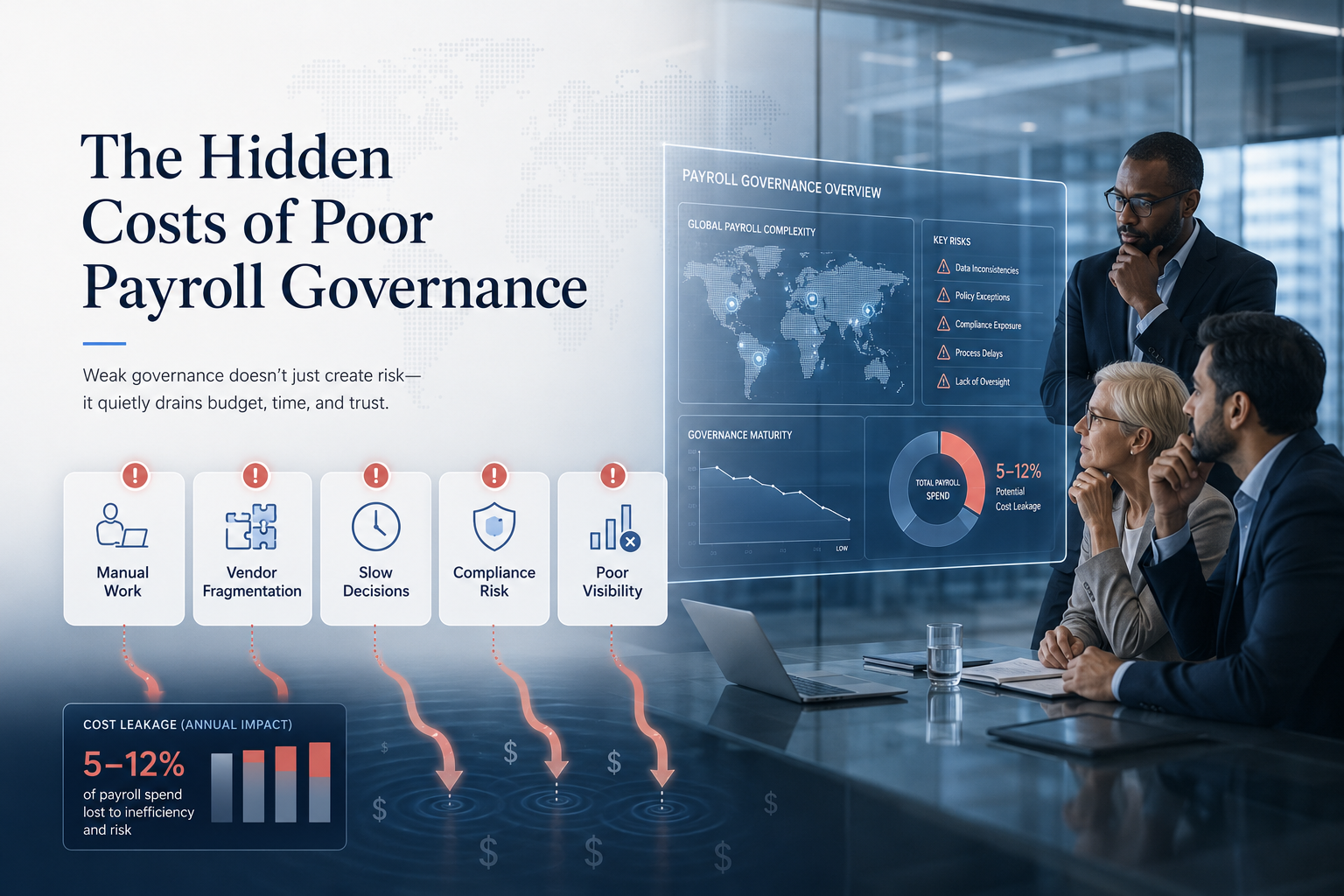
Poor payroll governance rarely causes immediate disruption. Instead, problems accumulate gradually through inconsistent processes, fragmented technologies, unclear ownership, and outdated operational models. Over time, these weaknesses increase operating costs, reduce visibility into payroll performance, create compliance exposure, and make future transformation initiatives significantly more difficult.
Many leadership teams initially focus on payroll technology when seeking operational improvements. While modern systems are important, technology alone cannot solve governance issues. Sustainable payroll performance depends on strategic oversight, standardized operating models, effective vendor management, and clearly defined responsibilities across HR, Finance, Payroll, IT, Procurement, and local business teams.
Organizations that invest in governance are generally better positioned to improve efficiency, reduce operational complexity, and support long-term international growth.
Why Payroll Governance Matters More Than Ever
Global businesses operate in an environment where payroll regulations continue to evolve rapidly. Tax legislation changes frequently, employment laws differ between jurisdictions, and reporting obligations become increasingly sophisticated. At the same time, organizations expect payroll to deliver greater transparency, faster reporting, and stronger support for strategic decision-making.
Without governance, payroll quickly becomes fragmented.
Different countries often adopt separate payroll providers, independent approval workflows, inconsistent reporting standards, and disconnected technologies. Local optimization may appear successful, yet the overall payroll ecosystem becomes increasingly inefficient from a global perspective.
Many organizations respond by investing in global payroll solutions designed to improve standardization and operational visibility. However, successful transformation requires much more than implementing a new platform. Governance establishes how decisions are made, who owns critical processes, how vendors are managed, and how performance is measured across every country.
Companies that underestimate governance often experience repeated transformation failures because underlying operational problems remain unresolved.
Understanding Payroll Governance
Payroll governance refers to the framework of policies, controls, responsibilities, processes, and performance standards that ensure payroll operates consistently across the organization.
Strong governance creates alignment between business strategy and payroll execution.
Rather than allowing every country or business unit to develop independent practices, governance establishes standardized principles while still providing flexibility to meet local legal requirements.
Effective governance normally includes:
clearly defined ownership and accountability
standardized payroll processes
documented approval workflows
vendor management frameworks
compliance monitoring
performance measurement
audit controls
risk management procedures
escalation protocols
continuous improvement practices
These components work together to create transparency across payroll operations while reducing operational uncertainty.
Hidden Operational Costs
One of the most overlooked consequences of poor governance is operational inefficiency.
Organizations frequently assume payroll costs consist primarily of software licenses and vendor fees. In reality, hidden operational expenses often exceed direct payroll processing costs.
Examples include duplicated work performed by regional teams, manual reconciliation activities, inconsistent reporting, unnecessary approval cycles, repeated error corrections, and excessive coordination between departments.
In organizations managing complex government payroll obligations across multiple legal entities, these inefficiencies become even more expensive because reporting standards and regulatory expectations are typically higher.
Employees spend valuable time solving preventable operational problems instead of focusing on strategic initiatives.
Finance teams struggle to reconcile inconsistent payroll reports.
HR departments answer increasing numbers of employee queries.
Management receives delayed or incomplete payroll information.
All of these activities consume resources without creating additional business value.
Fragmented Vendor Landscapes
Many multinational organizations have accumulated payroll providers over many years.
An acquisition introduces one provider.
A regional expansion adds another.
A local legal requirement creates a third.
Eventually dozens of providers operate independently with limited coordination.
Although every provider may perform adequately within its own market, the overall payroll ecosystem becomes fragmented.
This fragmentation reduces visibility, increases administrative overhead, and complicates governance.
Organizations frequently maintain multiple contracts with overlapping services, inconsistent pricing structures, different service-level agreements, and incompatible reporting formats.
Without regular benchmarking, businesses rarely know whether they continue receiving competitive commercial terms.
Companies operating extensive global payroll services environments often discover that vendor rationalization alone can produce meaningful operational improvements without disrupting payroll continuity.
Strategic governance ensures vendor relationships remain aligned with changing business objectives rather than historical decisions.
Poor Governance Creates Slow Decision-Making
Decision-making becomes increasingly difficult when governance structures are unclear.
Simple operational questions often require multiple departments to participate.
Nobody fully understands who owns process changes.
Escalations move slowly between HR, Payroll, Finance, Procurement, Legal, and external vendors.
Instead of making proactive improvements, organizations become reactive.
This creates delays during system upgrades, vendor transitions, acquisitions, regulatory changes, and business restructuring projects.
Leadership teams frequently underestimate how much productivity is lost because of governance uncertainty.
Well-designed governance frameworks significantly reduce these delays by establishing ownership before problems occur.
Compliance Is Only One Part of the Equation
Many organizations associate payroll governance exclusively with compliance.
Compliance is certainly essential, but governance delivers much broader business value.
Strong governance improves reporting quality.
It supports financial planning.
It enhances workforce visibility.
It strengthens internal controls.
It increases confidence in executive decision-making.
Companies with mature governance models are generally better prepared for mergers, acquisitions, international expansion, and organizational transformation because payroll becomes a predictable operational capability instead of a recurring business challenge.
The Financial Impact of Weak Governance
The financial impact of poor payroll governance extends far beyond regulatory penalties.
Organizations often experience:
duplicated vendor costs
unnecessary manual administration
increased audit expenses
project delays
higher consulting costs
inconsistent reporting
inefficient technology investments
reduced operational productivity
Many of these costs remain invisible because they are distributed across different departments rather than recorded as payroll expenses.
Executive leadership therefore underestimates the true cost of operational inefficiency.
Comprehensive governance reviews frequently identify opportunities for substantial long-term savings without reducing service quality.
Payroll Transformation Without Governance Often Fails
Many payroll transformation initiatives focus primarily on technology implementation.
However, replacing software without redesigning governance simply automates existing inefficiencies.
Organizations sometimes invest millions in transformation programs while maintaining unclear ownership structures, fragmented operating models, inconsistent approval processes, and outdated governance frameworks.
The result is disappointing.
New technology delivers only a fraction of its expected value.
Successful transformation begins with governance.
Technology should support well-designed operational models rather than define them.
Companies that first establish governance typically experience smoother implementations, higher adoption rates, and stronger long-term outcomes.
Governance Improves Risk Management
Every payroll operation contains risk.
Some risks involve compliance.
Others relate to operational continuity, vendor dependency, cybersecurity, data quality, employee experience, or financial reporting.
Without governance, these risks remain poorly understood.
Organizations often react after problems occur instead of proactively identifying vulnerabilities.
Effective governance establishes structured risk assessment processes that help leadership prioritize improvement initiatives.
Reducing payroll risk requires more than introducing additional controls. It involves creating an operating model where accountability, transparency, and continuous monitoring become part of everyday payroll management.
This proactive approach significantly improves organizational resilience.
The Employee Experience Matters
Employees rarely think about payroll until something goes wrong.
Incorrect salary payments, delayed bonuses, inaccurate tax calculations, or missing reimbursements immediately reduce confidence in the employer.
Payroll therefore plays a direct role in employee engagement and organizational reputation.
Poor governance increases the likelihood of communication failures between departments, inconsistent approval timelines, and delayed issue resolution.
Even when payroll teams work extremely hard, weak governance limits their ability to deliver consistently high-quality service.
Organizations that strengthen governance often improve employee satisfaction without increasing payroll operating costs.
Why Independent Advisory Creates Better Outcomes
Many payroll providers naturally recommend solutions aligned with their own commercial offerings.
Independent payroll advisors take a different approach.
Their objective is to evaluate governance objectively, benchmark operational performance, assess vendor relationships, identify inefficiencies, and develop transformation roadmaps based on business priorities rather than technology sales.
Independent expertise becomes particularly valuable during vendor selection, contract negotiations, governance redesign, and large-scale international payroll transformation programs.
Experienced advisors help organizations avoid costly implementation mistakes while building operating models that remain sustainable as business requirements evolve.
The Cost of Ignoring Small Problems
One of the biggest misconceptions about payroll governance is that small issues can simply be managed locally.
In reality, minor operational weaknesses tend to multiply over time.
A manual workaround introduced today becomes tomorrow's standard operating procedure.
A temporary reporting process becomes permanent.
An outdated approval workflow remains unchanged for years.
Eventually, these seemingly minor issues contribute to significant payroll errors, increased operating costs, compliance concerns, and declining confidence in payroll data.
Organizations that review governance regularly are far more successful at identifying and resolving these issues before they become expensive transformation projects.
Conclusion
Poor payroll governance creates costs that extend well beyond payroll itself. Operational inefficiencies, fragmented vendor landscapes, inconsistent processes, unclear accountability, and weak oversight gradually reduce organizational performance while increasing financial and compliance exposure.
Rather than viewing payroll as a purely administrative function, leading organizations recognize it as a strategic business capability requiring structured governance, measurable performance standards, and continuous improvement. By investing in governance before problems escalate, businesses create more resilient payroll operations that support international growth, improve decision-making, strengthen compliance, and deliver sustainable long-term value.
