
What Is Global Payroll and Why It Becomes Complex as You Scale
Managing payroll in a single country is already a demanding operational responsibility. Once organizations begin expanding internationally, payroll quickly evolves into a far more complex business function involving compliance, governance, technology integration, data security, and operational coordination across multiple jurisdictions. Many growing companies initially underestimate the level of structure required to support international payroll operations effectively.
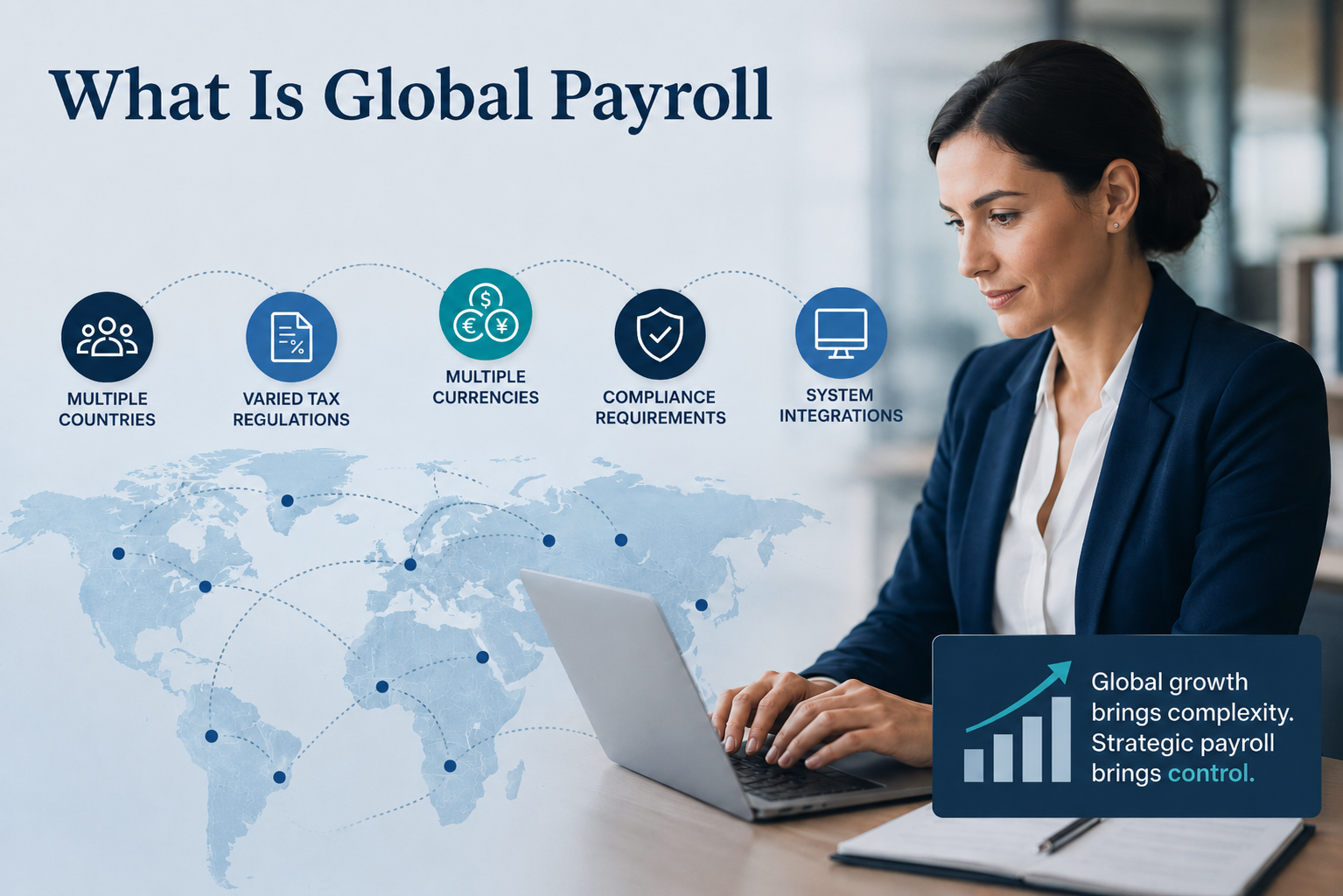
As businesses scale globally, leadership teams often discover that fragmented systems, inconsistent local practices, and disconnected vendors create operational inefficiencies that become increasingly difficult to control over time. This is one of the reasons why many organizations start evaluating managed payroll services as part of broader transformation initiatives designed to improve scalability, governance, and operational visibility.
Global payroll is no longer simply about paying employees correctly and on time. It now directly impacts employee experience, regulatory compliance, financial forecasting, audit readiness, and overall operational resilience. For multinational organizations, payroll has become a strategic function that requires long-term planning and continuous optimization.
Understanding What Global Payroll Actually Means
Global payroll refers to the processes, technologies, governance structures, and operational models used to manage employee compensation across multiple countries simultaneously. This includes salary payments, tax calculations, statutory reporting, benefits administration, compliance management, and workforce data coordination across different jurisdictions.
Unlike domestic payroll, global payroll operations must account for varying labor laws, currencies, tax systems, reporting standards, and regulatory frameworks. Each country introduces unique legal obligations and operational challenges that organizations must navigate carefully.
Many companies initially attempt to manage international payroll using localized solutions implemented independently within each region. While this may work temporarily during early expansion phases, the model often becomes unsustainable as operational complexity increases.
To improve standardization and long-term scalability, organizations frequently invest in centralized global payroll solutions that allow leadership teams to improve oversight while maintaining flexibility for local regulatory requirements.
A well-structured global payroll environment typically includes:
centralized governance frameworks
standardized reporting structures
local compliance management
integrated technology systems
vendor coordination processes
data security protocols
audit and control mechanisms
Without proper coordination between these elements, payroll operations often become fragmented and difficult to manage effectively.
Why Payroll Complexity Increases as Companies Scale
The complexity of payroll grows rapidly when organizations expand internationally. New countries introduce additional regulations, employment structures, languages, tax obligations, and operational dependencies that must all be managed simultaneously.
Many businesses assume payroll complexity increases gradually. In reality, complexity often grows exponentially because each new jurisdiction adds multiple operational layers rather than a single new process.
practically , expanding may require managing:
separate tax and social security requirements
multiple currencies
different reporting calendars
varying employee classifications
distinct labor law requirements
local data privacy regulations
separate payroll vendors or technologies
As a result, payroll environments quickly become difficult to standardize without clear governance structures and scalable operational models.
This challenge becomes even more significant when organizations grow through acquisitions or decentralized expansion strategies. Newly acquired entities may use completely different payroll technologies, vendors, approval processes, and reporting standards.
To manage this operational fragmentation effectively, companies increasingly evaluate strategic payroll service solutions that help align systems, workflows, governance models, and reporting structures across the organization.
The goal is not necessarily to centralize everything into a single platform immediately. Instead, successful organizations focus on creating operational consistency while maintaining the flexibility required to address local realities.
The Hidden Risks of Fragmented Payroll Structures
One of the most common causes of payroll inefficiency is fragmentation. Over time, many multinational organizations develop disconnected payroll ecosystems involving multiple providers, isolated systems, and inconsistent governance practices.
This fragmentation often occurs gradually. Regional teams implement local solutions independently based on immediate operational needs, creating a patchwork environment that becomes increasingly difficult to coordinate globally.
Fragmented payroll models frequently lead to:
inconsistent reporting standards
duplicated operational tasks
limited payroll visibility
weak accountability structures
compliance gaps
increased manual intervention
delayed issue resolution
These problems create hidden operational costs that are not always immediately visible within standard financial reporting.
Another major challenge involves data consistency. HR systems, finance platforms, and payroll technologies often operate independently without proper integration. This creates reconciliation issues, reporting delays, and increased administrative workloads.
Organizations operating large-scale global payroll services environments must therefore invest in stronger governance frameworks that improve visibility, accountability, and operational coordination across all regions.
Without centralized oversight, leadership teams often struggle to answer basic strategic questions regarding payroll spending, vendor performance, operational efficiency, or compliance exposure.
Compliance Challenges in International Payroll
Compliance management is one of the most difficult aspects of global payroll operations. Labor laws and payroll regulations continue evolving rapidly across most jurisdictions, creating ongoing operational pressure for multinational organizations.
Every country has different requirements related to taxation, employee classification, reporting deadlines, social contributions, benefits administration, and data protection obligations.
Failure to comply with local regulations can lead to:
financial penalties
legal disputes
reputational damage
employee dissatisfaction
audit failures
operational disruption
The challenge becomes even more complex when organizations operate in dozens of countries simultaneously. Regulatory changes may occur frequently, requiring continuous monitoring and operational updates.
Many companies mistakenly assume that payroll providers automatically absorb all compliance responsibility. In reality, final accountability remains at the organization itself.
Strong governance and clearly defined responsibilities are therefore essential for maintaining compliance stability across international operations.
Why Technology Alone Does Not Solve Payroll Problems
Technology plays a critical role in modern payroll transformation initiatives, but software alone cannot resolve structural operational weaknesses.
Many organizations invest heavily in new payroll platforms without first addressing governance gaps, fragmented workflows, or unclear operational responsibilities. As a result, they often automate inefficient processes instead of improving them.
Technology should support a broader operational strategy rather than function as the strategy itself.
Modern payroll environments require careful coordination between:
payroll systems
HR technologies
finance platforms
reporting frameworks
compliance monitoring tools
workflow management processes
Organizations increasingly adopt integrated payroll services to improve connectivity between these functions while reducing manual interventions and reporting inconsistencies.
Integration is particularly important for multinational businesses managing large workforces across multiple regions. Without strong system connectivity, payroll teams spend significant time reconciling data manually between departments and platforms.
At the same time, businesses should avoid excessive technological complexity. Over-engineered payroll environments often create additional support costs and operational dependencies that reduce flexibility over time.
The Importance of Payroll Governance
Payroll governance refers to the frameworks, controls, accountability structures, and decision-making processes used to manage payroll operations effectively.
Strong governance is one of the most important factors separating scalable payroll environments from unstable operational models.
Many organizations focus heavily on technology selection while underestimating the importance of governance design. However, even advanced payroll systems can become inefficient without clearly defined responsibilities and operational standards.
Effective payroll governance typically includes:
clear ownership structures
standardized approval processes
escalation management frameworks
vendor oversight procedures
compliance monitoring mechanisms
reporting and audit controls (including External Audit such as SOC 1 and SOC 2)
Governance also improves operational transparency. Leadership teams gain better visibility into payroll spending, vendor performance, operational risks, and transformation priorities.
As organizations scale internationally, governance becomes essential for maintaining consistency across different countries, business units, and operational teams.
The Growing Role of HR/Admin and Payroll Alignment
Historically, payroll and HR/Admin departments often operated independently with limited coordination between systems and workflows. Today, this separation creates operational inefficiencies that become increasingly problematic at scale.
Employee lifecycle changes managed by HR/Admin directly impact payroll accuracy. Hiring events, terminations, compensation adjustments, leave management, and organizational changes all require synchronized data flows between departments.
Disconnected HR/Admin and payroll structures frequently result in:
inaccurate employee records
delayed payroll updates
inconsistent reporting
manual reconciliation efforts
compliance risks
all of which put employees’ experience but also employer License to Operate at serious risk.
To improve operational efficiency, many organizations are now investing in stronger HR & payroll services alignment strategies that connect workforce management processes more effectively.
Improved collaboration between HR/Admin and payroll teams helps reduce administrative workloads while improving employee experience and reporting accuracy.
This alignment also supports broader workforce planning initiatives by providing leadership teams with more reliable operational data and reporting visibility.
Vendor Management and Operational Oversight
Vendor management is another critical component of successful global payroll operations. Many organizations rely on multiple regional providers without implementing standardized oversight processes.
Over time, this creates inconsistent service quality, duplicated operational responsibilities, and limited contractual transparency.
Regular vendor evaluations help organizations assess:
pricing competitiveness
service quality
compliance support
operational responsiveness
reporting capabilities
scalability potential
Strategic benchmarking exercises are particularly valuable because payroll market conditions evolve rapidly. Contracts negotiated several years ago may no longer reflect competitive industry standards.
However, changing providers should never be treated as a simple cost-cutting exercise. Payroll transitions involve operational risks that require careful planning and governance support.
Successful organizations focus on long-term operational value rather than short-term savings alone.
Why Independent Payroll Advisory Matters
As payroll ecosystems become more complex, organizations increasingly require independent strategic guidance to support transformation initiatives effectively.
Internal teams often face resource limitations or operational blind spots that make objective evaluation difficult. Plus, very few individuals executed full transformations end-to-end hence offer the necessary experience and stamina to lead such projects. External payroll advisory support helps organizations assess existing environments more strategically, secure execution and identify long-term improvement opportunities.
Independent payroll consultants can support organizations through:
operational assessments
governance reviews
vendor benchmarking
process optimization
transformation planning
technology evaluation
compliance risk analysis
This external perspective is particularly valuable during periods of rapid growth, acquisitions, or major operational restructuring.
Experienced payroll advisors also help organizations avoid common transformation mistakes that can increase operational complexity rather than reduce it.
Conclusion
Global payroll has evolved into one of the most operationally complex functions within multinational organizations. As companies expand internationally, payroll environments become increasingly difficult to manage due to fragmented systems, varying regulations, disconnected vendors, and growing governance requirements.
Organizations that approach payroll strategically are better positioned to improve scalability, operational visibility, compliance stability, and long-term efficiency. Successful payroll transformation requires more than technology implementation alone. It demands strong governance, process alignment, vendor oversight, and integrated operational planning.
Businesses that continue treating payroll as a purely administrative task often struggle with rising operational costs, compliance risks, and limited scalability. In contrast, organizations that invest in structured payroll strategies are able to create more resilient and sustainable operating models capable of supporting future growth.
As international expansion continues accelerating across industries, payroll will remain a critical strategic function that directly impacts operational performance, employee experience, and long-term business stability.
