
When Does an Organization Need External Payroll Consultancy?
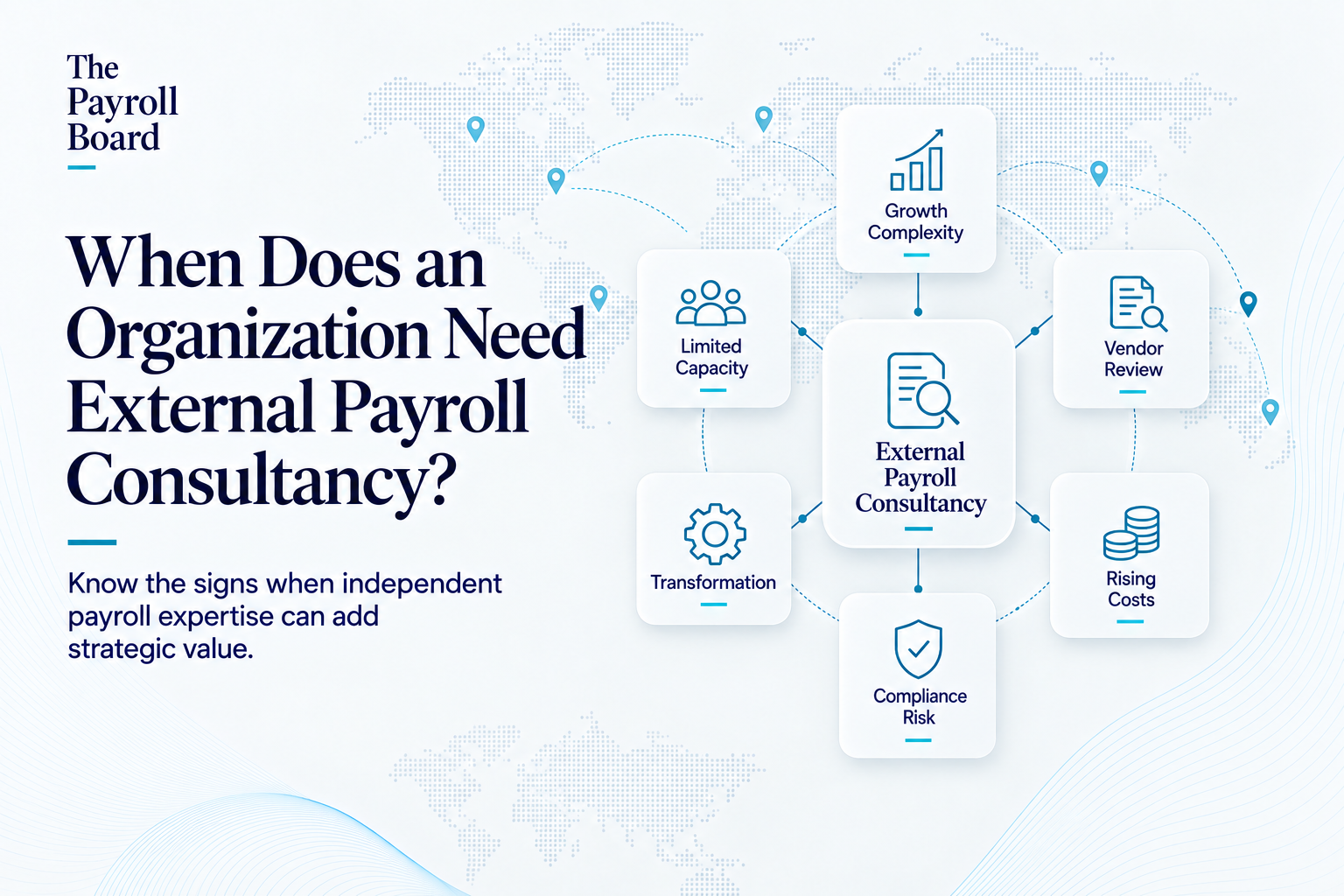
External payroll consulting can become valuable when payroll complexity grows beyond what internal teams can manage efficiently. Organizations need independent expertise when they face international expansion, transformation, vendor changes, rising costs, or growing compliance demands. External support is not necessarily a sign that an internal team is underperforming. It can provide an independent view of the operating model and a practical path to improvement.
Internal teams are usually focused on keeping payroll accurate and on time. That operational responsibility can make it difficult to step back and evaluate whether the wider payroll ecosystem is still fit for purpose. External support provides an objective perspective on processes, providers, costs, controls, and future requirements. This perspective is especially valuable when decisions have long-term financial, operational, or compliance consequences for the business.
When Payroll Complexity Becomes a Business Problem
Payroll complexity rarely appears overnight. It usually develops as an organization enters new countries, acquires businesses, adds legal entities, or starts working with additional providers.
Processes that were effective when the company was smaller can become difficult to manage at scale. Different countries may use separate systems, workflows, reporting standards, and approval structures.
The result can be:
duplicated administrative work;
inconsistent payroll processes;
unclear ownership;
limited reporting visibility;
recurring payroll errors;
increasing vendor costs;
greater compliance exposure.
When these issues begin consuming significant management attention, an external assessment can help identify their underlying causes.
When the Payroll Operating Model Needs Review
A payroll operating model defines how responsibilities are divided between internal teams, vendors, HR, finance, technology platforms, and local stakeholders.
As organizations grow, these responsibilities often change without a corresponding redesign of the operating model. A company may continue using arrangements that were appropriate several years earlier but no longer support its current scale.
Strong payroll governance is therefore essential when responsibilities are distributed across countries, vendors, HR, finance, and local stakeholders. Clear ownership, reporting, escalation routes, and performance controls help leadership maintain visibility while allowing local teams to address legitimate country-specific requirements.
An external review can determine whether responsibilities are appropriately allocated and whether the organization has sufficient control over critical payroll activities.
Signs That Governance Is Not Working
Weak governance can be difficult to recognize because payroll may continue running from day to day. However, several warning signs can indicate that the underlying structure needs attention.
For example, leadership may struggle to answer basic questions about payroll performance, costs, vendor responsibilities, or compliance ownership.
Other warning signs include:
repeated escalation between internal teams and providers;
unclear responsibility for resolving payroll issues;
inconsistent performance reporting;
limited visibility into country-level operations;
contracts that are difficult to manage centrally;
recurring problems with no clear owner.
These issues do not necessarily require a complete transformation. Sometimes a governance redesign can resolve significant problems without replacing systems or providers.
When an Organization Is Planning Payroll Transformation
Payroll transformation can involve substantial investment and organizational disruption. It may include technology implementation, vendor consolidation, process redesign, data migration, and changes to operating responsibilities.
Before beginning such a program, organizations need to understand their current environment and define what the future state should look like.
Transformation programs can involve technology selection, process redesign, vendor evaluation, implementation planning, and governance changes. An experienced specialist can connect these activities to business objectives and help the organization avoid investing in a new system before understanding what the operating model actually needs.
A payroll consultant can support this process by conducting a current-state assessment, defining requirements, evaluating potential providers, developing a transformation roadmap, and establishing measurable objectives.
When Existing Payroll Vendors Are No Longer Competitive
Long-term vendor relationships can create another reason to seek external expertise. Payroll contracts may remain in place for years even though business requirements, market conditions, and pricing models have changed.
Organizations should periodically review whether their providers continue to deliver appropriate value.
Common warning signs include:
unexplained price increases;
unclear service scope;
recurring service-level failures;
duplicated services across vendors;
poor reporting;
unresolved contractual disputes;
limited scalability.
An independent review can benchmark pricing, service scope, contractual terms, and performance against current market expectations.
Importantly, the answer does not always have to be changing providers. Contract renegotiation, clearer governance, or a redesigned service model may deliver better results with significantly less disruption.
When Payroll Costs Are Rising
Payroll operating costs can increase for legitimate reasons, particularly as a company grows internationally. However, unexplained increases can indicate underlying inefficiencies.
Organizations may be paying for overlapping services, unnecessary manual activities, outdated processes, or technology that no longer matches business requirements.
External support should focus on understanding the complete cost structure rather than simply cutting visible expenses.
A structured payroll consultancy engagement can map the cost drivers, identify operational inefficiencies, and prioritize opportunities according to business impact. The objective should be sustainable improvement rather than short-term savings that create additional compliance or service risks.
When Internal Teams Need Additional Strategic Capacity
Internal payroll professionals usually have extensive knowledge of their organization's processes. However, they are also responsible for daily payroll delivery.
This can make it difficult to dedicate sufficient time to strategic initiatives such as operating model reviews, vendor benchmarking, contract analysis, or transformation planning.
External specialists can provide additional capacity without requiring the organization to permanently expand its internal team.
This can be especially useful during:
mergers and acquisitions;
international expansion;
major system implementations;
vendor transitions;
organizational restructuring;
significant regulatory changes.
The objective is to complement internal expertise rather than replace it.
What External Payroll Support Should Deliver
Hiring external expertise should result in practical recommendations that leadership can act on. A generic report with broad observations is unlikely to create meaningful value.
The scope should be determined by the organization's specific situation. It may include an assessment of current processes, technology, vendors, costs, governance, and compliance risks.
External support can then translate these findings into a prioritized roadmap.
Typical deliverables may include:
Current-state assessment
Future-state operating model
Payroll transformation roadmap
Vendor evaluation framework
Contract benchmarking
Process optimization recommendations
Governance framework
Implementation planning
Performance measurement framework
Executive-level recommendations
The most useful recommendations should clearly explain what needs to change, why the change matters, and how it can realistically be implemented.
When Targeted Advisory Support Makes More Sense
Not every organization needs a large consulting project. Sometimes leadership faces one specific issue that requires independent expertise.
For example, a company may need help evaluating a vendor dispute, reviewing a contract, addressing a country-specific operational problem, or making an important technology decision.
External payroll advisory services can provide focused support in these situations. The advisor can investigate the issue, evaluate available options, and provide an independent recommendation without requiring a long-term transformation engagement.
This approach can be particularly valuable for organizations that already have a strong internal payroll function but need specialist knowledge for a complex or unusual decision.
Choosing the Right External Partner
The quality of the outcome depends heavily on the experience and independence of the advisor.
Organizations should look for experience that goes beyond payroll administration. Strategic transformation requires knowledge of operating models, vendor management, governance, contract structures, technology, and international payroll environments.
When evaluating payroll consulting firms, companies should also determine whether the advisor is genuinely independent or primarily focused on selling a specific outsourcing or technology solution.
A suitable partner should be able to challenge existing assumptions, identify trade-offs, and provide recommendations based on the organization's objectives rather than a predetermined solution.
Questions to Ask Before Hiring a Consultant
Before engaging external support, leadership should establish what problem it actually needs to solve.
Useful questions include:
What has changed in our payroll environment?
Where are our biggest operational risks?
Can we accurately measure our current payroll costs?
Are vendor contracts still competitive?
Is responsibility clearly defined across regions?
Can our current operating model support future growth?
Do we have enough internal capacity to conduct the required analysis?
Would an independent perspective improve an important decision?
If several answers reveal significant gaps, external expertise may provide substantial value.
External Consultancy as a Strategic Investment
External payroll support should not be viewed only as an expense. When used appropriately, it can help organizations avoid costly decisions, improve vendor economics, reduce operational inefficiencies, and strengthen governance.
The business case should consider both direct and indirect value.
Potential benefits include:
reduced unnecessary operating costs;
stronger vendor negotiations;
fewer recurring operational issues;
improved compliance controls;
better management visibility;
more effective use of internal resources;
improved scalability.
The objective is not simply to spend less on payroll. It is to create a more efficient, controlled, transparent, and sustainable operating environment.
Conclusion
An organization may need external payroll consultancy when its payroll environment becomes too complex, fragmented, costly, or strategically important to manage without independent support.
International expansion, transformation initiatives, vendor challenges, rising costs, weak governance, and limited internal capacity are among the most common triggers.
The right external partner should not simply recommend a new provider or technology platform. Instead, it should help the organization understand its current environment, identify the root causes of its challenges, evaluate realistic alternatives, and build a practical roadmap for improvement.
For organizations operating across multiple countries, independent expertise can provide the perspective and strategic capacity needed to make better payroll decisions while protecting operational stability and supporting long-term business growth.
