
Employer of Record (EOR): Opportunity Vs Risk
International expansion has never seemed easier.
A company can now hire an employee in São Paulo, Singapore or Stockholm within days, without establishing a legal entity, opening local payroll, or navigating months of administrative work. This capability has fuelled the rapid rise of Employer of Record (EOR) providers.
Once considered a niche service supporting occasional international hires, the EOR model has become one of the fastest-growing segments within the global workforce ecosystem. The combination of remote work, talent shortages and increasing internationalisation has transformed EORs into strategic enablers of global growth.
Yet, beneath the compelling marketing lies a more nuanced reality. The market remains relatively young, highly fragmented and rapidly evolving. While the model offers undeniable benefits, organisations should approach vendor selection with the same diligence they would apply to any strategic outsourcing decision.
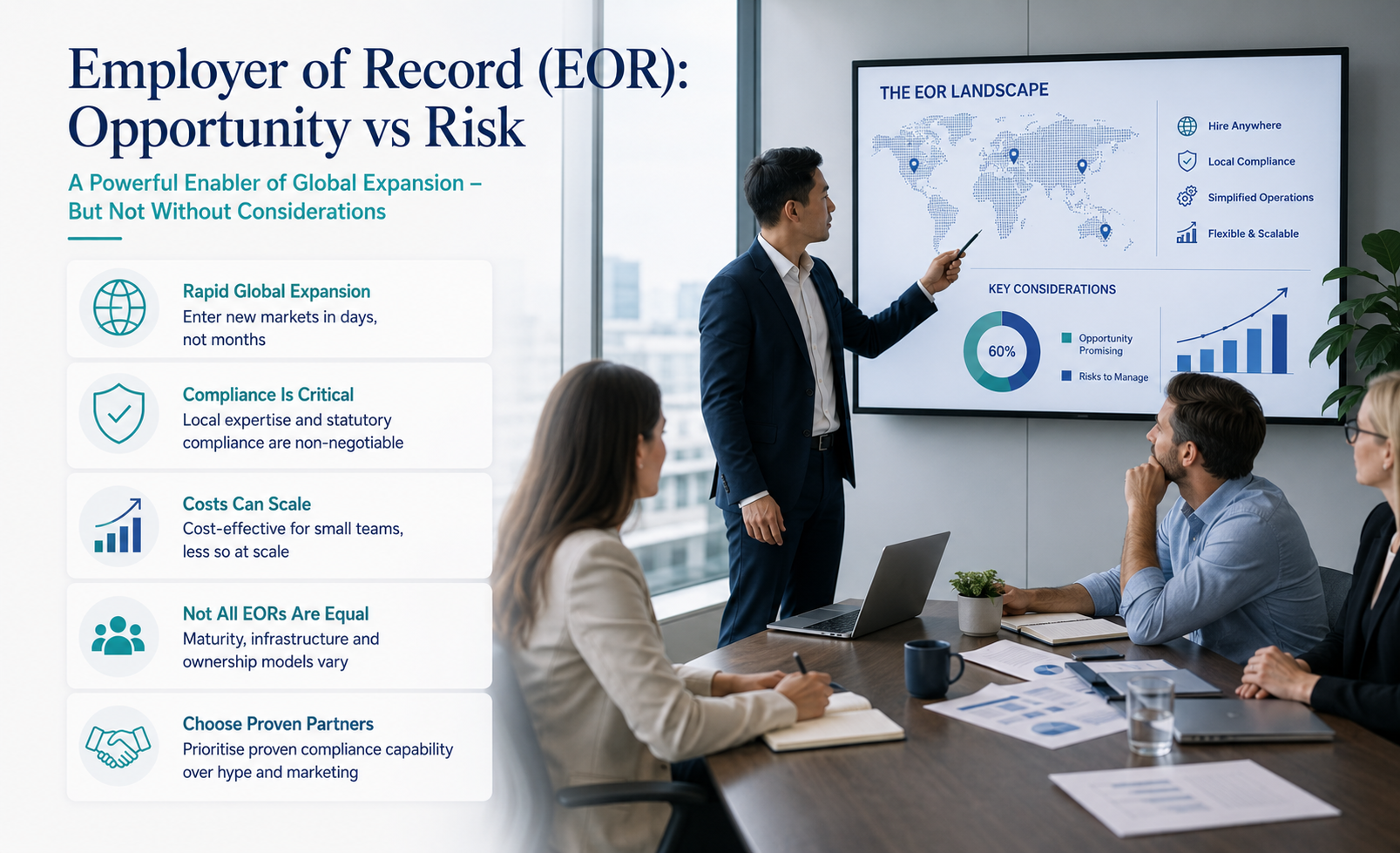
A Brief History of Employer of Record
The concept itself is not entirely new.
Professional Employment Organisations (PEOs) have existed for decades, primarily in North America, providing co-employment solutions for domestic businesses. The modern international Employer of Record model began to emerge during the 2010s as cloud technology, digital onboarding and remote work accelerated global hiring.
Following the COVID-19 pandemic, demand exploded.
Companies suddenly discovered they could recruit talent anywhere in the world, while candidates increasingly expected location flexibility. Establishing subsidiaries in every country was simply too slow and too expensive.
EOR providers filled this gap by combining three essential capabilities:
Legal employment through locally established entities
Payroll, tax and statutory compliance
HR administration and employee lifecycle management
The result was an attractive "all-in-one" solution allowing organisations to enter new markets in weeks rather than months.
Why Organisations Choose an EOR
For many businesses, speed is the primary driver.
Instead of incorporating a legal entity, appointing local directors, opening bank accounts and sourcing payroll providers, companies can begin employing workers almost immediately.
The principal advantages include:
Rapid Market Entry
Businesses can validate new markets before making significant long-term investments.
Lower Initial Investment
No need to establish legal entities or build local administrative infrastructure.
Simplified Compliance
The EOR assumes responsibility for local employment contracts, payroll administration, statutory filings and employment law compliance.
Centralised Experience
Many providers offer a unified technology platform covering onboarding, payroll visibility, documentation and reporting across multiple countries.
Operational Flexibility
Ideal for organisations hiring small teams internationally or supporting project-based expansion.
The Other Side of the Story
Like every outsourcing model, EORs also introduce limitations.
Long-Term Cost
While highly economical for small employee populations, EOR pricing may become less attractive as headcount grows. At scale, establishing a local entity often becomes financially preferable.
Reduced Control
Employment contracts, statutory processes and local employment relationships sit between the client and the employee through the EOR's legal entity.
Variable Compliance Maturity
Not every provider operates with the same level of legal expertise, local infrastructure or governance.
Some rely heavily on owned entities.
Others operate through extensive partner networks.
Both models can work—but they carry different operational risks that require careful evaluation.
Technology Does Not Replace Expertise
Many newer providers offer impressive user interfaces and highly automated workflows.
However, payroll remains fundamentally a compliance-driven function.
Modern software cannot compensate for weak local regulatory knowledge or inconsistent operational execution.
A Market Still Finding Its Shape
The EOR industry is currently experiencing extraordinary expansion.
New providers enter the market every year, venture capital continues to flow into the sector, and software acquisitions have become commonplace as vendors race to broaden their capabilities.
This rapid growth has created a highly competitive environment characterised by:
Significant investment in technology
Aggressive marketing campaigns
Product diversification
Frequent mergers and acquisitions
As with many emerging technology markets, consolidation appears inevitable.
Over time, some providers will differentiate themselves through operational excellence and compliance expertise, while others may struggle to sustain growth or integrate acquisitions successfully.
For buyers, this creates an additional challenge: today's market leaders may not necessarily be tomorrow's.
Compliance Remains the Ultimate Differentiator
Despite advances in automation and AI, global employment remains governed by thousands of local regulations.
Employment contracts.
Termination rules.
Social security.
Tax reporting.
Mandatory benefits.
Collective agreements.
Data privacy.
These cannot be standardised entirely through software.
The true value of an EOR ultimately depends on its ability to execute compliant local employment consistently across every jurisdiction.
Technology improves visibility.
Compliance protects the business.
The latter should always take precedence.
Is an EOR the Right Choice?
For many organisations, absolutely.
Employer of Record services are particularly well suited for:
High-growth companies entering new countries
Technology businesses recruiting globally
Organisations testing new markets
Businesses hiring only a handful of employees in each country
Companies seeking to avoid the complexity of immediate entity establishment
Conversely, organisations employing hundreds of workers within a single country may eventually benefit from transitioning towards their own legal entity and a more traditional global payroll operating model.
An EOR should therefore often be viewed as an accelerator—not necessarily the permanent destination.
Choosing the Right Partner
The EOR landscape is increasingly crowded.
Selecting a provider purely on pricing, funding announcements or marketing visibility may prove short-sighted.
Decision makers should instead evaluate:
Demonstrated compliance capability
Ownership and governance model
Local legal expertise
Payroll operational maturity
Service organisation and escalation processes
Financial stability
Customer references
Long-term strategic roadmap
Perhaps most importantly, organisations should seek evidence of proven delivery rather than polished sales presentations.
Payroll is simply too business-critical to become an experiment.
Few organisations are willing to make their employees the "guinea pigs" of an immature operating model.
Conclusion
Employer of Record solutions have fundamentally changed the way organisations approach international expansion.
They remove barriers that historically slowed growth and offer a compelling route for companies seeking rapid access to global talent.
However, the market itself remains in expansion mode.
The coming years will likely bring consolidation, acquisitions and increasing differentiation between providers. Some will emerge as trusted long-term partners built on compliance excellence. Others may prove stronger in marketing than operational delivery.
For organisations evaluating EOR solutions, technology should certainly be considered—but it should never outweigh proven compliance capability, operational maturity and demonstrable payroll expertise.
Global employment ultimately depends on trust.
When employees expect to be paid accurately, compliantly and on time, there is little appetite for experimentation.
Choosing the right EOR is therefore not simply a technology decision—it is a business risk decision.
As part of our Service Offer, we support organizations assessing how EORs fit into their strategy, and where applies select and implement the right partner.
