
Global Payroll Transformation Lessons from Large International Organizations
Global expansion creates new opportunities, but it also introduces operational complexity that many businesses underestimate. As organizations enter new markets, payroll quickly evolves from an administrative function into a strategic business capability that influences compliance, employee experience, financial reporting, and operational resilience. Successful global payroll transformation is therefore not simply about implementing new technology – it is about redesigning governance, processes, and operating models that support sustainable international growth.
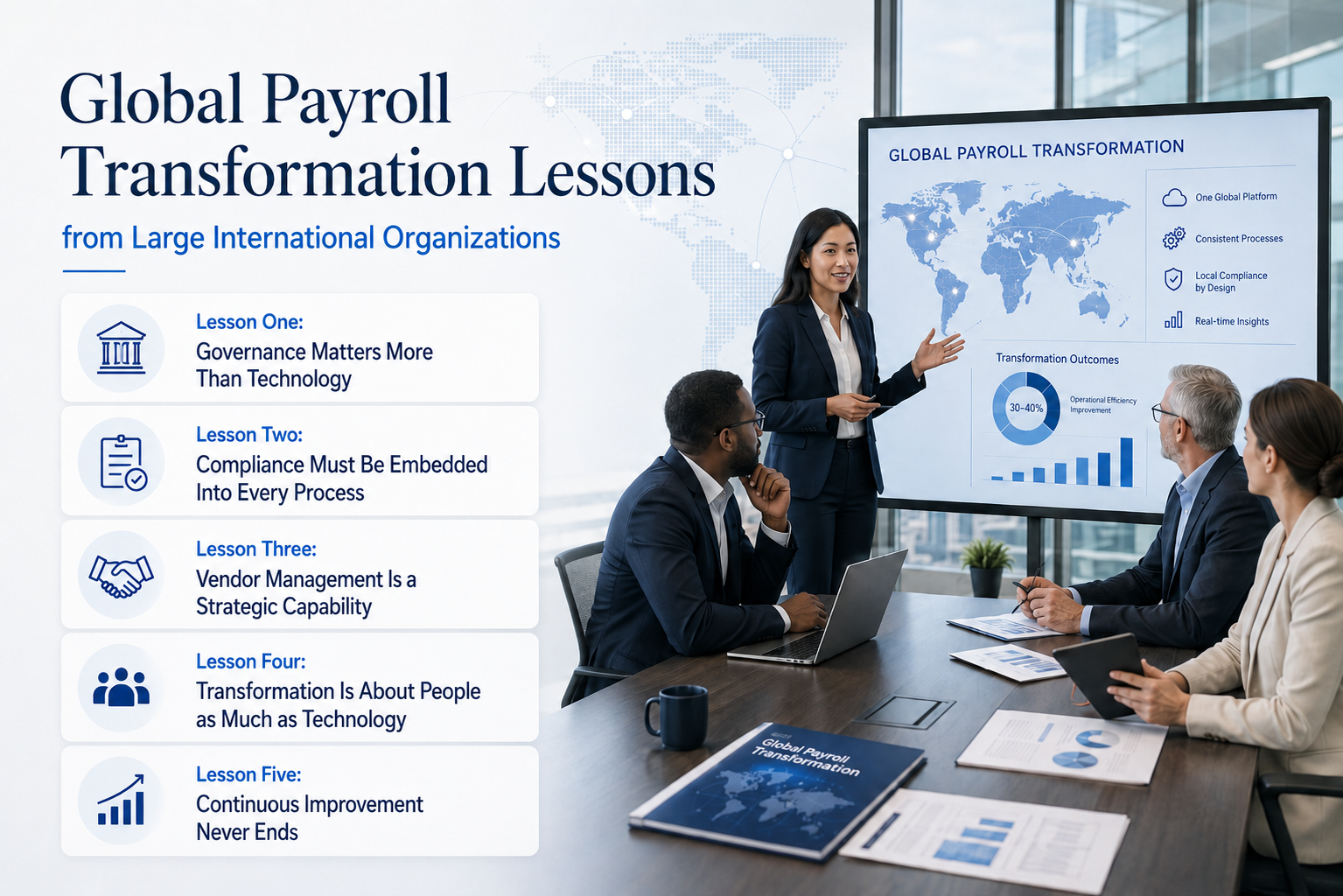
Global Payroll Transformation Lessons
Many multinational organizations begin transformation initiatives with ambitious goals but limited preparation. Leadership teams often focus on replacing payroll systems while overlooking fragmented processes, inconsistent governance, duplicated responsibilities, and outdated vendor agreements. These hidden issues frequently become the primary reasons why transformation projects exceed budgets, miss deadlines, or fail to deliver the expected business value.
The world's most successful organizations approach payroll transformation differently. Instead of treating payroll as a standalone function, they integrate it into broader business strategy, digital transformation programs, finance modernization initiatives, and workforce planning. This integrated approach allows organizations to improve operational efficiency while reducing compliance risk and creating scalable foundations for future expansion.
Why Large Organizations Prioritize Payroll Transformation
Payroll transformation is rarely driven by technology alone. In most cases, it begins when organizations recognize that existing operating models can no longer support business growth. Mergers, acquisitions, international expansion, regulatory changes, and increasing workforce diversity all place additional pressure on payroll operations.
Many global businesses inherit different payroll systems through acquisitions. Each region may operate independently, using local providers, separate reporting standards, and different governance practices. While this decentralized approach may function adequately at first, it gradually creates operational silos that reduce visibility and increase administrative costs.
Forward-thinking organizations invest in global payroll solutions because they understand that standardization improves far more than payroll efficiency. Well-designed operating models strengthen financial reporting, improve compliance oversight, simplify vendor management, and provide executives with more reliable workforce data for strategic decision-making.
Successful transformation projects also begin with realistic expectations. Rather than attempting to change every process simultaneously, leading organizations prioritize governance, process consistency, stakeholder alignment, and measurable business outcomes before introducing new technology platforms.
Lesson One: Governance Matters More Than Technology
One of the biggest misconceptions in payroll transformation is the belief that software alone will solve operational problems. In reality, technology only supports the processes that already exist. Poor governance combined with advanced software still produces poor operational results.
Large multinational organizations invest significant time in defining ownership, accountability, approval structures, reporting responsibilities, and escalation procedures before implementing new payroll platforms.
Without clear governance, organizations often experience:
inconsistent payroll approvals
duplicated responsibilities
limited reporting visibility
delayed issue resolution
compliance gaps
fragmented decision-making
higher operational costs
Strong governance creates consistency across regions while allowing enough flexibility to address country-specific legal requirements. It also enables executive teams to monitor payroll performance using standardized metrics instead of relying on disconnected local reporting.
Another critical governance principle involves executive sponsorship. Payroll transformation affects HR, finance, IT, procurement, legal, and local business leaders simultaneously. Projects that lack executive alignment often struggle because departments optimize their own priorities instead of supporting enterprise-wide objectives.
Lesson Two: Compliance Must Be Embedded Into Every Process
International payroll is heavily influenced by changing legislation, tax rules, labor regulations, data privacy requirements, and reporting obligations. Organizations cannot rely solely on local expertise without establishing enterprise-level oversight. Leading multinational companies embed international payroll compliance into governance frameworks from the earliest stages of transformation rather than treating compliance as a final project checkpoint.
This proactive approach reduces operational risk while improving confidence among executive leadership, internal auditors, and regulatory stakeholders.
Compliance-focused organizations typically establish centralized governance standards while allowing controlled local flexibility. This balance enables regional teams to respond to country-specific legislation without creating unnecessary operational fragmentation.
Another lesson learned from global organizations is the importance of continuous compliance monitoring. Regulatory environments evolve constantly, making periodic reviews essential for maintaining operational resilience.
Businesses that proactively manage compliance often experience fewer payroll corrections, reduced legal exposure, stronger employee confidence, and more predictable operational performance across multiple jurisdictions.
Lesson Three: Vendor Management Is a Strategic Capability
Many organizations work with several payroll providers across different countries. Although local expertise is valuable, managing numerous providers without centralized oversight often creates inconsistent service quality, duplicated activities, and rising operational costs.
Leading enterprises periodically evaluate their global payroll services ecosystem instead of assuming existing vendor arrangements remain competitive indefinitely.
Vendor benchmarking has become an essential component of payroll transformation. Organizations assess pricing structures, contractual terms, service quality, reporting capabilities, escalation processes, innovation potential, and integration maturity before making strategic decisions.
Importantly, successful organizations understand that changing providers is not always the right answer. In many cases, stronger governance, clearer accountability, and improved operational coordination generate greater value than replacing vendors entirely.
Payroll leaders also recognize that vendors should support broader business objectives rather than operating as isolated service providers. Strong partnerships encourage continuous improvement, better communication, and greater transparency throughout the payroll lifecycle.
Lesson Four: Transformation Is About People as Much as Technology
Even the most sophisticated payroll platform cannot compensate for poor stakeholder engagement. Large organizations consistently demonstrate that successful transformation depends on communication, training, change management, and leadership alignment.
Employees, payroll specialists, HR teams, finance departments, and executives all experience transformation differently. Addressing their concerns early significantly improves project adoption and long-term success.
One topic frequently discussed during transformation planning is in house payroll vs outsourcing. Rather than treating this as a binary decision, experienced organizations evaluate which operating model best supports their strategic objectives, geographic footprint, internal capabilities, governance expectations, and long-term scalability.
Some businesses maintain internal payroll expertise while outsourcing transactional activities. Others centralize governance internally while relying on specialized regional partners for local execution. The optimal model depends on organizational maturity, operational complexity, and future growth plans rather than industry trends alone.
Change management also extends beyond training sessions. Successful organizations create ongoing communication strategies that explain why transformation is taking place, how new processes improve operational performance, and what support employees can expect throughout implementation.
Lesson Five: Continuous Improvement Never Ends
Payroll transformation should not be viewed as a project with a fixed finish line. Large international organizations treat transformation as an ongoing business capability that evolves alongside organizational growth.
Continuous performance measurement enables businesses to identify new opportunities for optimization, strengthen governance, improve reporting quality, and adapt to regulatory changes without launching entirely new transformation programs.
Modern organizations increasingly invest in payroll modernization by combining automation, analytics, process standardization, artificial intelligence, and stronger governance frameworks into long-term operational strategies.
Rather than focusing exclusively on reducing costs, these organizations measure broader business outcomes such as compliance performance, payroll accuracy, employee satisfaction, operational resilience, reporting quality, and executive visibility.
As payroll environments become increasingly interconnected with HR, finance, workforce planning, and enterprise technology ecosystems, modernization creates value far beyond payroll itself.
Conclusion
Global payroll transformation is one of the most complex operational initiatives multinational organizations undertake. The experience of large international companies demonstrates that long-term success depends far less on technology than on governance, strategic planning, stakeholder alignment, compliance management, and continuous operational improvement.
Organizations that approach payroll strategically build scalable operating models capable of supporting international growth while reducing operational risk. They regularly reassess vendor relationships, standardize processes where possible, strengthen governance, and embed compliance into every stage of payroll operations.
Perhaps the most important lesson is that payroll should no longer be viewed as a back-office administrative function. It has become a strategic business capability that influences financial performance, employee trust, regulatory compliance, and organizational resilience. Companies that recognize this shift are significantly better positioned to support sustainable global expansion while maintaining operational excellence in an increasingly complex business environment.
