
How to Align Payroll Strategy with Business Growth Plans
Business growth creates opportunities, but it also introduces operational complexity that many organizations underestimate. Expanding into new markets, hiring across multiple jurisdictions, and adapting to changing workforce expectations require far more than additional resources – they require a structured operational framework. One area that often determines whether growth remains sustainable is payroll. Effective workforce planning should always include payroll as a strategic business function rather than a purely administrative process. When payroll is aligned with broader business objectives, organizations are better positioned to control costs, maintain compliance, improve employee experience, and support long-term expansion.
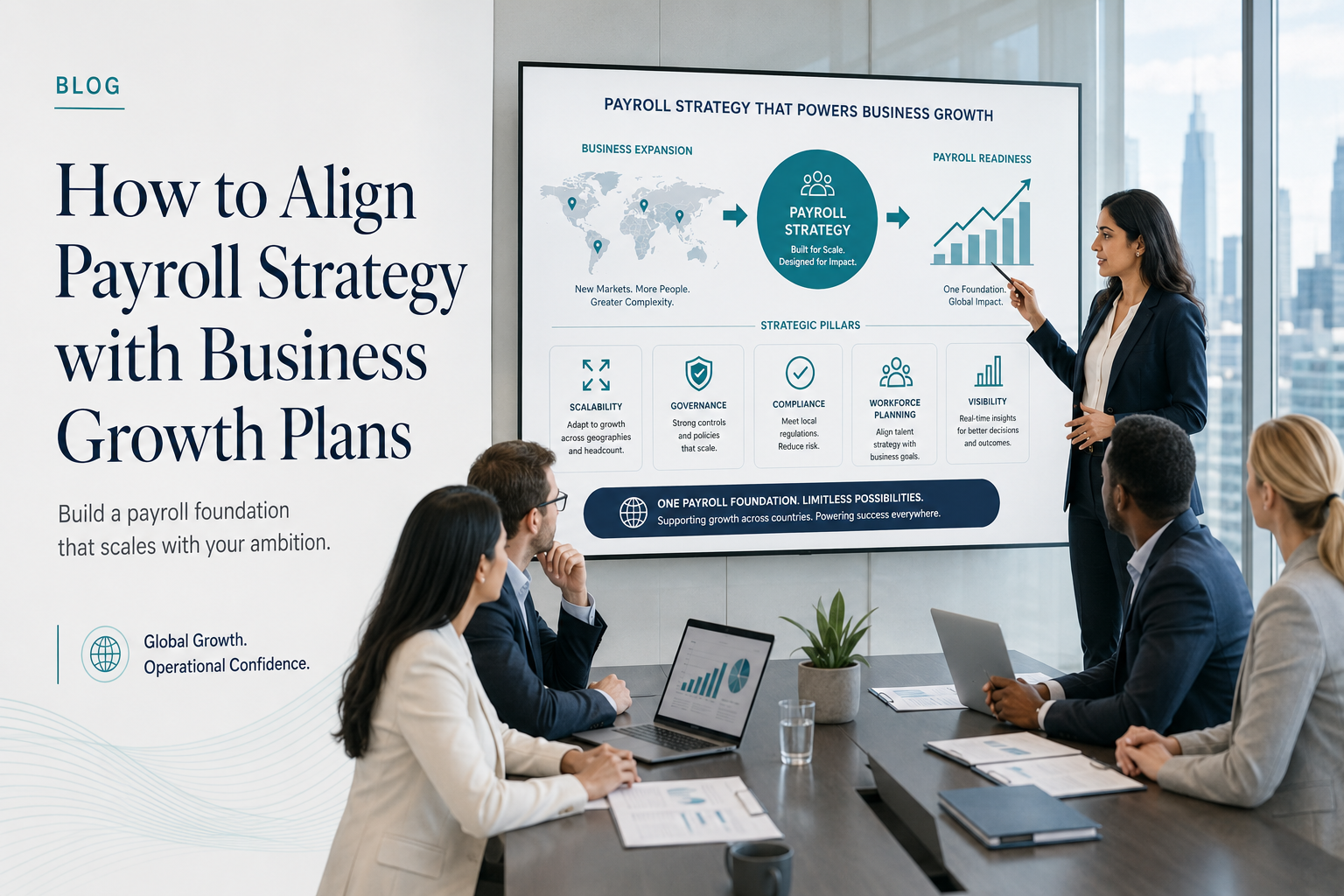
Many businesses initially develop payroll processes to meet immediate operational needs. As the organization grows, these processes become increasingly fragmented. Different countries adopt different providers, business units implement separate approval workflows, and local regulations create unique compliance requirements. Over time, these disconnected practices reduce visibility, increase costs, and make future expansion significantly more difficult.
Organizations that treat payroll strategically are able to adapt more quickly to acquisitions, international hiring, mergers, organizational restructuring, and evolving workforce models. Rather than reacting to payroll challenges after growth occurs, they proactively build scalable operating models that support future business ambitions.
Why Payroll Strategy Should Support Business Strategy
Payroll is no longer an isolated back-office function. Executive leadership increasingly recognizes its influence on financial planning, operational resilience, compliance management, and employee satisfaction.
Business growth affects nearly every payroll process. New legal entities, changing tax regulations, additional reporting obligations, evolving employment contracts, and multiple currencies all increase operational complexity. Without a clear strategy, payroll can become a bottleneck that slows expansion and increases organizational risk.
Many companies focus heavily on sales, operations, technology, and finance during growth initiatives while overlooking payroll readiness. This oversight often leads to manual workarounds, duplicated responsibilities, inconsistent reporting, and escalating administrative costs.
Developing sustainable global payroll solutions enables organizations to create standardized governance models while maintaining the flexibility required to address local legislative requirements. Instead of building separate payroll processes for every country, businesses can establish consistent operating principles supported by centralized oversight and local expertise.
This balanced approach reduces unnecessary complexity while improving transparency across the organization.
Understanding the Link Between Payroll and Organizational Growth
Growth plans are rarely limited to increasing revenue. Organizations may expand into new countries, introduce remote work policies, acquire competitors, or establish regional service centers. Every one of these initiatives directly affects payroll operations.
Without proper planning, payroll teams are often forced to react to organizational change instead of supporting it proactively. New employees may be onboarded through temporary processes, reporting structures become inconsistent, and local payroll providers operate independently without standardized governance.
The consequences are rarely immediate. Initially, payroll continues functioning adequately. However, as additional countries, vendors, and systems are introduced, operational inefficiencies multiply. Leadership teams begin spending more time resolving payroll issues instead of focusing on strategic initiatives.
Strong payroll governance helps organizations anticipate future operational demands rather than responding to problems after they occur.
Building Payroll Around Future Workforce Needs
Successful organizations design payroll operating models that support future business objectives instead of simply reflecting current organizational structures.
Expansion into new markets requires organizations to consider employment legislation, local tax frameworks, statutory reporting obligations, banking requirements, and workforce mobility. Payroll strategy should therefore be integrated into broader expansion planning from the earliest stages.
This becomes particularly important during periods of rapid workforce growth, when hiring volumes increase significantly across multiple countries or business units. Payroll systems, governance models, approval workflows, and reporting capabilities must all be capable of supporting larger employee populations without creating operational disruption.
Organizations that prepare for workforce expansion in advance typically experience fewer implementation delays, lower compliance risks, and greater operational consistency.
Rather than continuously adapting payroll after each expansion milestone, businesses should establish scalable governance frameworks that evolve alongside the organization.
Common Challenges That Prevent Payroll Alignment
Many organizations encounter similar obstacles as they grow internationally. One of the most common issues is operational fragmentation. Different regions often select independent payroll vendors based on local preferences without considering long-term enterprise governance.
Technology fragmentation creates another challenge. HR systems, finance platforms, payroll software, and reporting tools may operate independently with limited integration, requiring significant manual intervention.
Communication gaps between payroll, HR, finance, tax, procurement, and executive leadership also contribute to operational inefficiencies. Without clearly defined responsibilities, decision-making becomes slower and accountability becomes less transparent.
In addition, many businesses underestimate the importance of regular vendor evaluations. Service agreements that were appropriate several years ago may no longer reflect current operational requirements or market conditions.
These challenges rarely originate from poor operational execution. Instead, they often result from the absence of a long-term payroll strategy that evolves together with the business.
Why Governance Matters More Than Technology
Technology plays an essential role in payroll transformation, but technology alone cannot solve governance problems.
Organizations frequently invest in new payroll platforms while maintaining outdated operational processes. As a result, inefficient workflows become automated rather than improved.
Effective governance establishes decision-making structures, accountability, reporting standards, escalation procedures, and performance measurement across the payroll function. These elements provide consistency regardless of which systems or vendors are used.
Companies operating complex global payroll services environments benefit significantly from governance models that standardize operational principles while allowing local flexibility where required. This balance improves visibility without reducing the ability to respond to country-specific legislation or business practices.
Executive leadership also gains access to more reliable reporting, enabling better financial planning and stronger strategic decision-making.
Aligning Payroll With Business Objectives
Payroll strategy should always reflect broader corporate priorities.
If an organization plans to expand internationally, payroll must support rapid onboarding, regulatory compliance, and standardized reporting.
If mergers and acquisitions are expected, payroll governance should simplify entity integration rather than creating additional operational barriers.
If workforce flexibility becomes a strategic priority, payroll processes must accommodate contractors, remote employees, hybrid work arrangements, and evolving employment structures without increasing compliance exposure.
This alignment requires collaboration across multiple departments including HR, finance, procurement, legal, compliance, IT, and executive leadership.
When payroll is involved early in strategic planning, organizations can avoid many operational challenges that commonly emerge during periods of rapid growth.
The Value of Independent Payroll Advisory
One of the biggest advantages organizations gain from external advisory support is objective decision-making.
Payroll technology vendors naturally recommend their own platforms. Outsourcing providers promote their service models. Internal stakeholders often prioritize immediate operational concerns.
Independent advisors evaluate payroll from a broader business perspective.
They assess governance structures, operating models, vendor relationships, reporting capabilities, compliance risks, transformation readiness, and future business requirements before recommending strategic improvements.
This approach supports genuine strategic payroll planning rather than isolated operational improvements.
Organizations also benefit from independent benchmarking that compares existing vendor contracts, governance frameworks, service quality, and operating models against current market practices.
This insight enables leadership teams to make informed decisions based on long-term organizational value rather than short-term implementation considerations.
Measuring Payroll Success Beyond Cost
Cost reduction is an important objective, but it should never be the only performance indicator.
Modern payroll functions contribute to employee satisfaction, operational resilience, financial accuracy, regulatory compliance, and executive decision-making.
Organizations should therefore evaluate payroll performance using multiple criteria, including:
operational efficiency
payroll accuracy
compliance performance
reporting quality
process standardization
vendor performance
employee experience
governance maturity
scalability for future growth
These indicators provide a more complete understanding of payroll performance and support continuous operational improvement.
Preparing Payroll for Sustainable Growth
Business growth rarely follows a perfectly predictable path. Organizations may expand faster than expected, enter new markets unexpectedly, or experience structural changes driven by acquisitions or economic conditions.
Payroll must therefore be designed with flexibility in mind.
Future-ready organizations invest in governance structures, standardized processes, scalable technology, and clear operational accountability before growth creates additional complexity.
This preparation allows payroll teams to respond confidently to changing business requirements without compromising compliance, reporting quality, or employee experience.
Long-term payroll scalability depends on thoughtful planning rather than reactive operational adjustments. Businesses that establish scalable operating models early are significantly better positioned to support expansion while maintaining efficiency, transparency, and control.
Conclusion
Payroll strategy should never exist independently from business strategy. As organizations grow, payroll becomes increasingly connected to workforce planning, financial management, regulatory compliance, technology transformation, and executive decision-making.
Companies that proactively align payroll with their long-term business objectives create stronger governance, improve operational efficiency, reduce unnecessary complexity, and support sustainable international expansion.
Rather than viewing payroll as an administrative necessity, successful organizations recognize it as a strategic capability that enables confident growth. By investing in structured governance, scalable operating models, independent advisory support, and continuous optimization, businesses can build payroll environments that remain effective regardless of how quickly the organization evolves.
