
The Most Common Payroll Transformation Risks – And How to Mitigate Them
Payroll transformation has become a strategic priority for organizations seeking greater efficiency, stronger compliance, and better employee experience. Whether businesses are replacing legacy systems, consolidating vendors, or redesigning operating models, every transformation introduces opportunities as well as risks. A successful payroll implementation requires much more than deploying new technology. It demands careful planning, executive sponsorship, process standardization, governance, and continuous stakeholder engagement.
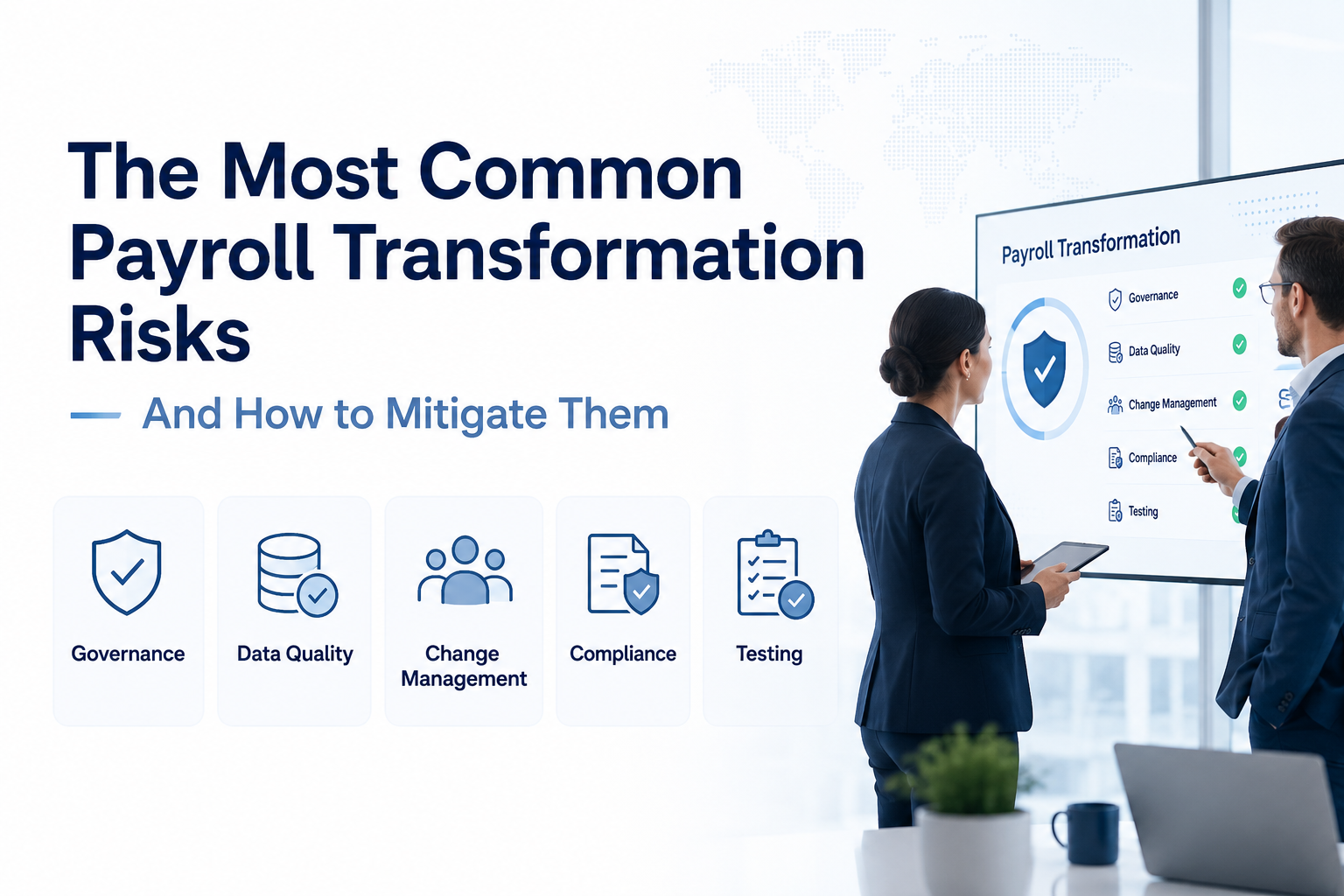
Organizations often underestimate the complexity of payroll transformation because payroll affects almost every department. Human resources, finance, IT, legal teams, local business units, and external vendors all contribute to the payroll ecosystem. When communication between these stakeholders breaks down, projects can quickly fall behind schedule or fail to deliver the expected value.
Rather than focusing solely on software deployment, companies should approach payroll transformation as a long-term business initiative designed to improve operational resilience, reporting accuracy, compliance, and scalability.
Why Payroll Transformation Projects Fail
Many payroll projects begin with ambitious goals but lack a clearly defined roadmap. Leadership teams often prioritize technology selection while spending insufficient time understanding current operational challenges.
Without documenting existing workflows, identifying ownership gaps, and reviewing governance structures, organizations risk transferring old problems into new systems. Instead of simplifying payroll operations, transformation efforts may introduce additional complexity.
Another common issue is unrealistic project timelines. Payroll affects thousands of employees and numerous regulatory requirements. Attempting to accelerate implementation without adequate testing significantly increases operational risk.
Many organizations also underestimate change management. Employees, payroll professionals, HR teams, and finance departments must all understand new processes before the system goes live.
Companies that invest early in structured planning and global payroll solutions are generally better equipped to standardize processes across countries while maintaining the flexibility needed to support local legal requirements.
Successful transformation should balance global consistency with regional adaptability rather than forcing identical processes onto every location.
Risk 1: Poor Governance
Governance is one of the most overlooked aspects of payroll transformation.
Many organizations establish project teams but fail to define who owns strategic decisions, escalation processes, vendor relationships, or compliance accountability.
Without governance, even technically successful implementations struggle operationally after go-live.
Leadership should define clear responsibilities for:
Executive sponsors
Payroll leadership
HR teams
Finance stakeholders
IT departments
External implementation partners
Regional payroll managers
Clearly documented governance structures improve accountability and accelerate decision-making throughout the transformation lifecycle.
Risk 2: Incomplete Process Mapping
Payroll processes often evolve over many years.
Local workarounds, manual approvals, spreadsheets, and undocumented practices become embedded within daily operations.
When organizations replace systems without documenting existing workflows, critical activities may be forgotten until payroll deadlines are missed.
Comprehensive process mapping should include:
Employee lifecycle events
Time and attendance integration
Variable compensation
Tax reporting
Year-end activities
Exception handling
Approval workflows
Organizations should redesign inefficient processes instead of simply recreating them in new technology.
Risk 3: Technology Selection Based Only on Features
Technology demonstrations frequently focus on functionality.
However, the most feature-rich platform is not always the best strategic choice.
Businesses should evaluate:
scalability
implementation methodology
integration capabilities
reporting flexibility
vendor support
regulatory updates
total cost of ownership
For public-sector organizations, selecting appropriate government payroll software becomes even more critical because regulatory reporting, security standards, and audit requirements are often considerably more demanding than in the private sector.
Technology should always support business strategy rather than dictate operational design.
Risk 4: Weak Data Quality
Payroll accuracy depends entirely on data quality.
Many transformation projects discover inconsistent employee records, duplicate information, outdated organizational structures, or incorrect historical payroll data.
Poor-quality data creates problems throughout implementation.
Organizations should conduct multiple validation exercises before migration begins.
Recommended activities include:
Employee master data cleansing
Duplicate record removal
Historical payroll reconciliation
Position validation
Organizational hierarchy review
Bank information verification
Strong data governance significantly reduces implementation delays.
Risk 5: Underestimating Global Complexity
International organizations rarely operate under identical payroll regulations.
Every country introduces unique requirements regarding taxation, statutory reporting, employment law, social contributions, leave policies, and reporting obligations.
Attempting to standardize every process globally often creates unnecessary compliance challenges.
Organizations managing complex global payroll services should establish global standards while allowing sufficient flexibility for local legal requirements.
The objective is consistency where possible—not uniformity at any cost.
Successful multinational payroll models balance centralized governance with localized operational expertise.
Risk 6: Vendor Management Challenges
Vendor relationships continue long after implementation.
Unfortunately, many organizations spend considerable effort selecting vendors but very little effort governing them afterwards.
Effective vendor management should include:
Service-level monitoring
Performance reviews
Pricing evaluations
Compliance reporting
Escalation management
Continuous improvement planning
Independent benchmarking can also identify opportunities to improve service quality while reducing operational costs.
Risk 7: Insufficient Testing
Testing should never be treated as a final project milestone.
It should occur throughout implementation.
Organizations typically perform:
Unit testing
Integration testing
Parallel payroll runs
User acceptance testing
Country-specific validation
End-to-end scenario testing
Testing should cover both normal payroll processing and unusual situations including bonuses, retroactive payments, international transfers, leave adjustments, and employee terminations.
The more realistic the testing environment, the lower the operational risk after deployment.
Risk 8: Ignoring Compliance
Compliance remains one of the biggest concerns during payroll transformation.
Regulatory requirements continue changing across jurisdictions, making ongoing governance essential.
Many businesses focus primarily on operational efficiency while overlooking payroll compliance risks associated with data privacy, tax legislation, statutory reporting, and employee classification.
A compliance-first mindset should guide every transformation decision.
Organizations should involve legal, HR, payroll, and compliance specialists throughout the project instead of consulting them only before go-live.
Regular internal audits also help identify weaknesses before they become significant business issues.
Risk 9: Poor Change Management
Payroll transformation changes daily routines for hundreds—or even thousands—of employees.
Without proper communication, users often resist new processes.
Effective change management includes:
Leadership communication
Training sessions
User documentation
Knowledge transfer
Internal support teams
Post-go-live assistance
Employees who understand why transformation is happening are generally more willing to adopt new systems and workflows.
Risk 10: Lack of Continuous Improvement
Many organizations view go-live as the finish line.
In reality, it represents the beginning of operational optimization.
Performance indicators should be monitored continuously, including:
Payroll accuracy
Processing time
Employee satisfaction
Compliance metrics
Vendor performance
Operational costs
Regular reviews allow organizations to refine processes as business requirements evolve.
Building a Risk-Based Payroll Transformation Strategy
Every payroll transformation should begin with strategic planning rather than software selection.
A mature transformation program evaluates governance, technology, vendors, business objectives, compliance obligations, operating models, and organizational readiness before implementation begins.
One of the most effective approaches is conducting a comprehensive payroll risk assessment before launching the project. Identifying operational weaknesses, governance gaps, data quality issues, integration challenges, and compliance exposures early enables organizations to prioritize mitigation strategies and significantly improve the likelihood of project success.
Rather than reacting to problems during implementation, businesses should establish proactive controls that reduce uncertainty throughout the transformation journey.
Best Practices for Reducing Payroll Transformation Risk
Organizations that consistently deliver successful payroll transformations typically share several characteristics:
Strong executive sponsorship
Clearly defined governance
Realistic implementation timelines
Independent strategic advisory
Comprehensive process documentation
High-quality data management
Extensive testing before go-live
Continuous vendor oversight
Ongoing compliance monitoring
Regular post-implementation optimization
These practices help organizations achieve sustainable operational improvements while minimizing disruption to employees and business operations.
Conclusion
Payroll transformation is no longer simply an IT initiative. It is a strategic business program that affects operational efficiency, compliance, employee experience, financial reporting, and long-term organizational resilience.
While every transformation carries inherent risks, most failures can be avoided through careful planning, strong governance, structured change management, and continuous performance monitoring. Organizations that treat payroll transformation as an ongoing journey rather than a one-time implementation project are far more likely to achieve lasting business value.
By investing in strategic planning, experienced advisory support, and proactive risk management, businesses can transform payroll from an administrative necessity into a scalable, efficient, and resilient function that supports sustainable global growth.
