
How to Choose the Right Payroll Service Provider
Managing payroll has become increasingly complex for modern organizations operating across multiple countries, legal systems, and workforce structures. Companies are expected to maintain compliance, deliver accurate payments, manage sensitive employee data, and adapt quickly to changing regulations while controlling operational costs. As businesses scale internationally, choosing the right payroll partner becomes a strategic decision rather than a purely administrative one.
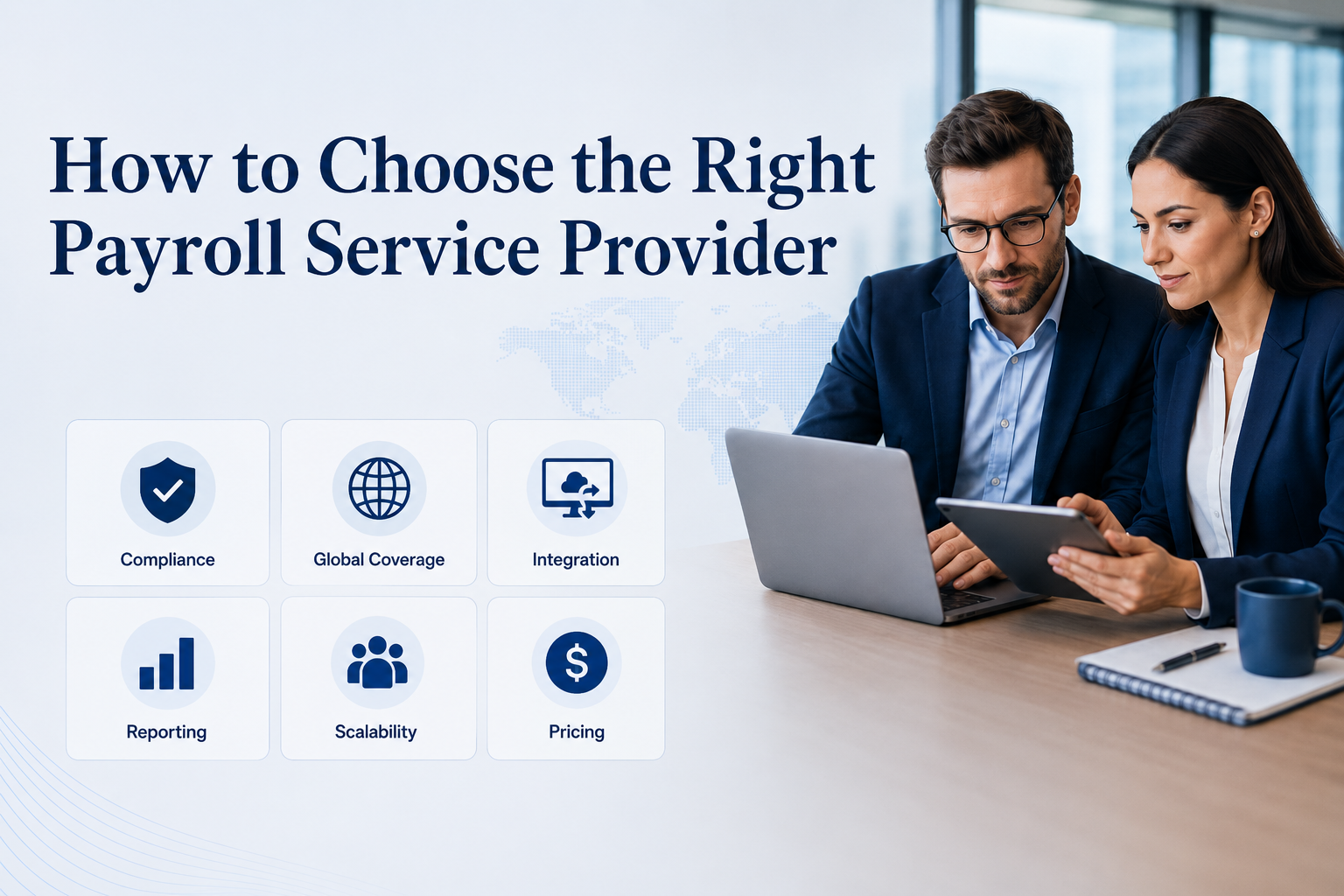
Many organizations invest in modern payroll solutions to improve efficiency, increase visibility, and reduce operational risks. However, selecting the wrong provider can create long-term complications including fragmented processes, inconsistent reporting, compliance exposure, and rising service costs. The decision therefore requires a structured evaluation process aligned with business goals, operational complexity, and future growth plans.
Why Payroll Provider Selection Matters
Payroll is one of the few business functions that directly impacts every employee within an organization. Errors, delays, or compliance failures can quickly damage employee trust and create significant operational disruption. Because payroll connects HR, finance, compliance, and workforce management, the provider selection process should involve multiple stakeholders rather than being treated as a procurement exercise alone.
Many organizations initially focus only on pricing or software functionality. While technology is important, sustainable payroll operations depend equally on governance models, service quality, local expertise, reporting structures, scalability, and operational accountability.
As businesses expand internationally, payroll ecosystems become more difficult to coordinate. Different countries may involve separate vendors, legal requirements, tax frameworks, and reporting obligations. Organizations therefore increasingly evaluate broader global payroll solutions that can support operational consistency while maintaining local compliance flexibility.
A strategic provider selection process should assess both current operational requirements and long-term transformation objectives. Companies that only focus on immediate operational problems often face additional challenges later as their workforce structure evolves.
Understanding the Different Types of Payroll Providers
The payroll market includes a wide range of providers offering different service models, technologies, and operational approaches. Some focus primarily on payroll software, while others provide managed services, outsourcing support, or global coordination capabilities.
Organizations should first identify which operational model best fits their business environment. Companies with complex international operations may require integrated support across multiple regions, while smaller organizations may prioritize automation and administrative simplicity.
Not all providers offer the same level of strategic support. Some vendors focus mainly on transaction processing, while others provide advisory capabilities related to governance, transformation planning, compliance monitoring, and operational optimization.
When comparing different payroll providers, businesses should evaluate:
operational scalability
country coverage
reporting capabilities
compliance expertise
integration flexibility
implementation support
service governance models
pricing transparency
Service model (direct / through partners)
A detailed assessment helps organizations avoid selecting providers that may initially appear attractive but lack the operational maturity required for long-term success.
The Importance of Scalability in Global Payroll
One of the most common mistakes organizations make is selecting payroll systems based only on current requirements. Payroll environments evolve rapidly as companies enter new markets, acquire businesses, or restructure workforce models.
A provider that works effectively for a small regional operation may not support future international expansion. This often forces organizations into expensive migrations and operational redesign projects later.
Scalable payroll environments require flexible governance structures, centralized reporting visibility, and strong coordination between regional operations. Businesses operating across multiple countries also need consistent standards for compliance monitoring, approval workflows, and data management.
This is why many multinational companies prioritize providers capable of supporting complex global payroll services across different jurisdictions while maintaining operational consistency and reporting transparency.
Scalability also applies to technology integration. Payroll systems increasingly need to connect with HR platforms, finance tools, workforce management systems, and analytics environments. Organizations should therefore evaluate integration capabilities carefully during the provider selection process.
Evaluating Compliance and Risk Management
Compliance management remains one of the most critical aspects of payroll operations. Employment laws, tax regulations, reporting obligations, and data protection standards continue to evolve globally, making payroll governance increasingly difficult to manage internally.
Many organizations underestimate how quickly compliance risks can escalate when payroll processes lack standardization or operational oversight. Even small reporting errors may create financial penalties, employee disputes, or reputational damage.
Strong payroll governance requires clearly defined responsibilities between internal teams and external vendors. Organizations should fully understand which compliance obligations remain internal and which responsibilities are handled by the provider.
When evaluating any payroll processing company, businesses should carefully review:
local compliance expertise
audit support capabilities
escalation procedures
reporting accuracy controls
data protection frameworks
operational continuity processes
issue resolution timelines
A provider’s ability to manage complex compliance requirements often becomes more valuable over time than short-term pricing advantages.
Technology Should Support Strategy
Modern payroll technology offers significant advantages including automation, reporting visibility, workflow standardization, and operational efficiency. However, technology alone cannot solve poorly designed payroll processes.
Many organizations invest heavily in payroll systems without first reviewing operational workflows, governance structures, or accountability frameworks. As a result, inefficient processes become automated rather than optimized.
Technology should support broader payroll strategy rather than dictate it. Businesses should first define operational objectives and then evaluate whether potential providers can support those goals effectively.
Key areas to assess include user experience, reporting functionality, workflow flexibility, integration capabilities, and system scalability. Companies should also evaluate the provider’s long-term product roadmap and ability to adapt to changing market requirements.
In many cases, the best payroll solution is not necessarily the most technologically advanced platform, but the one that best aligns with operational realities and organizational structure.
Questions Organizations Should Ask Before Selecting a Provider
Choosing a payroll partner requires more than reviewing product demonstrations or pricing proposals. Organizations should conduct detailed operational assessments and involve stakeholders from HR, finance, compliance, procurement, and leadership teams.
Businesses evaluating how to choose a payroll provider should consider several strategic questions before making a final decision.
For example:
Does the provider support future international expansion?
How transparent are pricing structures and service scope definitions?
What governance model supports the relationship?
How are compliance responsibilities divided?
What implementation support is included?
How are operational issues escalated and resolved?
What level of reporting visibility is available globally?
Can the provider support organizational transformation initiatives?
How much does provider fit my internal procurement standards (T&Cs, IT security requirements, Internal controls etc…)
These discussions often reveal operational gaps or hidden limitations that are not immediately visible during standard sales presentations.
Why Independent Payroll Advisory Can Add Value
Many organizations rely entirely on vendor-led sales processes when selecting payroll partners. While vendors naturally highlight their strengths, they may not always provide fully objective guidance regarding operational fit or long-term scalability.
Independent payroll advisory support can help organizations evaluate providers more strategically by benchmarking operational models, pricing structures, governance frameworks, and implementation approaches against broader market standards.
External payroll experts can also help businesses avoid common transformation mistakes such as selecting overly complex system / inexperienced vendors, underestimating implementation timelines, or failing to define governance responsibilities clearly.
This becomes especially important for organizations managing multinational payroll environments with multiple stakeholders and operational dependencies across regions.
Common Mistakes During Payroll Transformation
Payroll transformation projects frequently fail because organizations focus too heavily on technology while overlooking operational design and governance planning.
One major mistake is assuming that replacing providers automatically solves existing operational problems. In reality, poorly defined processes, fragmented responsibilities, and weak governance structures often remain unresolved after implementation.
Another common issue involves unrealistic implementation timelines. Payroll transformations require detailed planning, testing, stakeholder coordination, and change management. Rushed projects often create operational disruption and compliance risks.
Organizations should also avoid selecting providers solely based on cost reduction promises. While payroll optimization can improve efficiency, sustainable results depend on operational quality, governance maturity, and long-term scalability.
Conclusion
Choosing the right payroll service provider is a strategic business decision that directly impacts operational efficiency, compliance stability, employee experience, and long-term scalability. Organizations should evaluate providers not only based on software functionality or pricing, but also governance capabilities, operational maturity, reporting visibility, and international support structures.
As payroll environments continue becoming more complex globally, businesses require partners capable of supporting transformation initiatives, operational standardization, and sustainable growth across multiple jurisdictions.
Companies that approach payroll strategically are better positioned to reduce operational risks, improve service quality, and build resilient payroll ecosystems that support long-term business objectives. A well-structured provider selection process helps organizations avoid costly mistakes while creating stronger operational foundations for future expansion.
