
As companies grow, payroll operations become significantly more demanding. Expanding teams, multi-country hiring, changing compliance obligations, and increasing employee expectations place pressure on internal HR/admin and finance functions. Many organizations that once managed payroll manually quickly realize that traditional approaches are no longer sustainable at scale. Modern businesses increasingly rely on payroll automation to reduce administrative workloads, improve reporting accuracy, and support more efficient payroll operations across evolving business structures.
Growth creates operational complexity that many companies underestimate during early expansion phases. What initially works for a small organization may become inefficient once headcount increases, international hiring begins, or multiple legal entities are introduced. Payroll delays, reporting inconsistencies, compliance risks, and fragmented approval processes often emerge gradually as operations expand.
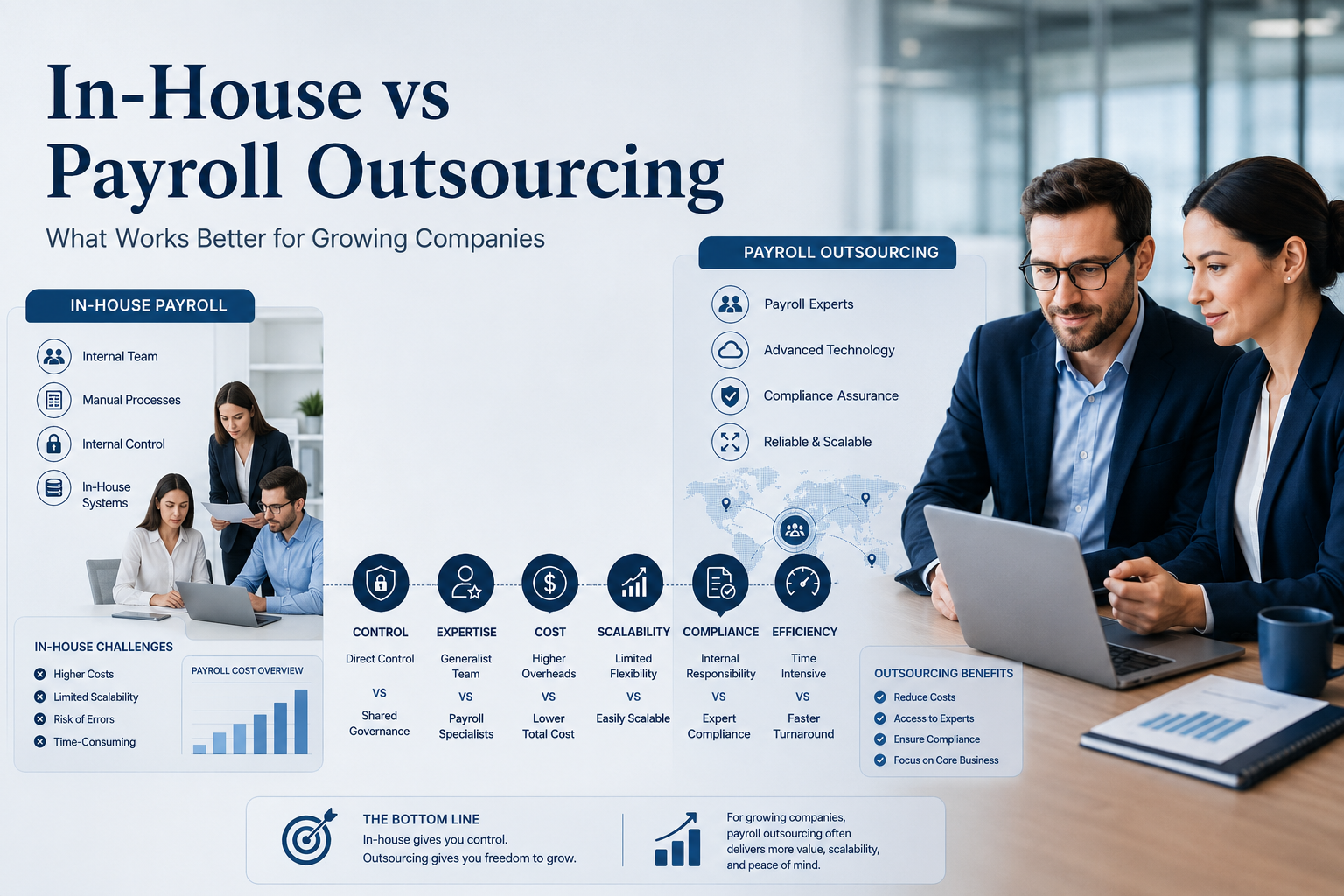
For leadership teams, one of the most important decisions becomes whether payroll should remain internally managed or whether outsourcing certain functions would create stronger operational efficiency and scalability. There is no universal answer because the right model depends on organizational structure, growth strategy, workforce distribution, compliance exposure, and internal capabilities.
Some companies prefer maintaining direct operational control, while others prioritize flexibility, scalability, and external expertise. Understanding the strengths and limitations of both approaches is critical before making long-term payroll decisions.
Why Payroll Becomes More Complex During Growth
Payroll complexity grows faster than many businesses expect. Even organizations with strong internal finance teams often struggle to maintain consistency once operations expand across regions or countries.
Multiple challenges begin to appear simultaneously. Employee classifications become more varied, tax obligations evolve, reporting structures increase, and payroll approval chains become longer and more fragmented. In many cases, payroll teams also need to coordinate with external accountants, local advisors, HR departments, and technology vendors.
As operational demands increase, businesses often start evaluating broader global payroll solutions that can support scalability, reporting consistency, and centralized governance across different regions.
One major challenge involves maintaining visibility over payroll operations. Growing companies frequently operate with disconnected systems that create duplicate work and inconsistent reporting. Data may move manually between HR, finance, and payroll teams, increasing the risk of errors and delays.
At the same time, compliance obligations continue to evolve. Governments regularly update labor regulations, tax rules, and reporting requirements. For organizations operating internationally, these changes become difficult to monitor consistently without dedicated expertise or structured governance processes.
Technology also plays a major role. Businesses using outdated payroll systems often struggle to integrate payroll with broader HR and financial reporting environments. This creates inefficiencies that increase operational costs over time.
Understanding the In-House Payroll Model
An in-house payroll model means payroll operations are managed internally by the organization’s own teams. This may involve dedicated payroll specialists, HR personnel, finance teams, or a combination of internal resources.
Many businesses initially prefer internal management because it provides direct operational visibility and greater perceived control over employee data, processes, and decision-making.
Internal payroll structures can work effectively for organizations with:
stable workforce structures
strong internal payroll expertise
manageable compliance exposure
Flexibility at the core
However, internal management also requires continuous investment in systems, training, compliance monitoring, and operational support.
As organizations scale, payroll responsibilities often become increasingly resource-intensive. Internal teams must manage system updates, tax changes, reporting requirements, audit preparation, employee inquiries, and cross-functional coordination simultaneously.
This is one reason many growing businesses eventually begin evaluating payroll outsourcing models as a way to improve operational flexibility and reduce administrative pressure on internal departments.
Still, outsourcing is not automatically the best solution for every company. Internal payroll teams can provide valuable organizational knowledge and direct operational alignment that external providers may struggle to replicate fully.
The decision ultimately depends on whether internal structures can continue supporting business growth without creating operational bottlenecks or compliance vulnerabilities.
The Advantages of Payroll Outsourcing
Payroll outsourcing allows organizations to transfer certain payroll responsibilities to external providers. Depending on the operating model, providers may manage payroll calculations, reporting, compliance monitoring, technology platforms, employee support, or full operational administration.
For rapidly growing organizations, outsourcing can provide significant scalability advantages. External providers typically operate with specialized payroll expertise, dedicated technologies, and structured operational processes designed to support large and complex environments.
This becomes particularly valuable for businesses managing multi-country operations or complex workforce structures requiring coordinated global payroll services across different legal and regulatory environments.
Outsourcing can also reduce internal administrative burdens. Instead of allocating substantial internal resources to payroll operations, leadership teams can focus more heavily on strategic business priorities and growth initiatives.
Some additional outsourcing advantages include:
access to specialized expertise
improved operational scalability
reduced technology maintenance responsibilities
broader compliance support
standardized operational workflows
increased reporting capabilities
However, outsourcing also introduces governance considerations. Organizations still remain accountable for payroll accuracy and compliance even when operational responsibilities are transferred externally.
Strong vendor management and clear accountability structures therefore remain essential for successful outsourcing relationships.
The Risks of Fully Outsourced Payroll Models
Although outsourcing provides many operational advantages, fully outsourced payroll models can also create challenges if governance frameworks are weak or provider relationships are poorly managed.
One common issue involves reduced operational visibility. Some companies become overly dependent on external providers without maintaining adequate internal oversight or reporting structures.
Communication delays may also occur when responsibilities between providers and internal teams are not clearly defined. This can create confusion regarding issue escalation, compliance ownership, or operational accountability.
Another risk involves fragmented provider environments. Many multinational organizations work with multiple local vendors simultaneously, creating inconsistent service quality and reporting standards between regions.
To avoid these problems, organizations require structured governance models and strong payroll management solutions that maintain transparency, accountability, and operational coordination across the broader payroll ecosystem.
Vendor contracts should also be reviewed regularly. Service agreements that were competitive several years ago may no longer align with current market conditions or operational requirements.
Successful outsourcing relationships therefore depend not only on provider capabilities but also on ongoing governance, strategic oversight, and operational alignment.
When In-House Payroll Still Makes Sense
Despite the growth of outsourcing models, internal payroll management remains highly effective for certain organizations.
Companies with stable workforce structures, and strong internal payroll expertise may benefit from maintaining internal control over payroll operations. In some industries, direct oversight is considered strategically important due to data sensitivity, regulatory requirements, or operational complexity.
Businesses with highly customized compensation models may also prefer internal management to maintain closer alignment between payroll processes and broader business operations.
Strong in house payroll structures can provide faster internal communication, greater operational familiarity, full control span and more direct collaboration between HR, finance, and leadership teams.
However, maintaining internal payroll operations successfully requires continuous investment in:
compliance monitoring
employee training
payroll technologies
reporting capabilities
process optimization
operational scalability
Without these investments, internal payroll models may gradually become inefficient as organizations continue expanding.
Hybrid Payroll Models Are Becoming More Common
Many modern organizations are moving toward hybrid payroll structures rather than choosing fully internal or fully outsourced models.
Hybrid models combine internal strategic oversight with selective external operational support. For example, a company may retain governance, vendor management, and reporting internally while outsourcing payroll calculations or local compliance administration.
This approach allows businesses to maintain operational visibility while still benefiting from specialized external expertise and scalable delivery capabilities.
Hybrid models are particularly effective for organizations operating across multiple countries where local compliance requirements differ significantly between jurisdictions.
They also allow businesses to adapt more flexibly as operational needs evolve over time.
Instead of viewing payroll as a simple administrative process, many organizations now treat payroll as a strategic operational function connected to employee experience, compliance management, financial planning, and broader transformation initiatives.
Technology and Governance Matter More Than the Model Itself
One important reality is that neither in-house nor outsourced payroll automatically guarantees operational success. Many payroll problems result from weak governance, fragmented systems, unclear accountability, or poor process design rather than the operating model itself.
Organizations with strong governance frameworks often perform well regardless of whether payroll is internally managed or externally supported.
Likewise, companies with weak operational structures may continue facing payroll issues even after changing providers or implementing new technologies.
Successful payroll operations typically require:
clearly defined responsibilities
structured approval workflows
consistent reporting standards
centralized governance models
scalable technologies
regular operational reviews
Businesses should therefore evaluate payroll strategically rather than focusing only on cost reduction or provider selection.
Conclusion
Choosing between in-house payroll and payroll outsourcing depends on far more than operational cost alone. Growing organizations must consider scalability, compliance exposure, reporting complexity, governance quality, internal expertise, and long-term business objectives.
For some companies, maintaining internal payroll operations provides stronger control and operational alignment. For others, outsourcing creates scalability advantages and access to specialized expertise that internal teams cannot easily replicate.
Increasingly, businesses are adopting hybrid approaches that combine strategic internal oversight with external operational support.
Ultimately, the most successful payroll environments are those built around strong governance, scalable processes, effective technology integration, and clear operational accountability.
As payroll complexity continues increasing globally, organizations that approach payroll strategically will be far better positioned to support sustainable growth while maintaining compliance, operational efficiency, and employee trust.
