
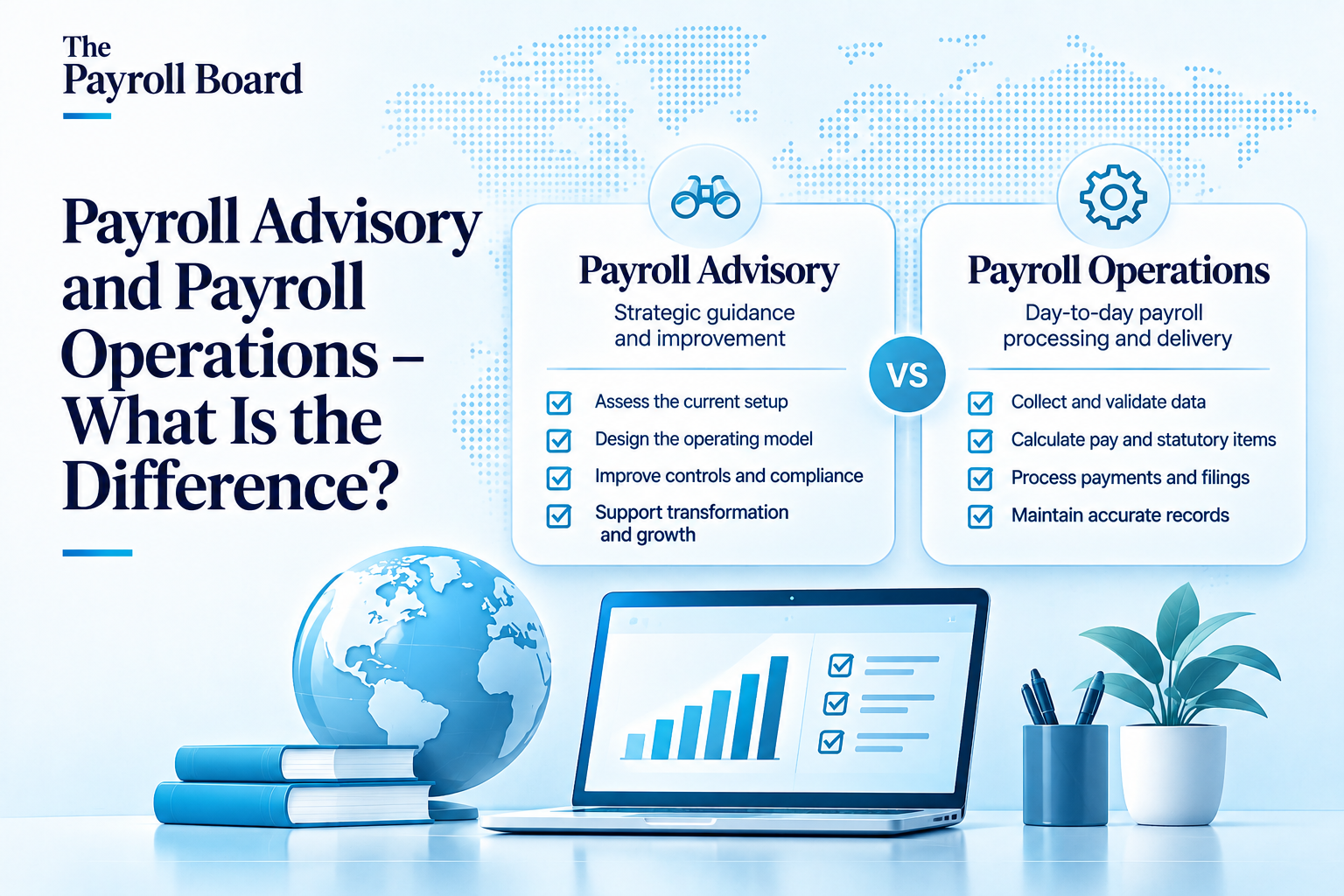
Payroll advisory helps businesses decide how payroll should be organised, governed and improved. It focuses on strategy, risk, provider selection and operational performance rather than calculating and paying salaries each month. For international companies, understanding this distinction is important when choosing external support or reviewing an existing payroll model.
What Does Payroll Advisory Cover?
Advisory work examines the decisions and controls behind payroll delivery. It can include assessing operating models, clarifying responsibilities between HR and finance, benchmarking vendors, planning technology changes and identifying weaknesses in governance.
For organisations operating across borders, international payroll compliance is an important consideration in these decisions. An adviser may examine how a company monitors local rules, assigns compliance ownership and oversees external providers. The aim is to strengthen accountability and reduce exposure, not to replace specialist legal or tax advice in each country.
The review should also identify who signs off policy changes and whether audit findings are tracked through to completion.
What Is Payroll Processing?
Payroll processing is the operational work required to calculate and deliver employee pay. It usually covers collecting approved salary changes, calculating gross-to-net amounts, applying statutory deductions, generating payslips and preparing payment or reporting files.
Processing performance is generally measured through accuracy, timeliness, successful payments and adherence to agreed procedures. A provider can deliver these activities consistently while the employer still needs independent oversight of its wider payroll strategy.
Where the Two Services Work Together
A multinational business might have local processing partners in several countries but no consistent method for assessing their performance. The payroll runs may be completed on time, yet reporting formats, escalation routes and internal controls could differ significantly.
In that situation, independent payroll consultancy can help review the operating model, compare provider arrangements and establish clearer governance. Processing partners remain responsible for the activities assigned to them, while the organisation gains a more coherent view of risks, costs and service quality.
This separation allows leaders to challenge performance objectively without interrupting the established monthly pay cycle.
When Should a Business Engage Payroll Consultants?
Experienced payroll consultants are useful when problems extend beyond an individual pay run. Warning signs include recurring errors across countries, limited visibility of vendor costs, unclear accountability, inconsistent reporting and repeated delays during system changes.
A structured review can establish which problems result from technology, poorly defined processes, supplier performance or gaps in internal ownership. Recommendations should be based on evidence such as payroll reconciliations, service reports, contracts and interviews with process owners.
Choosing the Right Type of Support
Before purchasing external support, define what success should look like:
Routine delivery: choose a processing provider with the required local capabilities, documented responsibilities and service standards.
Strategic review: seek independent advice on governance, risk, operating models or vendor selection.
Transformation: combine strategic planning with a controlled implementation and testing process.
Ongoing oversight: establish regular performance reviews, exception reporting and clear escalation ownership.
Ask potential partners about their scope, independence, local expertise and expected deliverables. A proposal should explain whether the supplier will provide recommendations, perform operational tasks or do both.
How Payroll Consultancy Services Create Long-Term Value
Payroll consultancy services support decisions that influence payroll quality well beyond the next payment cycle. They can help organisations assess whether current structures fit their workforce, whether vendor arrangements offer suitable value and whether controls remain effective as operations expand.
The strongest outcomes are measurable: clearer ownership, more consistent reporting, fewer repeated exceptions and better evidence for investment decisions. Advisory and processing should therefore be treated as complementary capabilities, not competing alternatives.
Conclusion
Payroll processing delivers the regular calculations, payments and reporting employees depend on. Advisory evaluates the strategy, providers and governance supporting that delivery. Businesses that understand the difference can choose the right expertise, maintain accountability and build payroll operations that remain dependable as they grow.
