
Payroll Governance in Practice: How to Define Roles, Controls, and Accountability
Effective Payroll Governance provides the structure organizations need to manage payroll consistently, securely, and transparently. As payroll environments become more complex, particularly across multiple countries, unclear ownership and inconsistent processes can create operational inefficiencies, compliance exposure, and unnecessary costs. A strong governance framework establishes who makes decisions, who performs critical activities, who reviews results, and who is ultimately accountable for payroll outcomes.
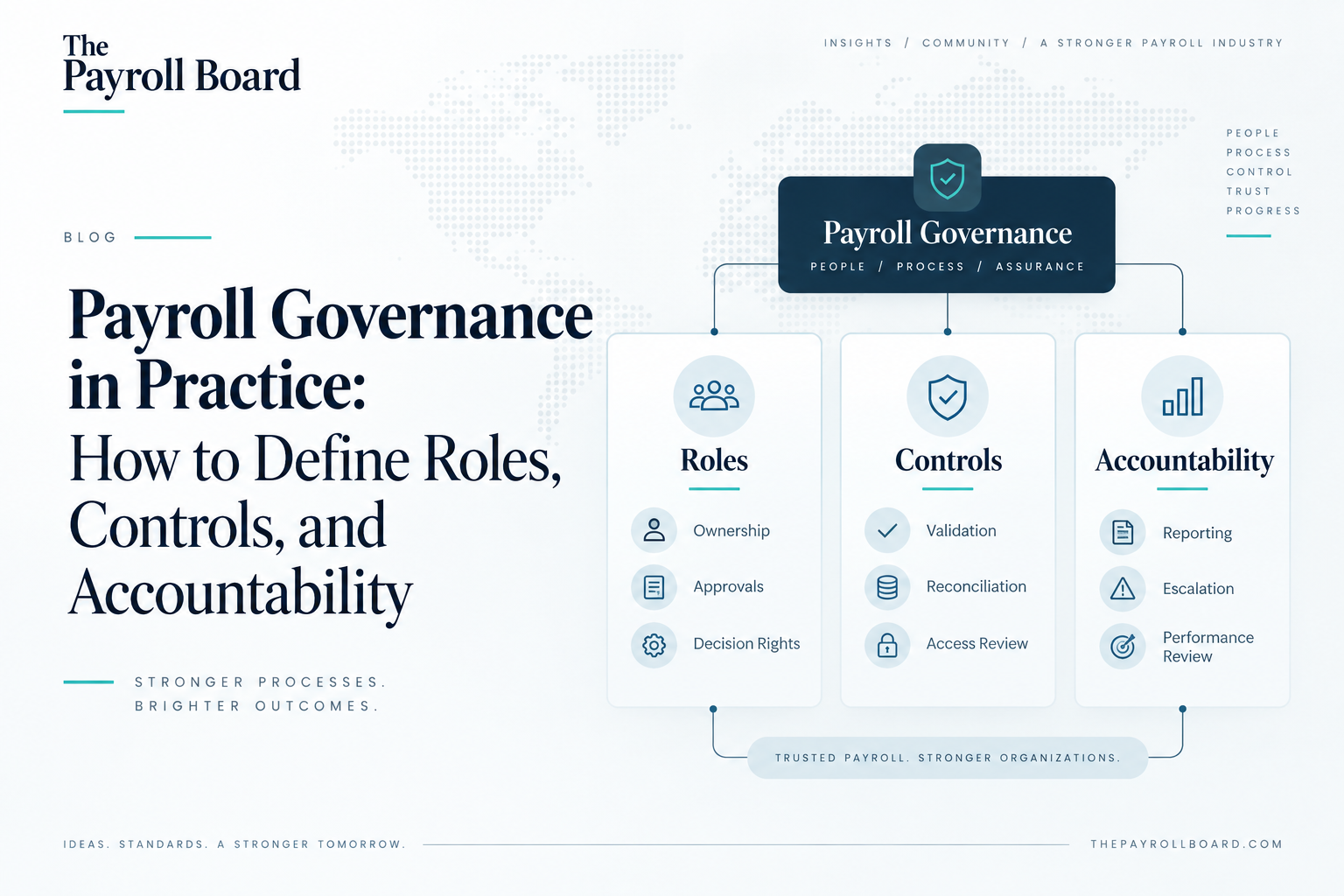
Payroll governance is not simply an administrative framework. It connects payroll operations with HR, finance, legal, procurement, IT, local business units, and external providers. Without clearly defined relationships between these functions, even well-designed payroll processes can become difficult to control.
For multinational organizations, governance becomes especially important as the number of countries, legal entities, payroll vendors, and systems increases. A structured approach allows organizations to maintain appropriate global standards while accommodating legitimate local requirements.
What Is Payroll Governance?
Payroll governance is the framework of policies, responsibilities, controls, decision-making processes, and oversight mechanisms used to manage payroll operations.
It defines how payroll activities should be performed and, more importantly, how the organization ensures that those activities remain accurate, compliant, controlled, and aligned with business objectives.
A practical governance framework typically covers:
roles and responsibilities;
decision-making authority;
process ownership;
internal controls;
compliance monitoring;
vendor management;
data governance;
escalation procedures;
performance measurement;
reporting and oversight.
The objective is not to create unnecessary bureaucracy. Good governance should make payroll easier to manage by removing ambiguity and establishing clear accountability.
Why Payroll Governance Becomes More Difficult at Scale
A small organization may have a relatively straightforward payroll structure, with a limited number of employees and a small internal team. As the organization expands, however, payroll responsibilities can become distributed across multiple functions and locations.
A multinational business may have local payroll teams, HR business partners, finance teams, global payroll leadership, external providers, technology vendors, and regional management involved in the same payroll process.
This creates several potential governance problems.
For example, responsibility for employee data may sit with HR, while payroll processing is handled by an external provider and financial reconciliation is performed by finance. If ownership is not clearly defined, issues can remain unresolved because each function assumes another team is responsible.
The same problem can occur with approvals, compliance monitoring, vendor performance, and payroll controls.
Start With a Clear Governance Model
The first step in establishing effective governance is defining the operating model.
Organizations should document how payroll is structured across corporate, regional, local, and external teams. This creates a clear picture of where decisions are made and where operational responsibilities sit.
The governance model should answer several fundamental questions:
Who owns the overall payroll strategy?
Who is responsible for day-to-day operations?
Who approves payroll results?
Who owns employee and payroll data?
Who monitors compliance?
Who manages external providers?
Who investigates exceptions?
Who has authority to make changes?
Who receives performance reports?
Who is accountable when something goes wrong?
These questions may appear simple, but documenting the answers can reveal significant gaps in existing operating models.
Establish a Payroll Governance Committee
For larger organizations, a formal governance committee can provide an effective mechanism for cross-functional oversight.
The committee does not need to manage daily payroll activities. Its role is to provide strategic direction, monitor performance, review significant risks, and resolve issues that require cross-functional decisions.
A typical governance group may include representatives from:
global payroll;
HR;
finance;
legal or compliance;
procurement;
IT;
information security;
regional operations.
The exact composition should reflect the organization's operating model and risk profile.
Regular governance meetings can focus on performance trends, compliance issues, vendor performance, transformation initiatives, major incidents, and decisions requiring executive attention.
Build a Responsibility Matrix
One of the most practical governance tools is a responsibility matrix. It translates a high-level operating model into specific ownership for individual activities.
A RACI framework can be particularly useful. It distinguishes between the person responsible for performing an activity, the person accountable for its outcome, individuals who need to be consulted, and stakeholders who need to be informed.
The matrix should cover the complete payroll lifecycle rather than focusing only on payroll calculation.
For example, organizations may define ownership for:
employee master data;
payroll input validation;
payroll calculation;
payroll approval;
payments;
tax reporting;
reconciliations;
payroll changes;
system access;
vendor management;
issue escalation;
compliance monitoring.
The objective is to eliminate situations where critical activities have no clear owner or where several teams believe they are responsible for the same task.
Managing International Payroll Compliance
Compliance is one of the most important areas that governance needs to address. Organizations operating across multiple jurisdictions must manage different tax requirements, employment regulations, reporting obligations, payment rules, and data protection requirements.
Strong international payroll compliance requires more than relying on local knowledge. Organizations need defined ownership for monitoring regulatory changes, assessing their impact, updating processes, and confirming that changes have been implemented correctly.
Global governance should establish minimum control standards while allowing local teams or providers to address jurisdiction-specific requirements.
This distinction is important. A global payroll policy should not attempt to eliminate every local difference. Instead, it should define the principles, controls, responsibilities, and escalation mechanisms that apply across the organization.
Local requirements can then be incorporated within that broader governance framework.
Design Controls Around Key Payroll Risks
Payroll controls should be designed around the risks that could materially affect employees, financial reporting, compliance, or business operations.
Organizations should identify critical points in the payroll process where errors, unauthorized changes, or missed obligations could occur.
Examples of control areas include:
employee data changes;
bank account modifications;
payroll input approvals;
payroll calculation validation;
payment authorization;
reconciliation;
access management;
statutory reporting;
exception management.
Controls should have clearly defined owners and evidence requirements. It should also be possible to determine when a control was performed, by whom, and what happened when an exception was identified.
Use Payroll Audits to Test the Framework
Governance frameworks should not simply exist as documentation. Organizations need mechanisms to determine whether controls are actually operating as intended.
A payroll audit can provide an independent assessment of payroll processes, controls, data, compliance, and operational practices.
The scope of an audit can vary depending on the organization's needs. It may focus on a specific country, provider, process, control area, or the broader global payroll operating model.
An effective audit should identify both individual errors and systemic weaknesses. Recurring exceptions may indicate that a process needs to be redesigned rather than simply corrected each time.
Audit findings should therefore be incorporated into governance processes. Each significant finding should have an owner, corrective action, target date, and follow-up mechanism.
Separate Operational Responsibilities From Oversight
A strong governance structure should provide an appropriate degree of separation between performing payroll activities and reviewing their outcomes.
For example, the person responsible for entering or approving payroll changes should not necessarily be the only person responsible for validating the resulting payroll.
Segregation of duties reduces the risk that errors or unauthorized activities remain undetected.
This does not mean every organization needs a large payroll department. Smaller teams can use alternative review mechanisms, such as management approval, independent reconciliation, periodic audits, or automated controls.
The principle is to ensure that critical activities receive an appropriate level of independent review.
Define the Role of External Providers
External payroll providers can perform important operational activities, but outsourcing does not eliminate the organization's responsibility for governance.
The organization should clearly define which responsibilities remain internal and which are delegated to the provider.
This distinction is especially important when multiple vendors operate across different countries.
Contracts and service-level agreements should establish expectations for service quality, compliance support, reporting, issue resolution, data security, and escalation.
However, contractual language alone is not enough. Organizations also need regular performance reviews and governance mechanisms that allow provider performance to be evaluated against agreed expectations.
When Payroll Consultancy Can Strengthen Governance
Organizations sometimes have established payroll operations but lack the internal resources or independent perspective required to redesign their governance framework. In these situations, external payroll consultancy can support the organization without taking over payroll processing itself.
A consultant can assess the existing operating model, identify governance gaps, benchmark practices, and help define a practical roadmap for improvement.
Advisory support may include governance design, process assessment, vendor evaluation, contract benchmarking, control framework development, and transformation planning.
The value of external expertise is particularly relevant during major organizational changes, such as acquisitions, international expansion, provider consolidation, or payroll transformation programs.
The objective should be to strengthen the organization's ability to govern its payroll ecosystem rather than create long-term dependency on an external advisor.
Strengthen Internal Control for Payroll
Effective governance depends on controls that are both clearly documented and consistently performed. An internal control for payroll should address a specific risk and have an identifiable owner responsible for ensuring that the control operates as intended.
Controls can be preventive or detective.
Preventive controls may stop an unauthorized change before it reaches payroll, while detective controls can identify errors after processing but before or after payment.
Examples include approval workflows, access restrictions, reconciliation procedures, exception reports, and independent reviews.
Organizations should periodically assess whether existing controls remain appropriate. A control designed several years ago may no longer address the risks created by a new payroll platform, vendor model, or organizational structure.
Establish Clear Escalation Procedures
Even well-designed payroll processes will occasionally encounter exceptions. Governance should therefore define what happens when something goes wrong.
An escalation framework should specify:
which issues require immediate escalation;
who should be notified;
what information should be provided;
who has decision-making authority;
when executive involvement is required;
how incidents are documented;
how corrective actions are tracked.
Clear escalation procedures reduce confusion during high-pressure situations and help ensure that critical payroll issues receive appropriate attention.
They also create an opportunity to identify recurring problems. If the same type of incident repeatedly reaches senior management, the underlying process may require redesign rather than another individual correction.
Document Payroll Roles and Responsibilities
Clear payroll roles and responsibilities are essential for maintaining accountability across a complex payroll environment.
Organizations should document ownership at both strategic and operational levels. This includes defining who owns the payroll strategy, who manages providers, who approves changes, who monitors compliance, and who is accountable for the overall quality of payroll delivery.
Documentation should be accessible to relevant stakeholders and reviewed when the operating model changes.
A responsibility framework can also help during onboarding and organizational transitions. New employees, managers, or vendors can quickly understand where their responsibilities begin and end.
Measure Governance Effectiveness
Governance should itself be measurable. Organizations can establish indicators that show whether the framework is improving control and operational performance.
Useful governance indicators may include:
number of unresolved control issues;
recurring payroll errors;
audit findings;
overdue corrective actions;
SLA breaches;
compliance incidents;
unresolved vendor escalations;
percentage of processes with documented ownership;
completion of control reviews.
These indicators should not become a reporting exercise for its own sake. Their purpose is to identify weaknesses and support informed management decisions.
Review Governance After Major Changes
Payroll governance should evolve alongside the organization.
A merger, acquisition, new country entry, vendor transition, technology implementation, or significant workforce change can materially affect the existing control environment.
Following a major change, organizations should reassess:
decision-making authority;
process ownership;
vendor responsibilities;
system access;
data flows;
compliance controls;
reporting requirements;
escalation mechanisms.
This helps ensure that governance remains aligned with the actual operating environment rather than reflecting an outdated organizational structure.
A Practical Payroll Governance Checklist
Before finalizing a payroll governance framework, organizations can use the following checklist:
Are strategic and operational responsibilities clearly separated?
Does every critical payroll activity have an accountable owner?
Are local and global responsibilities documented?
Are key payroll risks mapped to specific controls?
Are approval and review procedures clearly defined?
Are external provider responsibilities documented contractually?
Are vendor performance and compliance monitored regularly?
Is there a formal process for handling exceptions?
Are audit findings tracked through completion?
Are governance documents reviewed after major changes?
Can leadership access reliable payroll performance information?
Are governance decisions documented and communicated?
A checklist such as this can help organizations identify obvious gaps before they become operational or compliance problems.
Conclusion
Effective payroll governance is ultimately about creating clarity. Organizations need to know who owns each process, who can make decisions, which controls protect critical activities, and who is accountable when performance falls short.
As payroll environments become more international and interconnected, informal arrangements become increasingly difficult to manage. A structured governance framework provides the foundation for consistent operations while allowing organizations to accommodate legitimate local differences.
The most effective approach combines clear responsibilities, risk-based controls, independent oversight, vendor governance, compliance monitoring, and continuous improvement.
Payroll governance should also remain practical. The objective is not to create layers of unnecessary administration, but to establish a framework that gives organizations greater visibility, stronger accountability, and confidence in the way payroll is managed.
When roles, controls, and accountability are clearly defined, payroll becomes easier to govern and better positioned to support long-term organizational growth.
