
Managing payroll tax across several countries is a challenge for international employers. Tax withholding, social contributions, filing deadlines and employer registrations can differ between jurisdictions, while remote work and employee transfers make responsibilities less obvious. A reliable approach starts with knowing where obligations arise, who owns each task and how payroll figures are checked before submission.
Why Multiple Jurisdictions Increase Tax Risk
Employees may live, work and be paid across different countries. This raises questions about withholding, registration and social security. Answers depend on the facts and local rules, not the payroll system's location.
Maintaining international payroll compliance therefore requires coordination between payroll, HR, finance and local tax specialists. Record work locations, employing entities and triggers for a compliance review. Document decisions, particularly when employees relocate or begin cross-border work.
An effective review should also flag uncertain cases for specialist advice instead of forcing them into standard workflows.
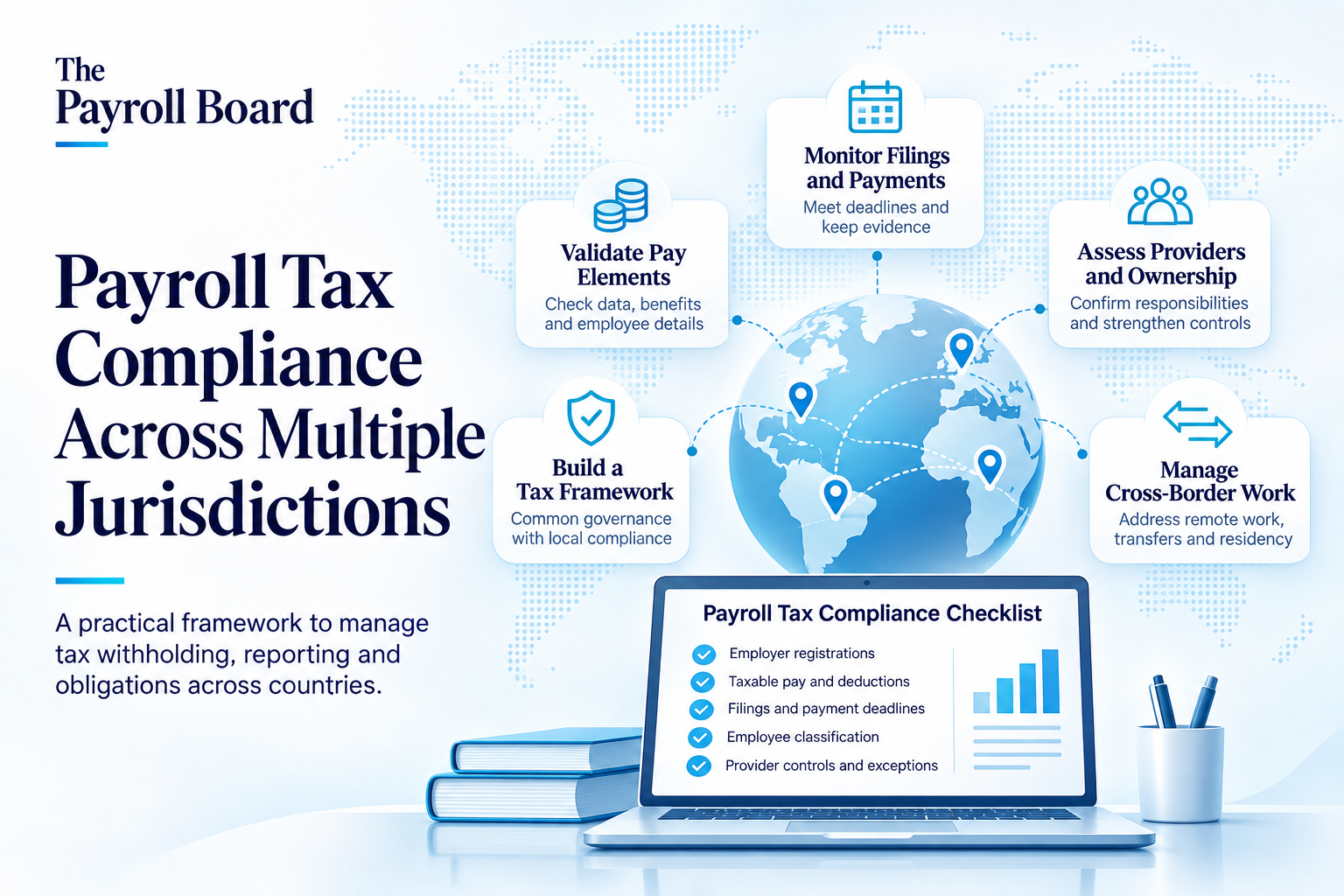
Build a Consistent Tax Compliance Framework
Effective global payroll tax compliance does not mean applying identical calculations everywhere. It means using common governance standards while checking each country's requirements separately. A central team can set approval rules, reporting expectations and escalation routes, while local specialists confirm the correct tax treatment and filing process.
Maintain a country register of employer identifiers, reporting deadlines, data sources and owners. Update it when entering markets, changing providers or moving employees.
Validate Pay Elements and Employee Information
Many tax errors begin with incomplete inputs rather than calculation software. Bonuses, equity awards, allowances, benefits and termination payments may receive different treatment across jurisdictions. Incorrect start dates, work locations or employee classifications can also affect withholding and reporting.
HR should approve changes, local specialists should review unusual payments and payroll should test calculations. Reconcile outputs with employee and finance records, keeping evidence of corrections.
Monitor Filing and Payment Obligations
Good international payroll tax compliance relies on meeting both payment and reporting requirements. A tax amount may be calculated correctly but still create exposure if a return is late, submitted under the wrong entity or unsupported by accurate records. Responsibilities must therefore extend beyond running payroll to confirming that every required step is completed.
Maintain country-specific calendars for filings, payments and reconciliations, with named owners. Obtain evidence of provider submissions and review legislative changes with local advisers.
Assess Providers and Internal Accountability
Multiple vendors can create reporting gaps. Contracts should specify who calculates pay, submits returns, monitors legal changes and resolves incidents, with evidence of completion.
Independent payroll consultancy can help examine these arrangements, benchmark providers and strengthen the operating model. The aim is clearer accountability and stronger controls, not replacing local tax advice or monthly processing. Monitor errors, response times and unresolved issues.
Teams should check whether recurring incidents indicate a weak process rather than treating each correction as an isolated task.
Address Cross-Border Working and Transfers
Cross border payroll tax questions become particularly complex when staff travel frequently, work remotely abroad or transfer between group companies. Tax residency, treaties, local withholding and social security may all matter. The payment location alone does not settle obligations.
Require early notification of international moves so HR, payroll and tax specialists can assess obligations before the next pay cycle. Review decisions when circumstances change.
What to Check During a Payroll Tax Review
A focused review should examine:
Employer registrations and responsible legal entities in each country.
Accuracy of taxable pay, benefits and statutory deductions.
Timeliness of filings, remittances and payroll reconciliations.
Evidence for employee classification and cross-border arrangements.
Provider responsibilities, approval controls and unresolved exceptions.
Prioritise risks, assign owners and deadlines, and verify fixes in later payroll cycles.
Conclusion
Managing payroll taxation internationally requires more than accurate calculations. Clear ownership, country-specific expertise, reliable data and documented controls help businesses identify risk before it affects employees or regulators. A coordinated governance framework makes compliance more consistent without overlooking the legal differences between markets.
