
Payroll consulting services help organisations assess how their payroll function operates, identify risks and make better decisions about systems, providers and responsibilities. Unlike payroll processing, which covers routine calculations and payments, consulting focuses on the structures and controls behind reliable delivery. This distinction matters when a company expands, changes suppliers or struggles to understand why recurring problems persist.
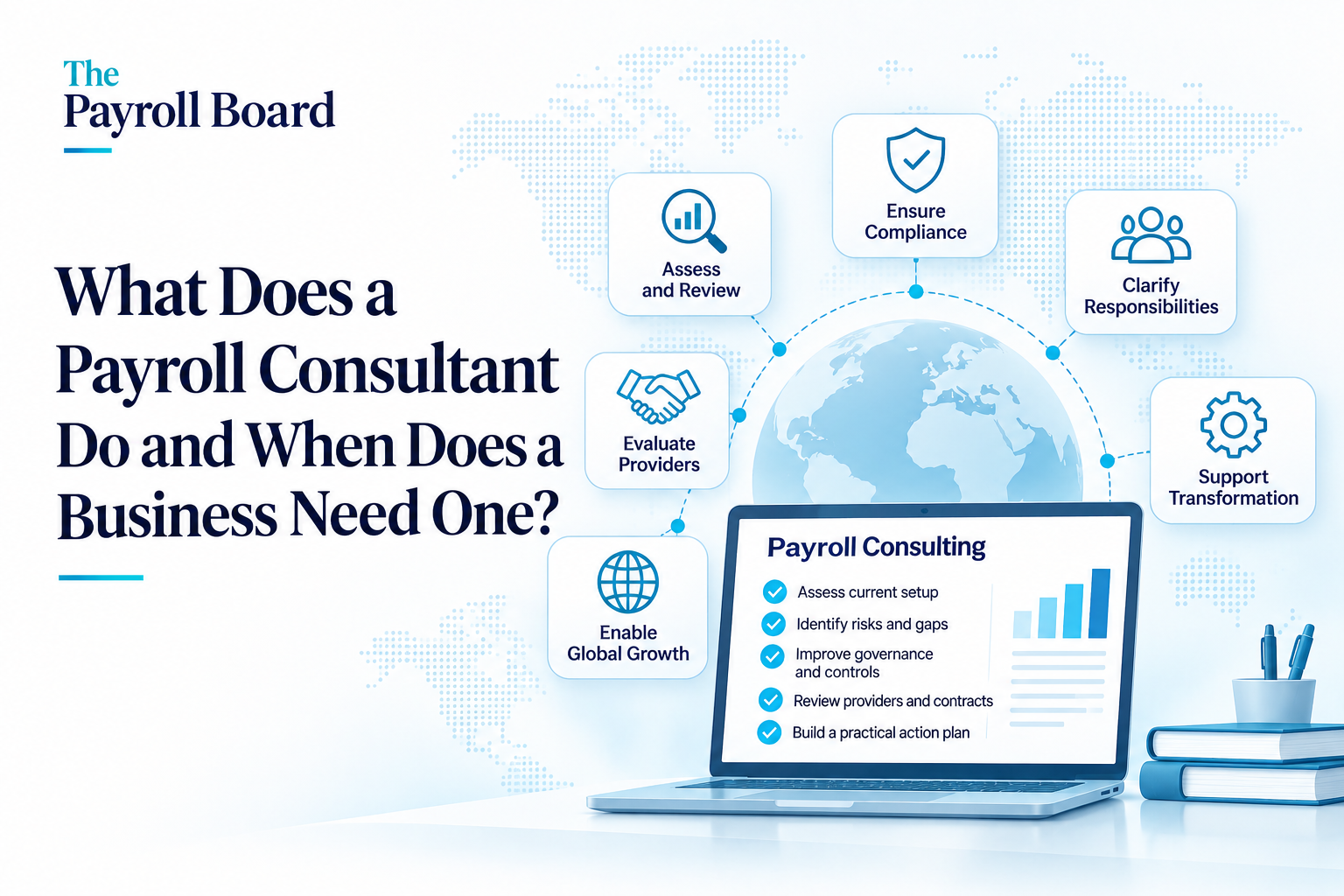
What Does a Payroll Consultant Actually Do?
A consultant begins by reviewing the current operating model. This may involve speaking with payroll, HR and finance teams, examining provider contracts, comparing reporting practices and testing whether responsibilities are clearly assigned. The aim is to identify the causes of problems rather than simply recommend another software platform.
For international employers, international payroll compliance is a central part of the review. Consultants can assess how an organisation monitors local obligations, escalates regulatory changes and checks the work of external providers.
Consulting Versus Processing
Monthly processing involves collecting payroll inputs, calculating deductions, preparing payslips and supporting statutory reporting. Consulting asks whether those activities are properly governed, efficiently organised and suitable for the business.
Payroll consultant services may include operational assessments, provider selection, contract reviews, governance design and transformation planning. Advice is most useful when it identifies who needs to act, what should change and how improvement will be measured.
When Should a Business Bring in a Consultant?
Repeated or cross-functional problems are different, particularly when nobody can clearly explain their cause.
Typical warning signs include:
Recurring errors or last-minute corrections across several pay cycles.
Inconsistent country reporting and limited visibility of provider performance.
Unclear responsibilities between HR, finance, payroll and vendors.
Unexpected costs, contract gaps or difficulty comparing suppliers.
Risks arising from acquisitions, new market entry or system migrations.
In these situations, an independent payroll consultancy can provide an objective assessment of the existing arrangements. The goal is to establish which changes are justified by evidence, rather than automatically replacing providers or centralising everything. Document the findings and prioritise actions according to business risk. Agree a timeline for each recommendation, name a responsible owner and review progress with the relevant teams.
Why International Operations Need Additional Oversight
Global payroll consulting addresses challenges that become harder to manage as a workforce spans multiple jurisdictions. Different statutory requirements, employee benefits, data formats and local providers can make a single global dashboard misleading unless the underlying information is consistent.
A consultant can help develop common definitions for accuracy, timeliness, exceptions and supplier performance. Local teams remain responsible for applying country-specific requirements, while central leaders gain a more reliable view of risk. This balance is often more practical than forcing every country onto an identical process.
How to Choose the Right Advisory Partner
Before appointing a payroll consulting company, define the business problem and expected outcomes. Ask whether the adviser has experience with comparable operating models, can work objectively with existing vendors and understands where local specialist input is required.
A useful proposal should explain the scope of work, evidence to be reviewed, stakeholder involvement and final deliverables.
What Good Payroll Advice Should Deliver
Effective consulting creates decisions the business can act on. The result might be clearer ownership, stronger approval controls, improved vendor reporting or a prioritised plan for technology changes. Success should be measured through fewer repeat exceptions, better visibility of risks and more dependable payroll operations.
Conclusion
A payroll consultant helps businesses understand and improve the system of people, providers and controls behind salary payments. Consulting is particularly valuable when problems recur, responsibilities are unclear or international growth increases complexity. The right adviser brings independent analysis and a workable plan, while the business retains accountability for payroll delivery.
