
Signs Your Payroll Operating Model Needs to Change
As organizations expand across regions, payroll becomes far more than an administrative function. It directly affects compliance, employee experience, operational efficiency, and financial performance. While many companies continue using the same payroll structure for years, business growth, regulatory changes, and evolving workforce expectations can gradually expose weaknesses that were previously manageable.
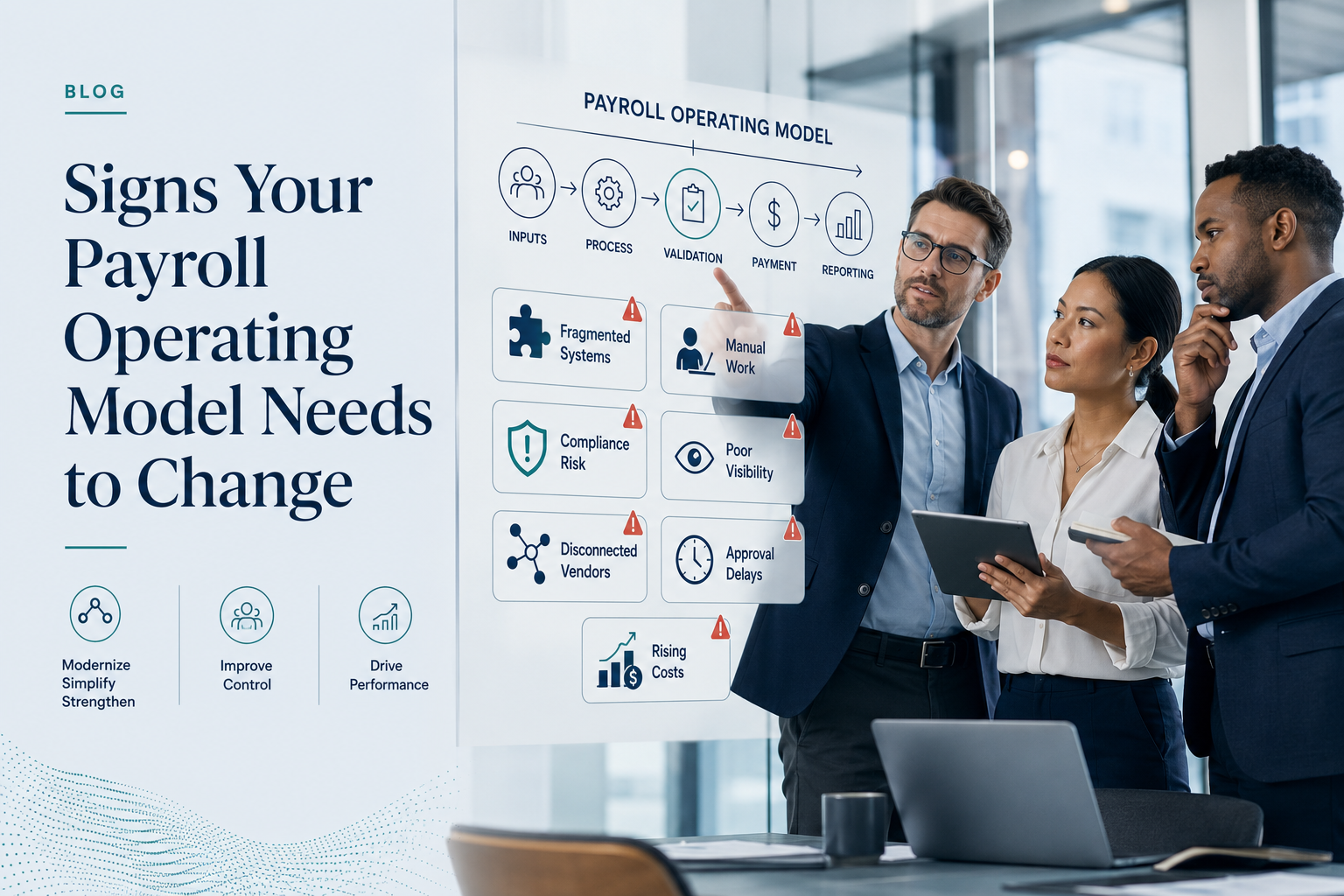
Strong payroll management is no longer simply about ensuring employees are paid accurately and on time. It requires a strategic approach that aligns people, processes, technology, vendors, and governance frameworks. Organizations that fail to modernize their payroll operations often experience increasing costs, operational inefficiencies, reporting inconsistencies, and compliance risks.
The challenge is that payroll problems rarely appear overnight. Instead, they develop gradually through fragmented systems, outdated processes, duplicated responsibilities, and limited visibility across the payroll ecosystem. By the time leadership notices the impact, the organization may already be dealing with unnecessary operational complexity and escalating expenses.
Recognizing the warning signs early allows businesses to make proactive improvements before small inefficiencies become major obstacles to growth. Understanding when change is needed is the first step toward building a more scalable and resilient payroll environment.
Why Payroll Operating Models Become Outdated
Every payroll operating model is designed around a specific business reality. As organizations evolve, however, that reality changes. New markets are entered, acquisitions take place, employee populations grow, and regulatory requirements become more complex.
Many companies continue operating with structures that were originally designed for a much smaller or less complex organization. While these models may continue functioning, they often struggle to support future growth efficiently.
Modern businesses increasingly rely on integrated technologies and centralized oversight. This has driven greater adoption of global payroll solutions that provide improved visibility, standardization, and control across multiple countries and business units.
Without periodic evaluation, payroll structures can become misaligned with broader organizational objectives. The result is often rising operational costs, inconsistent service quality, and reduced ability to support strategic business initiatives.
Organizations should regularly assess whether their payroll operating model still reflects current business requirements rather than historical circumstances.
Sign 1: Payroll Processes Depend Too Heavily on Manual Work
One of the clearest indicators that change is required is excessive reliance on manual activities. Manual data entry, spreadsheet reconciliations, email-based approvals, and disconnected reporting processes consume valuable resources while increasing the risk of human error.
As payroll complexity grows, manual processes become increasingly difficult to manage. Teams spend more time correcting mistakes, responding to inquiries, and performing repetitive administrative tasks rather than focusing on higher-value activities.
Manual operations also limit scalability. What works for a workforce of several hundred employees may become unsustainable when employee populations double or expand internationally.
Organizations facing these challenges often discover that stronger payroll governance frameworks are necessary to establish accountability, standardize procedures, and reduce operational inconsistencies.
Improved governance creates clearer ownership structures and supports the implementation of more efficient workflows that reduce dependency on manual intervention.
Sign 2: Vendor Management Has Become Increasingly Complex
Many organizations work with multiple payroll vendors across different countries and regions. While this may provide local expertise, it can also create fragmented service delivery models that are difficult to oversee effectively.
Vendor complexity often leads to inconsistent reporting, varying service levels, duplicated responsibilities, and limited transparency regarding overall payroll performance. Leadership teams may struggle to obtain a complete view of payroll operations across the organization.
Common indicators include:
Different payroll platforms across regions
Inconsistent service-level agreements
Multiple reporting formats
Limited contract visibility
Difficulty comparing provider performance
Escalating support costs
These challenges become even more significant within largeglobal payroll servicesenvironments where coordination between providers, internal teams, and stakeholders must remain consistent across multiple jurisdictions.
Organizations that lack structured vendor management processes often experience rising costs without corresponding improvements in service quality.
Sign 3: Compliance Risks Are Increasing
Payroll compliance requirements continue to evolve rapidly. Tax legislation, labor regulations, reporting obligations, and data privacy requirements frequently change across different countries.
An outdated payroll operating model may struggle to adapt to these changes effectively. Teams often become reactive rather than proactive, responding to issues after they occur instead of preventing them through structured controls.
Warning signs may include recurring compliance incidents, inconsistent audit results, increased dependence on external interventions, or uncertainty regarding regulatory responsibilities.
When compliance management becomes increasingly difficult, it often indicates deeper structural weaknesses within the payroll environment. Organizations should view these issues as strategic concerns rather than isolated operational problems.
A strong compliance framework requires clear accountability, documented procedures, reliable reporting mechanisms, and sufficient oversight capabilities to support ongoing regulatory obligations.
Sign 4: Payroll Costs Continue Rising Without Clear Explanation
Cost growth is not always a problem if it reflects business expansion. However, when payroll-related expenses increase without a clear connection to organizational growth, leadership should investigate underlying causes.
Hidden inefficiencies often emerge gradually. Duplicate processes, unnecessary vendor services, outdated technologies, and fragmented workflows can generate significant costs over time.
Without operational transparency, organizations may struggle to identify where resources are being consumed. This lack of visibility prevents informed decision-making and limits opportunities for optimization.
Many businesses addressing these challenges eventually discover that their existing payroll operating model no longer supports efficient resource allocation or scalable service delivery.
Comprehensive operational assessments frequently reveal opportunities to improve productivity, simplify workflows, and strengthen governance without compromising compliance or employee experience.
Sign 5: Reporting and Visibility Are Limited
Accurate payroll reporting is essential for strategic decision-making. Leadership teams require reliable data to support workforce planning, financial forecasting, compliance monitoring, and operational management.
Organizations operating with fragmented systems often struggle to produce consistent reports across different business units and regions. Data may be incomplete, delayed, or difficult to reconcile.
Limited visibility creates several challenges:
Difficulty identifying operational inefficiencies
Reduced confidence in workforce data
Delayed decision-making
Increased audit complexity
Poor performance measurement
Modern payroll environments require reporting capabilities that support both operational management and strategic oversight. Without reliable information, organizations are effectively managing payroll without a complete understanding of performance outcomes.
Improved reporting structures frequently become a central objective during payroll transformation initiatives.
Sign 6: Payroll Cannot Support Future Growth
Growth introduces complexity. New countries, acquisitions, remote workforce arrangements, and changing employment models all increase demands on payroll operations.
Organizations that struggle to onboard new entities efficiently or support changing business requirements may be operating within a structure that has reached its practical limits.
Scalability challenges often manifest through project delays, resource shortages, inconsistent service delivery, and growing operational workloads. While additional personnel may temporarily alleviate pressure, they rarely address underlying structural limitations.
In these situations, organizations should evaluate whether broader payroll process improvement initiatives are necessary to support long-term business objectives.
Process improvement efforts focus on redesigning workflows, strengthening controls, simplifying operations, and aligning payroll capabilities with future organizational needs.
Rather than treating payroll as a static function, leading organizations continuously adapt their operating models to remain efficient, compliant, and scalable.
How to Evaluate Your Current Payroll Operating Model
Organizations seeking to assess payroll effectiveness should examine several critical areas:
Governance structures
Process standardization
Vendor performance
Technology alignment
Compliance management
Reporting capabilities
Resource allocation
Scalability readiness
A structured review helps identify operational gaps while providing a foundation for future improvement initiatives.
Independent assessments can be particularly valuable because they offer objective perspectives that internal teams may overlook due to operational familiarity.
The goal is not necessarily to replace existing systems or providers. In many cases, targeted improvements can generate substantial benefits without requiring large-scale transformation projects.
Conclusion
Payroll operating models should evolve alongside the organizations they support. What worked effectively five years ago may no longer be suitable for today's business environment. Increasing complexity, regulatory pressure, technological change, and workforce growth all create new demands that payroll functions must address.
Organizations that ignore warning signs often face escalating costs, compliance risks, operational inefficiencies, and limited scalability. By identifying issues early and taking a strategic approach to improvement, businesses can strengthen payroll performance while supporting broader organizational objectives.
The most successful organizations treat payroll as a strategic business capability rather than a purely administrative function. Regular evaluation, strong governance, and continuous improvement help ensure payroll operations remain efficient, compliant, and capable of supporting long-term growth.
