
Payroll Vendor Selection Mistakes That Cost Companies Millions
Selecting a payroll vendor is one of the most important decisions an organization can make. Payroll impacts employee satisfaction, compliance, financial reporting, governance, and operational efficiency. Yet many organizations still approach vendor selection as a procurement exercise rather than a strategic business decision.
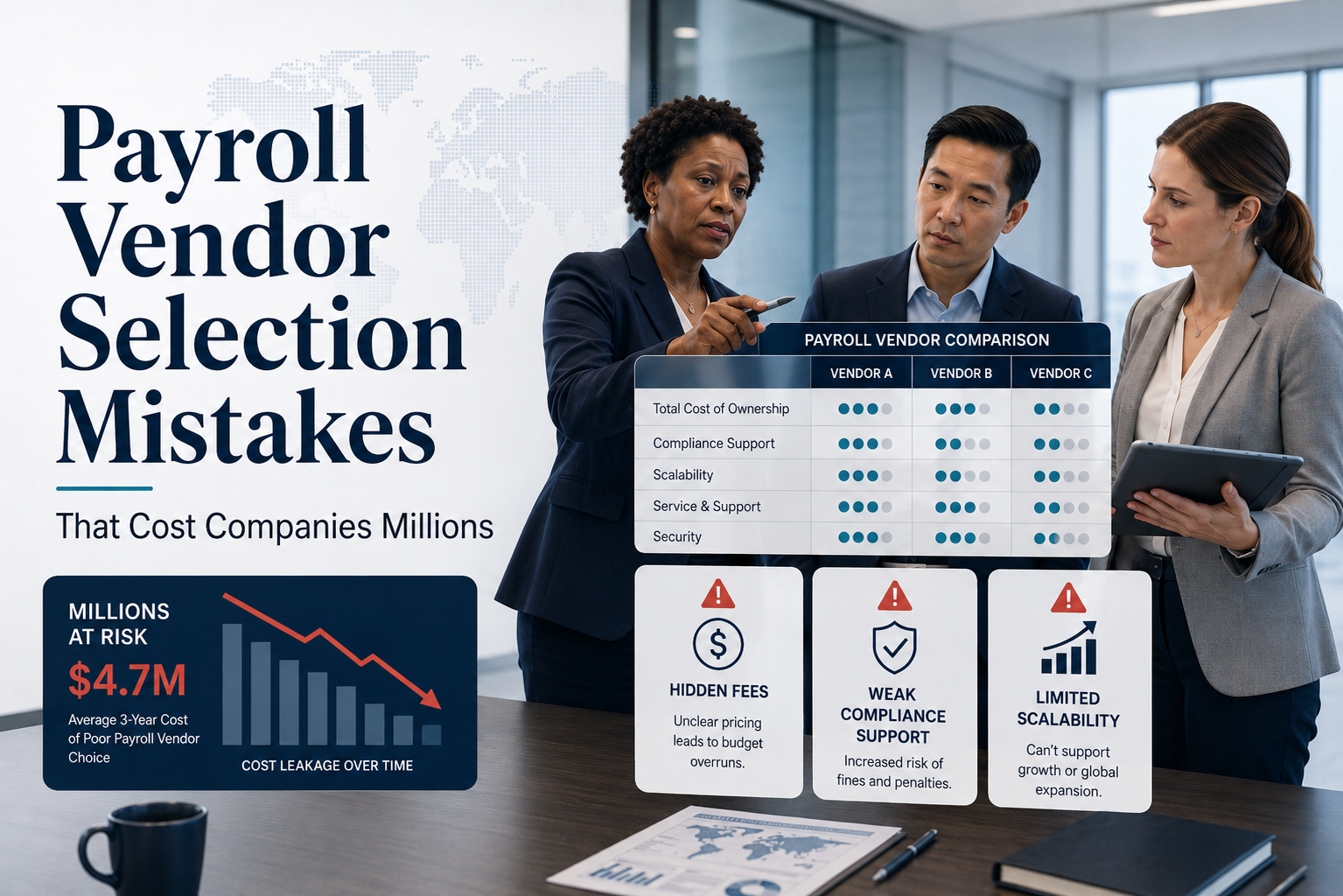
A poorly selected payroll outsourcing provider can create years of operational challenges, hidden costs, compliance risks, and employee dissatisfaction. What initially appears to be a cost-saving initiative can quickly evolve into a multimillion-dollar problem when organizations fail to evaluate vendors correctly, underestimate implementation complexity, or overlook long-term business requirements.
As payroll environments become increasingly global, businesses must manage multiple regulatory frameworks, currencies, employment models, and reporting obligations. The consequences of selecting the wrong provider extend far beyond payroll processing itself. They affect HR operations, finance teams, compliance functions, and overall business performance.
Many organizations only recognize these issues after contracts are signed and implementation projects are already underway. At that stage, reversing decisions becomes expensive, disruptive, and time-consuming. Understanding the most common payroll vendor selection mistakes can help organizations avoid costly errors and build a more sustainable payroll operating model.
Why Payroll Vendor Selection Has Become More Complex
The payroll market has changed dramatically over the last decade. New technologies, evolving service models, increased regulatory requirements, and growing workforce mobility have transformed the way payroll operates.
Organizations are no longer looking for providers that simply process payroll accurately. They need strategic partners capable of supporting digital transformation, operational scalability, governance requirements, and long-term business growth.
Many companies begin vendor evaluations with limited visibility into their current payroll environment. Existing inefficiencies, fragmented processes, and inconsistent governance structures often remain hidden throughout the selection process. As a result, businesses frequently choose vendors based on demonstrations, marketing materials, or pricing assumptions rather than actual operational requirements.
This challenge becomes even more significant when organizations are evaluating modern global payroll solutions designed to support multinational operations. While these platforms often offer impressive functionality, not every solution aligns with a company's unique business structure, compliance requirements, or future growth plans.
A successful vendor selection process requires organizations to clearly define objectives before engaging the market. Without this foundation, companies risk selecting providers that solve only part of the problem while creating new operational challenges elsewhere.
Mistake #1: Prioritizing Cost Over Business Requirements
One of the most common mistakes organizations make is focusing too heavily on vendor pricing during the selection process.
Lower implementation costs or attractive service fees may appear appealing initially. However, the cheapest provider is rarely the most cost-effective option over the long term.
Organizations often fail to calculate:
implementation costs
integration expenses
governance requirements
reporting limitations
future scalability needs
vendor management overhead
compliance support requirements
When these factors are ignored, the true cost of ownership becomes significantly higher than anticipated.
Payroll should be evaluated as a business-critical service rather than a commodity. Cost matters, but selecting a vendor solely based on pricing often leads to poor outcomes.
Companies that achieve successful payroll transformations typically conduct a detailed payroll provider comparison process that evaluates operational fit, service quality, governance capabilities, scalability, and long-term value alongside financial considerations.
This broader perspective allows decision-makers to identify solutions that support both immediate operational needs and future strategic objectives.
Mistake #2: Failing to Understand Current Payroll Processes
Many organizations rush into vendor selection without first understanding how payroll currently operates across the business.
Existing payroll environments often contain years of accumulated complexity. Different countries may follow different procedures, approval structures, reporting methods, and compliance practices.
Without documenting current-state operations, organizations struggle to define future requirements accurately.
This creates several problems:
Vendors receive incomplete requirements.
Project scope becomes unclear.
Implementation costs increase.
Stakeholder expectations become misaligned.
Governance gaps remain unresolved.
A comprehensive assessment should always precede vendor selection. Organizations must understand their current operating model before evaluating alternative solutions.
This becomes particularly important in large global payroll services environments where multiple countries, providers, technologies, and business units are involved.
A detailed operational review helps identify inefficiencies that can be addressed during transformation while ensuring vendor requirements reflect actual business needs rather than assumptions.
Mistake #3: Ignoring Governance Requirements
Governance is frequently overlooked during payroll transformation projects.
Organizations often focus heavily on technology and service delivery while paying insufficient attention to accountability structures, escalation procedures, decision-making frameworks, and performance management processes.
Poor governance creates operational instability regardless of how capable the vendor may be.
Without clear governance frameworks, companies often experience:
unresolved service issues
unclear ownership responsibilities
inconsistent reporting
compliance gaps
ineffective vendor management
reduced operational visibility
Governance should be considered from the earliest stages of vendor evaluation.
Organizations must define how vendors will interact with HR, finance, compliance, and payroll teams. Responsibilities should be documented clearly, and performance expectations should be established before contracts are signed.
Strong governance structures create transparency and help organizations maintain control throughout the entire vendor relationship lifecycle.
Mistake #4: Overlooking Scalability Requirements
Business requirements rarely remain static.
Organizations grow, enter new markets, acquire companies, restructure operations, and adapt to changing workforce demands. Payroll solutions must support these changes without requiring constant redesign.
Many companies select vendors based only on current requirements while ignoring future business plans.
This short-term perspective often results in costly migrations a few years later when the chosen solution can no longer support organizational growth.
Scalability should therefore be a core consideration during vendor evaluation.
Questions organizations should ask include:
Can the vendor support additional countries?
Can the platform handle acquisitions?
Does the service model support workforce growth?
How flexible are reporting capabilities?
Can governance structures scale effectively?
Businesses that address these questions early are far less likely to encounter operational limitations in the future.
Mistake #5: Treating Vendor Demonstrations as Proof of Capability
Vendor demonstrations can be useful, but they should never be the primary basis for selection decisions.
Demonstrations are designed to showcase strengths. They rarely expose operational limitations, implementation challenges, service constraints, or governance weaknesses.
Many organizations become overly influenced by polished presentations and fail to validate vendor claims independently.
A structured due diligence process should include:
reference checks
client interviews
contract reviews
service-level assessments
implementation methodology evaluations
governance framework reviews
Decision-makers should focus on operational reality rather than marketing messages.
The most successful payroll transformations are driven by evidence-based evaluations rather than sales presentations.
Mistake #6: Not Defining Success Metrics
Organizations frequently launch payroll transformation projects without clearly defining success.
If stakeholders cannot agree on expected outcomes, measuring vendor performance becomes extremely difficult.
Success metrics should be established before vendor selection begins.
These may include:
payroll accuracy improvements
compliance performance
reporting quality
processing efficiency
employee experience metrics
service responsiveness
cost optimization targets
Clear metrics help organizations compare vendors objectively and ensure transformation goals remain aligned throughout implementation.
Without measurable objectives, projects often drift away from original business priorities.
Mistake #7: Underestimating Implementation Complexity
Implementation is often the most challenging phase of any payroll transformation initiative.
Many organizations focus heavily on vendor selection while underestimating the effort required to deploy new systems and processes successfully.
Implementation challenges may include:
data migration
process redesign
compliance validation
system integration
stakeholder training
change management
testing activities
Even highly capable vendors cannot guarantee success if organizations fail to allocate sufficient resources internally.
Successful projects require strong collaboration between internal teams and external partners.
Companies should evaluate implementation methodologies carefully and ensure vendors have experience managing similar transformations within comparable business environments.
Mistake #8: Failing to Engage Key Stakeholders
Payroll impacts multiple functions across an organization.
Despite this, vendor selection decisions are often driven by a limited group of stakeholders.
When critical functions are excluded, important requirements may be overlooked.
Key stakeholders typically include:
payroll teams
HR leadership
finance departments
procurement functions
compliance specialists
IT teams
executive sponsors
Each group brings unique perspectives that contribute to a more comprehensive evaluation process.
Inclusive decision-making helps organizations identify risks earlier and improve long-term project success rates.
Mistake #9: Rushing the Selection Process
Time pressure frequently leads organizations to make poor vendor decisions.
Leadership teams may face contract expirations, operational challenges, regulatory concerns, or transformation deadlines that create urgency.
While speed can be important, rushed evaluations often result in incomplete analysis and poorly informed decisions.
One of the most common examples involves organizations rushing through the process of choosing a payroll provider because they want immediate cost savings or rapid modernization.
Unfortunately, accelerated timelines often reduce the quality of due diligence activities.
Organizations should balance urgency with discipline.
A structured selection process may require additional time initially, but it often prevents costly problems later.
Strategic decisions deserve thorough evaluation.
Mistake #10: Poor Contract Negotiation
Vendor contracts define the foundation of the future relationship.
Many organizations spend months evaluating providers but devote insufficient attention to contract negotiations.
Weak contracts can create significant problems including:
pricing disputes
service scope disagreements
unclear responsibilities
reporting limitations
governance challenges
change request conflicts
Contract negotiations should focus on operational outcomes rather than legal language alone.
Organizations must ensure that performance expectations, governance requirements, escalation procedures, and service obligations are documented clearly.
Independent benchmarking can also help companies determine whether proposed commercial terms remain competitive within the broader market.
Building a Strong Vendor Evaluation Framework
Avoiding payroll vendor selection mistakes requires a structured methodology.
Organizations should establish a framework that aligns payroll strategy with business objectives.
Effective evaluation frameworks typically include:
current-state assessment
future-state design
stakeholder alignment
governance planning
market analysis
vendor benchmarking
risk assessment
implementation readiness reviews
These activities help create objective decision-making processes while reducing the influence of assumptions and vendor marketing claims.
Strong frameworks improve transparency and increase the likelihood of successful transformation outcomes.
Understanding the Most Important Evaluation Factors
Every organization has unique requirements, but several considerations consistently influence long-term success.
Among the most important payroll provider selection criteria are operational scalability, compliance expertise, governance capabilities, reporting quality, implementation methodology, service model flexibility, and commercial transparency.
Organizations should evaluate each factor carefully rather than focusing excessively on technology features or pricing structures alone.
The best payroll solution is not necessarily the most advanced platform or the lowest-cost provider. It is the solution that aligns most effectively with business objectives while supporting sustainable operational performance.
Decision-makers should also recognize that payroll transformation is a business initiative rather than a technology project. Success depends on people, processes, governance, and organizational alignment as much as systems and vendors.
Conclusion
Payroll vendor selection mistakes can have consequences that extend far beyond payroll operations. Poor decisions often create years of inefficiencies, compliance risks, governance challenges, and unexpected costs that significantly exceed original business cases.
Organizations that approach vendor selection strategically are far more likely to achieve successful outcomes. By focusing on governance, scalability, stakeholder alignment, operational requirements, and long-term business objectives, companies can reduce risk while maximizing the value of payroll transformation investments.
In today's increasingly complex payroll landscape, selecting the right vendor requires discipline, independent evaluation, and a clear understanding of both current and future business needs. Companies that invest time in a structured selection process position themselves for stronger operational performance, improved compliance, and sustainable long-term growth.
