
The Biggest Mistakes Companies Make During Payroll System Implementations
Implementing a new payroll system is a major transformation project that can affect finance, HR, employees, compliance, and business operations across multiple markets. A successful global payroll implementation requires much more than selecting software and configuring payroll rules. Companies must consider operating models, data quality, integrations, governance, regulatory requirements, stakeholder responsibilities, and long-term scalability. When these elements are not addressed early, implementation projects can become expensive, delayed, and difficult to manage.
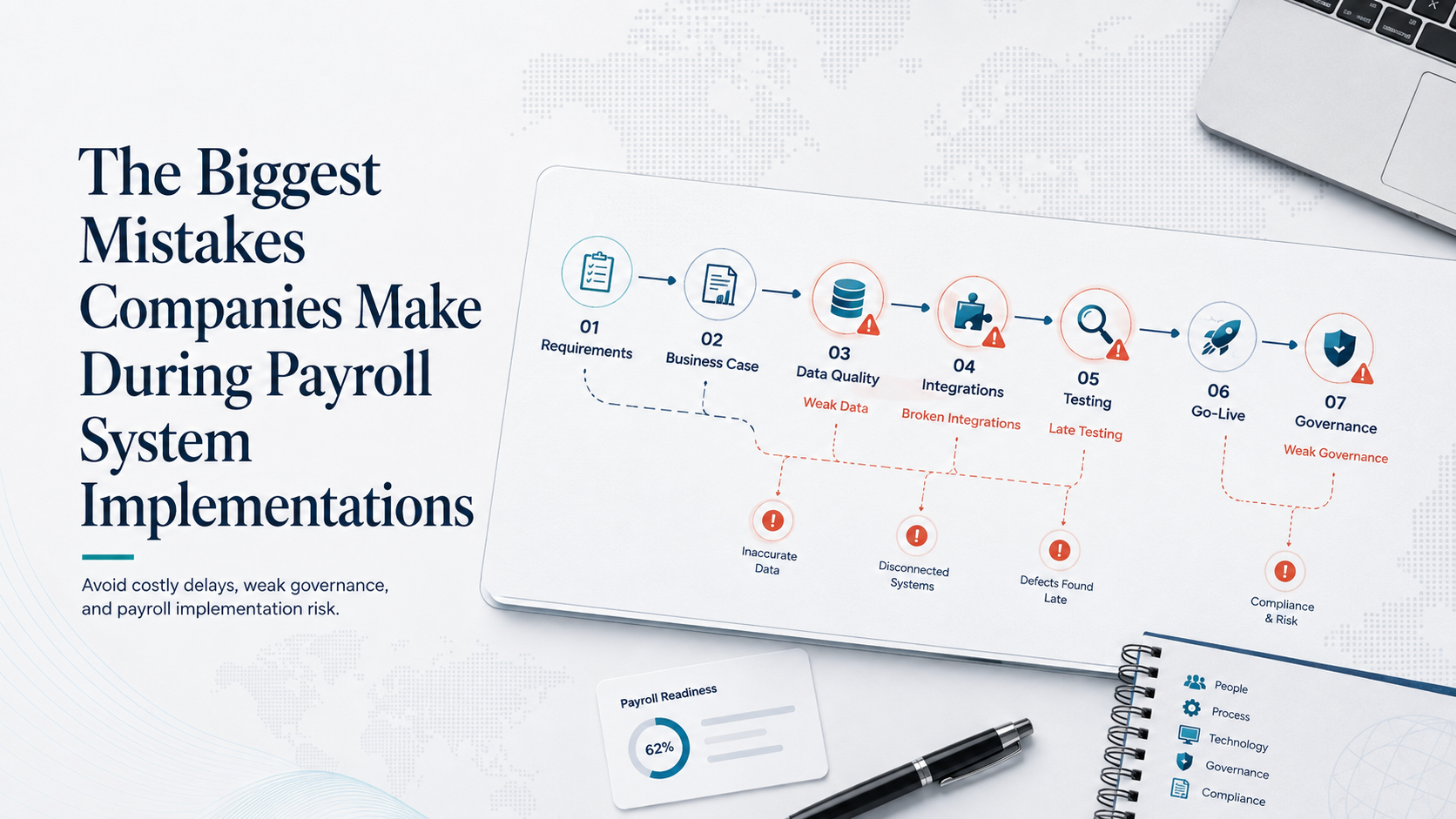
Payroll technology has evolved significantly, but technology alone does not guarantee a successful transformation. Organizations often assume that replacing an outdated platform will automatically eliminate operational problems. In reality, a new system can reproduce the same inefficiencies if the underlying processes, responsibilities, and governance structures have not been properly assessed.
The most successful implementations begin with a clear understanding of why change is necessary and what the organization expects to achieve. Cost reduction, improved compliance, better reporting, automation, standardization, and global visibility may all be valid objectives, but they need to be translated into measurable requirements before technology decisions are made.
This article examines the biggest mistakes companies make during payroll system implementations and explains how organizations can avoid them.
1. Starting With Technology Instead of Business Requirements
One of the most common mistakes is beginning the project with software selection.
Companies may immediately compare platforms, request demonstrations, and evaluate functionality without first defining the business problems they are trying to solve. This can result in technology being selected based on features rather than strategic requirements.
A payroll platform should support the organization's operating model, not determine it by default. Before evaluating vendors, businesses should understand how payroll currently works, where the major inefficiencies exist, and which processes need to change.
A proper assessment should consider:
current payroll operating models
country-specific requirements
internal and external responsibilities
existing technology infrastructure
HR and finance integrations
reporting requirements
compliance controls
employee experience
future growth plans
Without this foundation, organizations risk investing in technology that looks impressive during demonstrations but does not address their most important operational challenges.
2. Failing to Define a Clear Business Case
Payroll transformation can require significant financial and organizational investment. Yet some companies begin implementation without developing a detailed business case.
A business case should explain not only the expected cost of the project but also the operational and strategic value it is expected to generate.
Potential benefits may include reduced manual work, improved data accuracy, stronger compliance controls, lower vendor costs, better reporting, standardized processes, and improved visibility across countries.
Companies should also consider the cost of maintaining the existing environment. Legacy systems, fragmented vendors, manual processes, and duplicated activities can create substantial hidden expenses.
The business case should therefore compare the current state with the desired future state and establish realistic measures of success.
For multinational organizations, this analysis should also account for differences between countries. A solution that creates efficiencies in one market may require additional configuration or operational support elsewhere.
3. Assuming One Model Will Work Everywhere
Global organizations often make the mistake of trying to create complete uniformity across all countries.
Standardization is valuable, but payroll cannot always be treated as a single global process. Taxation, employment legislation, reporting requirements, pay frequencies, benefits, and statutory obligations can differ considerably between jurisdictions.
The objective should therefore be controlled standardization rather than absolute uniformity.
Modern global payroll solutions should provide a consistent framework while allowing sufficient flexibility for local requirements. Companies need to determine which processes can be standardized globally and which elements must remain country-specific.
This distinction should be established during the design phase rather than discovered after implementation begins.
A strong global operating model typically separates core principles from local execution requirements. Governance, reporting, data structures, security standards, and escalation processes may be standardized, while certain statutory calculations and local processes remain market-specific.
4. Underestimating Data Quality Problems
Data migration is one of the most challenging components of payroll transformation.
Organizations frequently assume that existing payroll data can simply be transferred into a new system. In practice, legacy data may contain duplicates, outdated employee records, inconsistent formats, missing information, incorrect classifications, or historical anomalies.
Moving poor-quality data into a new platform does not solve the underlying problem. It simply transfers it into a new environment.
Before implementation, organizations should conduct a structured data assessment. This should identify critical data elements, ownership responsibilities, retention requirements, historical records, and data-quality issues.
Data cleansing should happen before migration wherever possible. Companies should also define validation procedures and establish clear accountability for approving migrated data.
This is particularly important when payroll data comes from multiple countries or legacy platforms. Different systems may use different structures, terminology, and data definitions.
5. Treating Payroll as an IT Project
Payroll system implementation is often led primarily by IT departments. While technology expertise is essential, payroll transformation is fundamentally a cross-functional business project.
Payroll teams understand operational requirements. HR understands workforce processes. Finance understands financial controls and reporting. Legal and compliance teams understand regulatory obligations. IT manages infrastructure, security, integrations, and technical architecture.
All of these perspectives are necessary.
A successful payroll system implementation therefore requires strong collaboration between business and technical stakeholders. The project governance structure should define decision-making authority, escalation routes, ownership, and accountability from the beginning.
When payroll professionals are not sufficiently involved, technical teams may build solutions that work from an IT perspective but fail to reflect real payroll requirements.
Similarly, when technology teams are involved too late, organizations may discover integration or security limitations after important design decisions have already been made.
6. Ignoring Integrations
Payroll rarely operates as an isolated system.
Modern payroll environments interact with HR information systems, time and attendance platforms, finance systems, benefits platforms, identity management tools, banking infrastructure, reporting environments, and other business applications.
Poorly designed integrations can create significant operational problems.
For example, if employee information is transferred incorrectly between HR and payroll, the resulting errors may affect salary calculations, tax reporting, benefits, or employee records.
Organizations should therefore map all critical data flows before system configuration begins.
The integration strategy should define:
what information is transferred
where the data originates
how frequently it moves
who owns the data
how errors are identified
how failed transactions are resolved
how changes are monitored
Integration testing should be treated as a core part of the implementation rather than a final technical exercise.
7. Failing to Involve Key Stakeholders Early
Payroll implementations affect a wide range of stakeholders, yet companies sometimes involve key users only after the system has already been designed.
This creates resistance and often leads to expensive changes later in the project.
Stakeholder engagement should begin during the planning stage. Employees, payroll professionals, HR teams, finance representatives, local country teams, IT specialists, and leadership should have opportunities to contribute to requirements and design decisions.
Not every stakeholder needs the same level of involvement. However, the organization should understand who will use the system, who will manage it, who will approve transactions, and who will be responsible for resolving issues.
Early engagement also improves adoption. People are more likely to support a new system when they understand why the change is happening and how it will affect their responsibilities.
8. Neglecting Change Management
Even technically successful payroll projects can fail if organizations underestimate change management.
A new payroll system can change workflows, responsibilities, approval processes, reporting procedures, and employee interactions. These changes need to be managed deliberately.
Training should not be limited to explaining how to click through the new system. Users need to understand the new processes and the reasons behind them.
Change management should address:
stakeholder communication
training requirements
new responsibilities
process changes
support structures
employee communications
post-launch assistance
Organizations should also plan for different levels of training. Payroll administrators may require detailed technical training, while managers and employees may only need guidance on specific self-service functions.
9. Choosing a Vendor Without Sufficient Due Diligence
Vendor selection is another area where companies frequently focus too heavily on product demonstrations.
A platform may appear highly capable during a sales presentation but perform differently in a complex operating environment.
Organizations should evaluate vendors based on their ability to support actual business requirements rather than generic feature lists.
Important considerations include implementation methodology, integration capabilities, country coverage, data security, reporting, support structures, scalability, governance, and commercial terms.
References from organizations with comparable payroll complexity can also provide valuable insight.
Companies should avoid selecting a vendor solely because it offers the lowest initial price. Implementation costs, customization, support, integration requirements, and long-term operating expenses can significantly affect the total cost of ownership.
10. Underestimating Compliance Requirements
Payroll is closely connected to employment legislation, taxation, reporting obligations, data protection, and statutory requirements.
A system implementation that focuses primarily on functionality without sufficiently addressing compliance can expose the organization to significant risk.
For multinational businesses, compliance becomes even more complex because requirements differ across jurisdictions.
Companies should establish clear compliance requirements during the design phase and ensure that appropriate controls are incorporated into workflows, data structures, reporting, and approval processes.
Testing should also include regulatory scenarios rather than focusing exclusively on technical functionality.
This is particularly important when organizations operate through multiple global payroll services arrangements. Different providers and operating models can create variations in data handling, reporting, controls, and accountability.
A strong governance framework helps ensure that compliance responsibilities are clearly defined rather than assumed to belong to another team or vendor.
11. Testing Too Late
Testing is one of the most critical phases of payroll implementation, yet some organizations treat it as a final step.
Payroll systems require extensive testing because even small configuration errors can have direct financial consequences.
Testing should cover different types of scenarios, including:
standard payroll calculations
new hires
terminations
salary changes
bonuses
benefits
tax changes
deductions
retroactive adjustments
country-specific requirements
reporting
integrations
security permissions
Organizations should also perform parallel testing where appropriate. Comparing outputs from the old and new environments can help identify discrepancies before the new system becomes operational.
Testing should continue through multiple cycles rather than relying on a single final test.
12. Poorly Managed Payroll System Migration
Moving from a legacy platform to a new environment involves much more than transferring employee records. A successful payroll system migration requires structured planning, data validation, testing, reconciliation, and clear ownership.
Companies should define which historical data needs to be migrated and which information can be archived. Attempting to move everything without evaluating its business value can increase complexity and costs.
Migration planning should also consider timing. Payroll cycles create strict operational deadlines, meaning there may be limited opportunities to correct errors before employees are paid.
A controlled migration plan should therefore include clear milestones, validation procedures, contingency arrangements, and escalation mechanisms.
Organizations should also establish criteria for determining whether the migration is ready for go-live.
13. Changing Too Much at Once
Large payroll transformations often involve several simultaneous changes.
Companies may replace technology, change vendors, redesign processes, restructure teams, standardize operating models, and introduce new reporting requirements at the same time.
Although transformation can create significant value, attempting to change everything simultaneously increases implementation risk.
A phased approach can sometimes provide better control. Organizations may begin with a specific region, business unit, or process before expanding the model.
This allows teams to identify issues, refine processes, and apply lessons learned to subsequent phases.
The right approach depends on the organization's size, complexity, regulatory environment, and transformation objectives. There is no universal implementation model.
14. Focusing Only on Go-Live
Another common mistake is treating go-live as the final objective.
Launching the system is only one milestone in the transformation journey. The organization must continue monitoring performance after implementation to determine whether expected benefits are actually being achieved.
Post-implementation reviews should evaluate:
payroll accuracy
processing efficiency
support volumes
compliance performance
user adoption
reporting quality
vendor performance
operating costs
Organizations should also create a mechanism for continuous improvement.
Payroll environments change as companies expand, regulations evolve, workforce structures change, and technology develops. A system that works well today may require adjustments in the future.
15. Failing to Establish Strong Governance
Governance is often overlooked because implementation teams are focused on technology and deadlines.
However, governance determines who makes decisions, who owns processes, how issues are escalated, and how performance is monitored after implementation.
Without clear governance, organizations may experience confusion between internal teams and external vendors. Responsibilities can overlap or remain unassigned.
A strong governance framework should establish ownership across key areas such as:
system administration
payroll operations
data management
vendor management
compliance
reporting
security
change requests
Governance should also continue after implementation. It should become part of the organization's ongoing payroll operating model rather than disappearing once the project team is disbanded.
How to Improve the Chances of a Successful Payroll Implementation
Avoiding implementation mistakes starts with treating payroll transformation as a strategic business initiative rather than a software deployment.
Organizations should begin by documenting the current state, defining the desired future state, and identifying the gap between them.
The implementation roadmap should then connect technology decisions with business objectives.
A practical approach includes:
Assess the existing payroll environment.
Define strategic objectives and measurable outcomes.
Document country-specific requirements.
Establish the future operating model.
Review data quality and ownership.
Define integration requirements.
Evaluate potential technology and service providers.
Develop a detailed implementation roadmap.
Establish governance and decision-making structures.
Conduct comprehensive testing before go-live.
Prepare users through structured change management.
Monitor performance after implementation.
This approach reduces the likelihood that organizations will discover fundamental issues after major investments have already been made.
The Role of Independent Payroll Consulting
Organizations often benefit from independent expertise when planning complex payroll transformations.
External advisors can provide an objective assessment of the current environment and help leadership teams understand where the greatest risks and opportunities exist.
This can include reviewing the operating model, evaluating vendors, benchmarking contracts, assessing processes, defining governance structures, and developing a transformation roadmap.
Independent guidance can also help organizations avoid becoming overly dependent on a particular technology provider's recommended approach.
The objective is not necessarily to replace existing providers or systems. In many cases, significant improvements can be achieved by redesigning processes, strengthening governance, clarifying responsibilities, or renegotiating commercial arrangements.
The right strategy depends on the organization's specific operating environment and long-term business objectives.
Conclusion
Payroll system implementations are complex transformation initiatives that require careful coordination between technology, people, processes, vendors, and governance.
The biggest mistakes usually occur when organizations underestimate this complexity. Choosing technology too early, failing to define a business case, ignoring data quality, underestimating integrations, neglecting change management, and treating implementation as an IT project can all create unnecessary risk.
Successful transformation requires a structured approach that begins with business requirements and ends with continuous improvement.
Companies should focus on building a payroll environment that is scalable, compliant, transparent, and aligned with broader business objectives. Technology is an important component, but it is only one part of the solution.
When organizations combine strong governance, robust processes, high-quality data, effective stakeholder management, and appropriate technology, payroll transformation can deliver much more than a new system. It can create a more resilient operating model, improve visibility, reduce operational risk, and provide a stronger foundation for long-term international growth.
