
When Is It Time to Change Your Global Payroll Vendor?
Managing payroll across multiple countries requires more than simply selecting a provider and maintaining the relationship. As organizations grow, expand into new markets, or restructure their operating models, payroll environments can become increasingly complex. A global payroll provider that was suitable several years ago may no longer meet the organization's current requirements for scalability, transparency, compliance, technology, or service quality.
Changing a payroll vendor is a significant strategic decision. It involves operational disruption, data migration, stakeholder management, contractual considerations, and implementation risks. For this reason, organizations should not make the decision based on frustration with a single service issue.
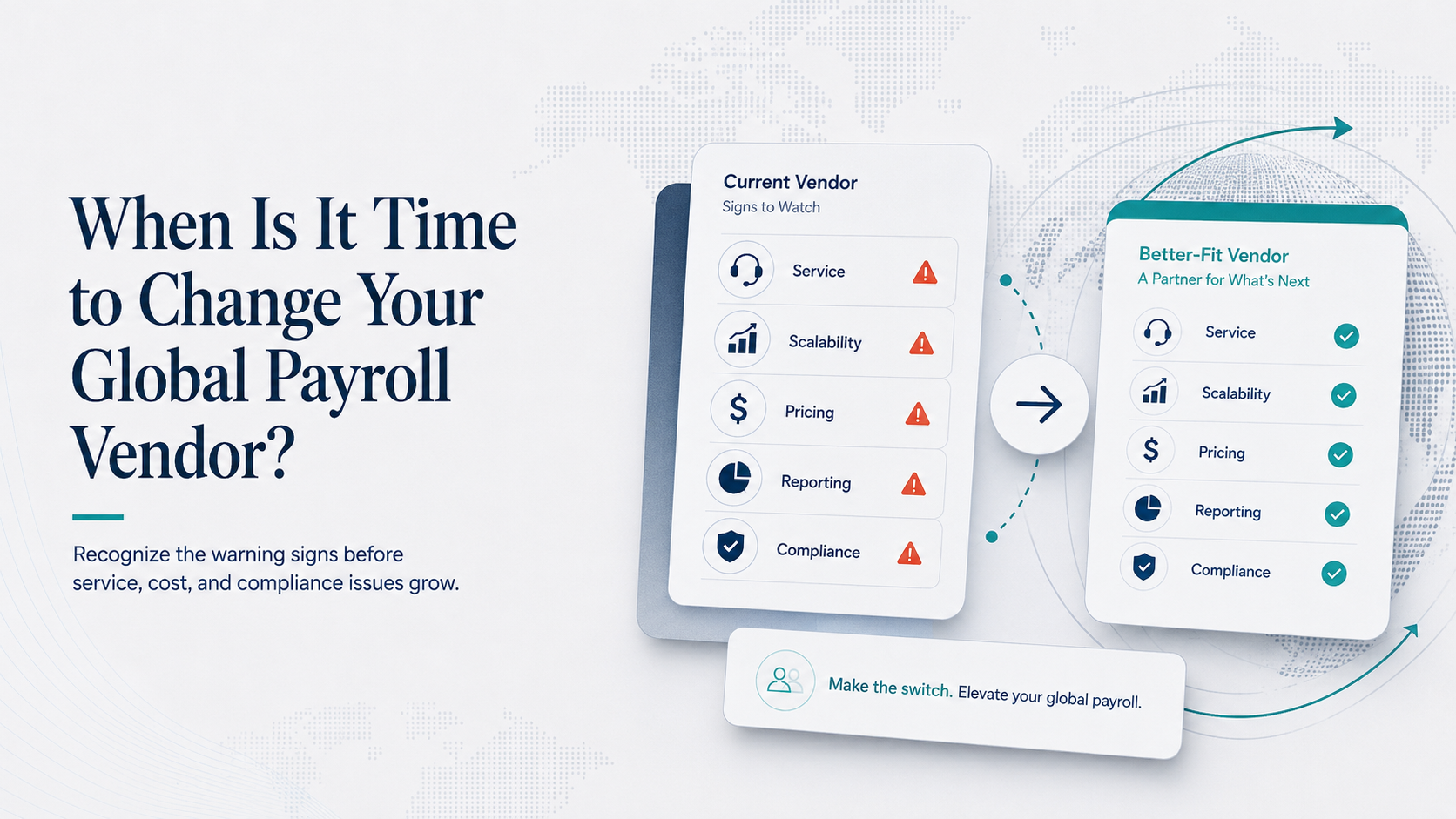
Instead, leadership should assess whether the existing provider continues to support the company's long-term business objectives. The warning signs often develop gradually: reporting becomes increasingly difficult, service issues become routine, costs become less transparent, and internal teams spend more time managing the provider than focusing on strategic priorities.
The key question is therefore not simply whether the current vendor has problems. It is whether those problems are structural, persistent, and significant enough to justify a change - and whether switching to an other vendor could realistically help.
Why Companies Outgrow Their Payroll Vendors
Payroll requirements rarely remain static. A company may begin with operations in a few countries and gradually expand into dozens of jurisdictions. Workforce structures change, new legal entities are established, acquisitions are completed, and employee populations become more diverse.
A provider that worked well for a smaller organization may struggle to support a much larger and more complex environment. The issue is not necessarily that the provider has become worse. The organization's requirements may simply have evolved beyond the original service model.
This is why vendor assessments should be based on current and future business needs rather than the reasons behind the original selection.
Organizations should periodically evaluate whether their payroll operating model still provides:
sufficient geographic coverage;
consistent service quality and cultural fit
transparent pricing;
reliable reporting;
effective compliance support;
scalable technology;
clear governance;
strong issue resolution processes; and
flexibility for future business growth.
If several of these areas are consistently underperforming, it may be time to reassess the relationship.
1. Service or Compliance Problems Have Become the Norm
Every payroll provider experiences occasional problems. Payroll is complex, and unexpected issues can arise from regulatory changes, employee data discrepancies, system failures, or local operational circumstances.
The concern begins when exceptions become the standard operating model.
If
payroll teams repeatedly have to escalate the same types of issues, manually correct errors, chase responses, or intervene in processes that should already be controlled by the provider,
the vendor response to those challenges is not convincing,
The organization may be dealing with a structural service problem
A useful assessment should distinguish between isolated incidents and recurring patterns. Organizations should examine whether payroll errors are increasing, service-level agreements are regularly missed, support tickets remain unresolved, and root causes are being properly addressed.
When internal teams repeatedly compensate for provider weaknesses, the relationship may no longer be delivering the operational value originally expected.
2. The Provider Cannot Scale With the Business
Growth is one of the most common reasons organizations reconsider their payroll arrangements.
Entering new countries can introduce additional tax rules, employment regulations, currencies, languages, reporting requirements, and local processes. Acquisitions can create multiple payroll populations that need to be integrated into a broader operating model.
A provider may have been effective in the original markets but lack the capabilities, infrastructure, or implementation capacity required for further expansion.
This is where a broader assessment of global payroll solutions becomes important. The objective should be to determine whether the current model can support the organization's long-term strategy rather than simply solving today's payroll requirements.
Scalability should be evaluated across several dimensions. Geographic expansion is only one factor. The organization should also consider employee growth, acquisition integration, technology requirements, reporting complexity, and changes to the operating model.
A vendor that requires extensive customization every time the organization changes may create increasing costs and operational dependencies.
3. Pricing Has Become Difficult to Understand
Cost is not necessarily a reason to change a vendor by itself. A high-quality provider can justify higher fees when the service delivers strong value, reliability, and strategic capability. As a matter of fact, strongest vendors are generally on the pricey side.
The problem arises when organizations cannot clearly understand what they are paying for.
Payroll contracts can contain multiple pricing components, including implementation fees, employee-based charges, country-level fees, transaction costs, reporting charges, integration expenses, and additional service fees.
Over time, the original commercial structure may become difficult to benchmark against current market conditions.
Organizations should periodically review:
total payroll spend;
pricing by country;
additional service charges;
implementation costs;
technology fees;
annual price increases;
out-of-scope charges; and
unused services.
Before deciding to switch payroll provider, companies should determine whether pricing problems can be resolved through contract renegotiation, or whether they indicate a broader issue with the commercial relationship. This is where contract Benchmarking may prove extremely helpful.
A detailed commercial review can reveal that the issue is not necessarily excessive pricing, but poor alignment between the contracted service and the organization's current requirements.
4. Reporting and Data Visibility Are Inadequate
Payroll is a major source of workforce and financial data. Leadership teams increasingly expect timely, accurate, and consistent information that can support decision-making.
When payroll reporting is fragmented, manual, or difficult to consolidate, the problem extends beyond the payroll department.
Finance teams may struggle with reconciliation. HR may lack reliable workforce information. Executives may not have a consistent view of payroll costs across countries.
These issues become particularly challenging in organizations operating multiple global payroll services environments with different local processes, systems, and reporting standards.
A strong payroll operating model should provide clear visibility into key metrics while maintaining appropriate controls around sensitive employee information.
If the current provider cannot deliver consistent reporting without significant manual intervention, this should be treated as a strategic concern rather than simply an inconvenience.
5. Technology Is Holding Back Transformation
Technology should support payroll transformation, not prevent it.
Organizations increasingly expect payroll platforms to integrate with HR systems, finance applications, workforce management tools, and reporting environments. Automation, data standardization, workflow management, and analytics are becoming increasingly important.
However, some organizations remain dependent on legacy technology or heavily customized environments that are difficult to maintain.
The problem can become particularly serious when the current payroll vendor cannot support the organization's broader technology strategy.
Before considering a change, companies should assess whether the problem is caused by the provider itself, the underlying technology, the implementation model, or internal processes.
A vendor change will not automatically solve a poorly designed operating model. Likewise, dropping a heavily customized system to reproduce the same error in the new environment is a common trap, which will undermine the value added of such move. The organization should first identify the root cause and determine whether it can realistically be addressed within the existing relationship.
6. Compliance Risk Is Increasing
Payroll compliance should be one of the strongest indicators used when evaluating a provider.
Regulations change constantly. Tax requirements, reporting obligations, employee protections, data privacy rules, and statutory payroll requirements can vary significantly between countries.
A provider should have effective processes for identifying regulatory changes and implementing the necessary updates.
Warning signs include repeated compliance errors, unclear ownership of regulatory responsibilities, delayed responses to legislative changes, or uncertainty about who is accountable when an issue occurs.
Compliance responsibilities should be clearly defined within the contract and operating model. The client should understand which activities are performed by the provider and which remain internal responsibilities.
If the current arrangement creates uncertainty or recurring compliance exposure, leadership should conduct a formal risk assessment before deciding whether to renew or transition the relationship.
7. The Provider Is Not Supporting Strategic Change
Payroll is increasingly connected to broader transformation initiatives.
Companies may be implementing new HR technology, consolidating legal entities, changing their operating model, integrating acquisitions, or centralizing payroll governance.
A provider that performs routine payroll activities well may still be unsuitable for a company undergoing significant transformation.
The organization should evaluate whether the provider can support change initiatives rather than simply maintain existing processes.
This includes implementation capabilities, project management, integration expertise, data migration, process redesign, and stakeholder coordination.
A provider should be capable of working within the organization's transformation roadmap rather than treating every change as an isolated project.
8. Internal Teams Spend Too Much Time Managing the Vendor
One of the most overlooked warning signs is the amount of internal effort required to manage the payroll relationship.
A vendor relationship should create operational leverage. If internal payroll, HR, finance, and IT teams spend excessive time coordinating routine activities, resolving recurring problems, and monitoring basic service delivery, the expected benefits of the relationship may no longer be materializing.
Organizations should measure the internal resources required to manage the current model.
Consider how much time is spent on:
issue escalation;
manual data corrections;
reporting reconciliation;
vendor meetings;
invoice validation;
compliance follow-up;
service-level monitoring; and
payroll quality checks.
These activities may not appear as direct payroll expenses, but they represent real operational costs.
9. The Contract No Longer Reflects Business Reality
Long-term contracts can create stability, but they can also become outdated.
A payroll agreement negotiated several years ago may have been designed around a completely different business structure. Since then, the organization may have entered new countries, reduced its workforce, acquired businesses, changed technology platforms, or introduced new reporting requirements.
The contractual scope may no longer match the services the business actually needs.
Organizations should therefore review contracts regularly rather than waiting until renewal.
A structured contract review can assess whether service descriptions, pricing models, responsibilities, performance measures, and governance mechanisms still reflect current business requirements.
Benchmarking can also provide valuable insight into whether commercial terms remain competitive.
Should You Change the Vendor or Fix the Existing Relationship?
Changing a payroll provider is not always the right answer.
Some problems can be resolved through better governance, clearer responsibilities, revised service-level agreements, process redesign, or commercial renegotiation.
Before making a final decision, organizations should conduct a structured assessment of the current relationship.
A practical decision framework can include the following questions:
Are service issues recurring or isolated?
Has the provider addressed the root causes?
Can the current technology support future requirements?
Is pricing competitive and transparent?
Can the provider support geographic expansion?
Are compliance responsibilities clearly defined?
Does the provider have sufficient transformation capabilities?
Is the current operating model scalable?
How much internal effort is required to manage the relationship?
Can the identified problems realistically be resolved?
If most issues can be addressed through targeted improvements, changing vendors may create unnecessary disruption.
If problems are structural and the provider cannot realistically address them, a transition may be justified.
How to Prepare for a Vendor Change
Once the decision has been made, preparation becomes critical.
Organizations should avoid treating a vendor transition as a simple procurement exercise. Payroll is a business-critical process, and even a well-planned change can create operational risks.
The transition should begin with a detailed assessment of the existing environment.
This includes documenting countries, legal entities, employee populations, payroll calendars, systems, integrations, interfaces, reporting requirements, statutory obligations, and existing responsibilities.
The organization should also define its target operating model before selecting a replacement provider.
A clear target model helps ensure that the company does not simply recreate the weaknesses of the previous environment with a new vendor.
Building a Strong Business Case
A vendor change should be supported by a clear business case.
The analysis should consider both direct and indirect costs. These may include implementation expenses, data migration, internal resources, technology changes, contract termination fees, transition support, and potential operational disruption.
At the same time, the business case should quantify expected benefits.
These can include:
reduced administrative effort;
improved compliance controls;
better reporting;
stronger service levels;
greater scalability;
simplified governance;
improved technology integration; and
more competitive commercial terms.
A strong business case allows executives to evaluate the decision based on total business value rather than headline vendor pricing.
Planning the Transition Around Risk
Payroll transitions should be carefully sequenced.
Organizations should establish clear ownership for data migration, testing, compliance validation, employee communications, parallel payroll runs, issue management, and go-live activities.
Testing should cover more than basic payroll calculations.
Organizations should validate integrations, reporting, statutory requirements, employee data, accounting outputs, payment files, and exception handling.
A controlled transition should also include contingency planning in case unexpected issues occur during implementation.
What Should You Look for in a New Provider?
Selecting a new provider should begin with business requirements rather than vendor marketing.
The organization should define what success looks like and use those criteria consistently throughout the selection process.
Important evaluation areas include:
geographic capabilities;
technology architecture;
implementation methodology;
service delivery model;
reporting capabilities;
compliance processes;
integration capabilities;
pricing transparency;
governance structure;
escalation procedures;
scalability; and
transformation experience.
It is also important to evaluate how the provider works with clients during difficult situations.
A strong sales process does not necessarily indicate strong long-term service delivery. References, implementation evidence, service metrics, and contractual commitments should all be considered.
The Role of Independent Payroll Consulting
Organizations often find it difficult to evaluate their payroll environment objectively because internal teams are closely involved in day-to-day operations.
Independent advisory support can provide a different perspective.
Experienced consultants can assess the existing operating model, benchmark commercial arrangements, identify structural inefficiencies, define future requirements, and support vendor selection.
This is particularly valuable when the organization is uncertain whether its problems are caused by the provider, internal processes, technology, or governance.
Independent guidance can also help organizations avoid making a vendor decision based solely on short-term frustration.
The objective should be to build a sustainable payroll model that supports business growth and reduces unnecessary complexity.
Common Mistakes When Changing Payroll Providers
Organizations can create additional risk when they rush the transition process.
One common mistake is selecting a new provider before defining the target operating model. This can result in the organization choosing technology or services that do not address its underlying business requirements.
Another mistake is focusing primarily on price.
A lower contract value does not necessarily mean a lower total cost. Implementation complexity, internal management requirements, service quality, compliance exposure, and additional charges can materially affect the overall business case.
Other common mistakes include:
underestimating data migration complexity;
insufficient testing;
unclear accountability;
weak stakeholder communication;
inadequate transition planning;
failing to benchmark commercial terms; and
overlooking local country requirements.
A structured transformation approach helps reduce these risks.
When Is It Really Time to Make a Change?
There is no single threshold that determines when an organization should change its payroll provider.
However, the decision becomes increasingly justified when multiple problems occur simultaneously and cannot be resolved through governance or renegotiation.
For example, a company may face recurring service failures, increasing costs, weak reporting, limited technology capabilities, and insufficient geographic scalability at the same time.
When these issues are structural, continuing the relationship simply because changing providers is difficult can become more expensive in the long term.
The cost of maintaining an ineffective model should be compared directly with the cost and expected benefits of transformation.
Conclusion
Changing a payroll provider is a major strategic decision, but staying with an unsuitable provider can also create significant financial, operational, and compliance risks.
The right approach is to evaluate the relationship objectively and determine whether current problems can be resolved within the existing operating model.
Organizations should look beyond individual payroll errors and assess the broader picture: service quality, scalability, technology, reporting, compliance, governance, pricing, and strategic alignment.
For companies considering changing payroll providers, the most important question is not simply whether another provider can offer a lower price. It is whether the new model can deliver greater operational resilience, transparency, scalability, and long-term value.
A well-managed transition should ultimately create more than a new vendor relationship. It should provide an opportunity to redesign the payroll operating model, strengthen governance, improve visibility, and establish a foundation that can support the organization's future growth.
For organizations facing persistent payroll challenges, an independent assessment can help determine whether the best path forward is to improve the existing relationship or begin a structured vendor transformation.
