
As organizations expand across multiple countries, payroll becomes significantly more complex than simply paying employees on time. Different tax regulations, labor laws, currencies, reporting obligations, and local employment practices all influence how payroll should be managed. Companies that continue growing without reviewing their payroll structure often experience rising operational costs, inconsistent governance, and reduced visibility across their workforce.
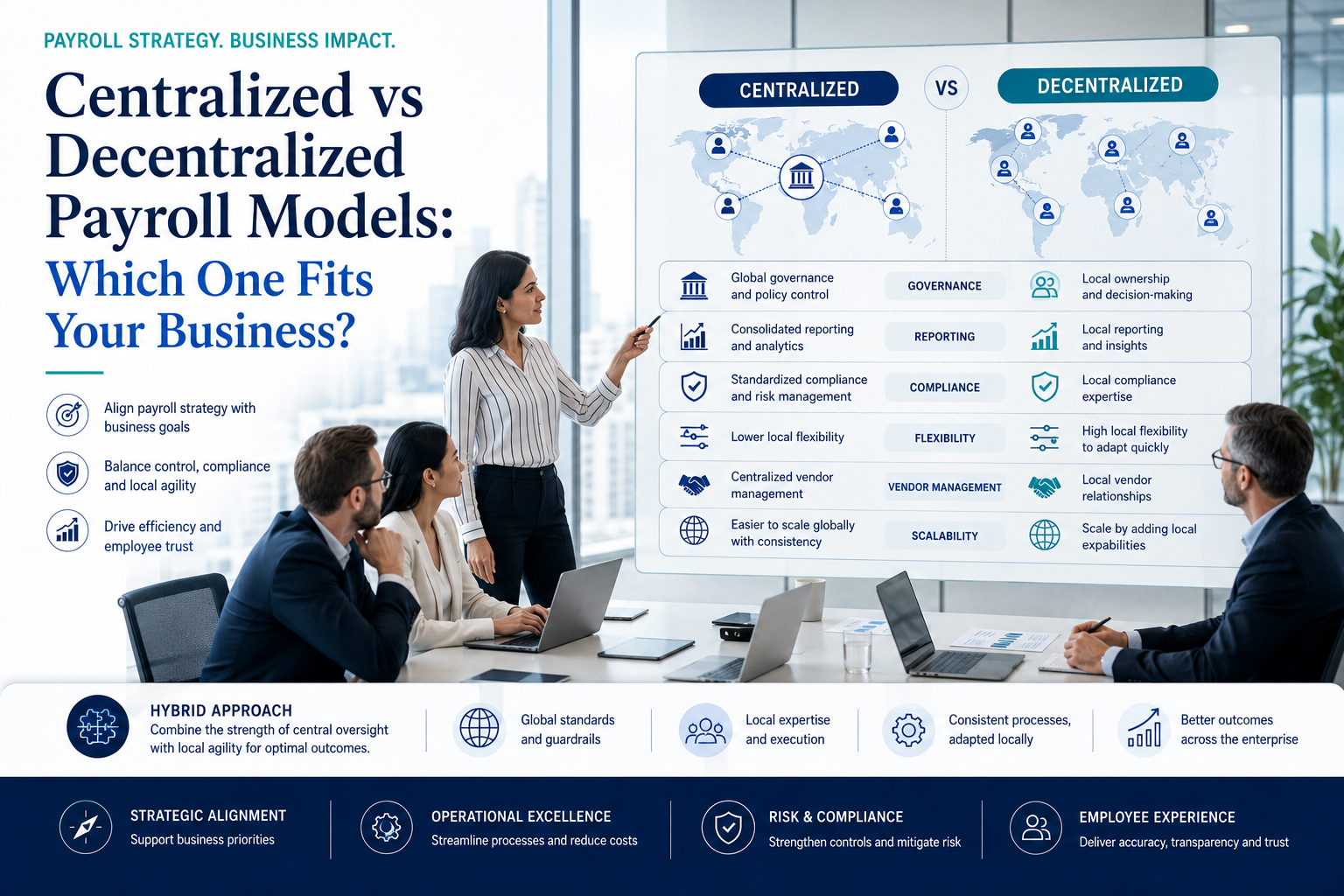
For many multinational organizations, choosing between a centralized payroll approach and a locally managed structure becomes one of the most important strategic decisions. The right model affects compliance, operational efficiency, employee experience, reporting quality, and long-term business scalability. Rather than asking which model is universally better, organizations should determine which approach best supports their growth strategy, operational maturity, and geographic footprint.
Payroll is no longer viewed as a purely administrative function. Executive teams increasingly recognize payroll as an essential business capability that directly influences financial planning, compliance management, workforce satisfaction, and organizational resilience. Selecting the appropriate operating model therefore requires a careful balance between global consistency and local flexibility.
Why Payroll Structure Matters More Than Ever
Many organizations inherit their payroll landscape over time. As new countries are added through expansion or acquisitions, local payroll providers are often appointed independently. While this may solve immediate operational needs, it frequently creates fragmented environments with different technologies, inconsistent processes, and limited global oversight.
Without a defined operating model, organizations may face duplicated activities, inconsistent governance, poor reporting visibility, and increasing administrative costs. These issues become more significant as the workforce grows and regulatory requirements continue evolving.
To address these challenges, many organizations invest in global payroll solutions that improve process standardization while allowing local legal requirements to be managed effectively. These strategic initiatives help businesses simplify payroll ecosystems, increase operational transparency, and build stronger governance frameworks without sacrificing flexibility where it is genuinely required.
Payroll transformation should never focus solely on technology. Successful projects begin with clearly defining business objectives, governance responsibilities, and future operating models before selecting systems or vendors.
Understanding Modern Payroll Models
There is no single payroll structure that works for every organization. The most effective approach depends on business size, international presence, regulatory complexity, corporate culture, and long-term strategic priorities.
Modern Payroll Models generally fall into three categories. Some organizations centralize decision-making and governance while maintaining local execution. Others allow each country to manage payroll independently. Increasingly, multinational businesses adopt hybrid approaches that combine centralized oversight with localized operational expertise.
The choice should never be based solely on historical practices. Instead, leadership teams should evaluate how payroll contributes to broader organizational goals, including operational efficiency, compliance management, financial control, and employee experience.
A well-designed payroll model provides consistent governance while remaining flexible enough to adapt to changing regulations, acquisitions, workforce expansion, and new technologies.
What Is a Centralized Payroll Model?
A centralized payroll model brings governance, strategic decision-making, reporting standards, vendor management, and operational oversight under a single global structure. Rather than allowing every country to operate independently, organizations establish common processes and accountability across all regions.
Centralization does not necessarily mean every payroll calculation occurs in one location. Local specialists may still process payroll where country-specific expertise is required. However, governance, technology standards, reporting, vendor relationships, and performance management remain coordinated centrally.
Large multinational organizations frequently adopt this model because it provides stronger visibility into workforce costs, operational performance, and compliance risks.
Companies operating complex global payroll services environments often find that centralized governance improves consistency across countries while reducing duplicated activities and strengthening executive decision-making.
A centralized approach also simplifies strategic initiatives such as digital transformation, vendor consolidation, contract benchmarking, and enterprise reporting.
Advantages of Centralized Payroll
One of the greatest advantages of centralization is improved governance. Executive leadership gains better visibility into payroll performance across all business units, making it easier to identify inefficiencies before they become costly operational problems.
Standardized processes also reduce inconsistencies between countries. Common approval workflows, reporting standards, documentation requirements, and performance metrics improve overall operational quality while supporting stronger internal controls.
Centralized structures frequently improve vendor management as well. Instead of maintaining separate commercial relationships in every country, organizations can negotiate broader agreements that improve service consistency and pricing transparency.
Other important benefits include:
Better executive reporting
Stronger governance frameworks
Greater operational visibility
Improved contract management
Easier technology integration
Standardized compliance monitoring
More consistent employee experience
Reduced duplication of administrative work
Centralization also enables organizations to implement transformation initiatives more efficiently because governance structures already exist to coordinate changes across multiple countries.
Potential Challenges of Centralization
Although centralization offers significant advantages, it is not without challenges. Every country maintains unique legal requirements, tax regulations, cultural expectations, and employment practices. Excessive standardization may reduce the flexibility needed to address these local realities effectively.
Organizations that centralize too aggressively sometimes create bottlenecks where local payroll teams must wait for global approvals before resolving routine issues. Decision-making may become slower if governance structures become overly complex.
Successful centralized environments therefore require clear accountability, well-defined escalation paths, and strong collaboration between global leadership and local payroll experts.
Technology integration can also become more challenging during the transition phase. Legacy payroll systems, historical data inconsistencies, and multiple vendor relationships often require careful planning before centralization delivers measurable benefits.
Optimizing Payroll Operations Across Multiple Countries
Regardless of organizational structure, companies should continuously evaluate how efficiently payroll is being delivered. Cost reduction should not be achieved through reduced service quality or weakened compliance. Instead, organizations should focus on eliminating unnecessary complexity while improving operational resilience.
High-performing payroll operations are typically characterized by standardized workflows, clearly defined responsibilities, accurate reporting, strong governance, and continuous performance measurement.
Organizations should regularly review:
Process efficiency
Vendor performance
Service-level agreements
Compliance controls
Reporting quality
Technology utilization
Operational risks
Employee satisfaction
Continuous improvement allows payroll teams to adapt as business requirements evolve while maintaining operational excellence across all locations.
Understanding Decentralized Payroll
A decentralized approach allows each country, business unit, or region to manage payroll independently. Local teams often select their own providers, determine operational processes, manage compliance activities, and interact directly with local authorities.
For organizations operating in highly regulated industries or countries with unique employment legislation, decentralized payroll may provide greater flexibility and stronger local responsiveness.
Local payroll professionals usually possess detailed knowledge of country-specific regulations and cultural expectations. They can respond quickly to legislative changes, employment disputes, or operational challenges without waiting for centralized approvals.
However, decentralized environments also create greater variation between countries. Reporting standards, governance practices, technology platforms, and operational performance may differ significantly across the organization.
Without effective coordination, businesses often experience duplicated effort, inconsistent reporting, increased vendor costs, and reduced visibility at the executive level.
Is a Hybrid Model the Best Option?
Many multinational organizations ultimately adopt a hybrid payroll model that combines centralized governance with localized execution.
Under this structure, global leadership establishes governance frameworks, reporting standards, technology strategy, vendor management, and performance expectations. Meanwhile, local payroll experts continue handling country-specific compliance, legislative changes, and employee support.
Hybrid models often provide the best balance between operational consistency and local flexibility. They enable organizations to standardize strategic activities while respecting regional legal requirements and cultural differences.
This approach has become increasingly popular because it supports both scalability and compliance without forcing businesses into overly rigid operational structures.
Factors to Consider Before Choosing a Payroll Model
Before redesigning payroll governance, organizations should evaluate several strategic questions:
Does the business operate in only a few countries, or across dozens of jurisdictions?
How standardized are existing payroll processes?
Are current vendors delivering measurable value?
How complex are local regulatory requirements?
Does executive leadership require greater reporting visibility?
Can existing technology support future business growth?
Answering these questions helps organizations select an operating model aligned with both current business needs and future expansion plans.
Payroll transformation should always begin with business strategy rather than software selection.
Conclusion
There is no universally correct answer in the debate between centralized and decentralized payroll. Every organization has unique operational requirements, geographic challenges, regulatory obligations, and strategic objectives.
Businesses seeking greater consistency, visibility, and governance often benefit from centralized structures, while organizations operating in highly specialized local environments may continue relying on decentralized expertise. Increasingly, however, hybrid models are allowing multinational companies to achieve the advantages of both approaches.
The most successful payroll organizations continuously review their operating model as business requirements evolve. By combining strong governance, modern technology, experienced payroll professionals, and clear strategic direction, organizations can build payroll environments that are efficient, compliant, scalable, and capable of supporting long-term international growth.
