
Expanding into new markets creates exciting opportunities, but it also introduces significant operational complexity. Payroll is one of the first business functions to feel the pressure of international growth because every new country brings different regulations, tax systems, employment laws, currencies, reporting obligations, and workforce expectations. Without a structured global payroll strategy, organizations often find themselves managing disconnected providers, inconsistent processes, and fragmented governance that increase both costs and operational risk.
Many businesses begin their international expansion using local solutions that work well for individual markets but fail to support enterprise-wide visibility. As acquisitions, mergers, and rapid hiring continue, payroll environments become increasingly difficult to coordinate. Finance, HR, legal, procurement, and payroll teams frequently operate with different objectives, making it challenging to create standardized workflows that support business growth.
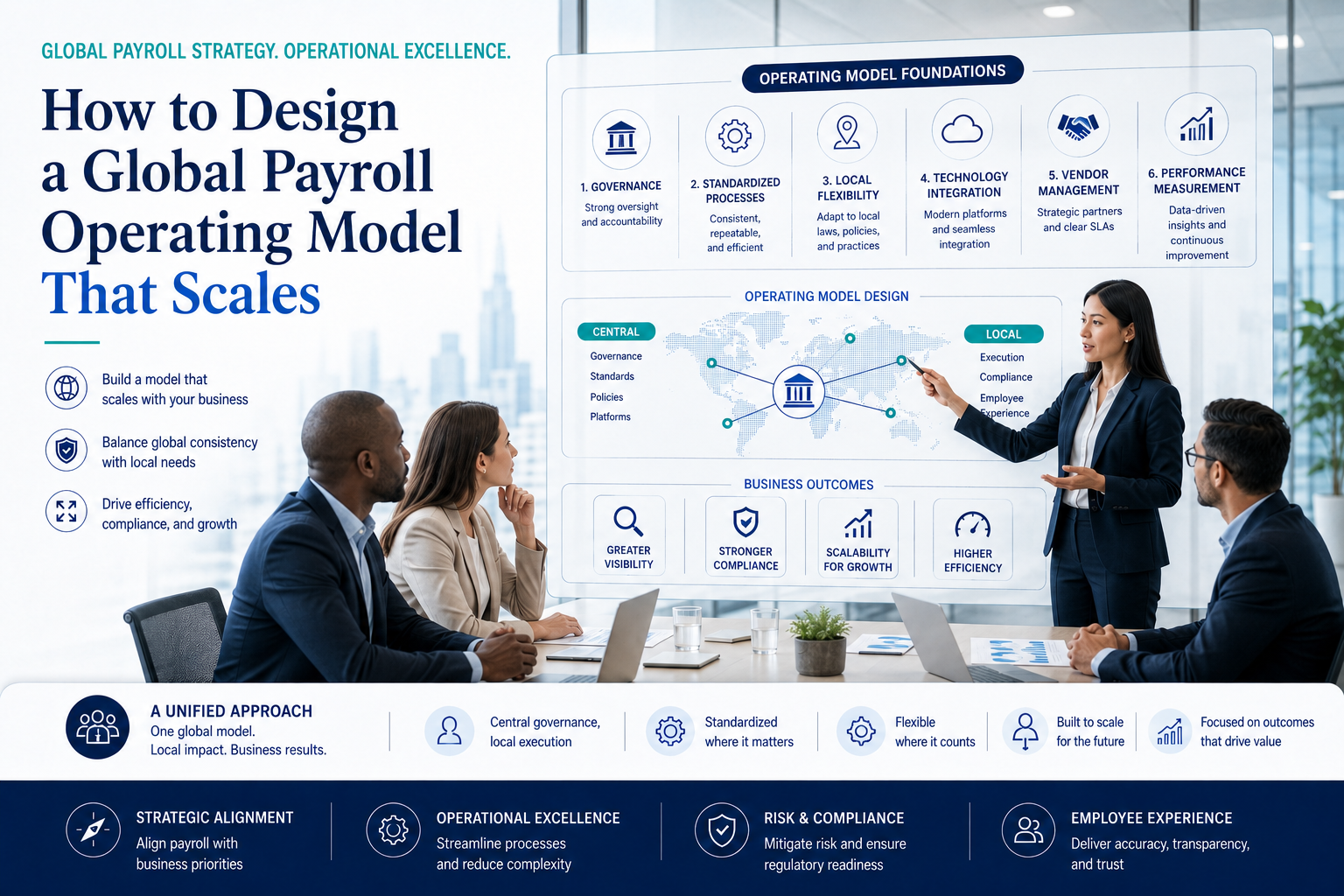
A scalable payroll operating model is not simply about choosing better technology or replacing payroll vendors. It requires organizations to rethink governance, accountability, process ownership, reporting structures, and decision-making across every region where employees are located.
Why Traditional Payroll Models Stop Working
Many payroll models evolve naturally rather than strategically. Local business units often select providers independently, implement country-specific workflows, and build reporting practices that meet immediate operational needs.
While these decentralized approaches can initially provide flexibility, they become increasingly difficult to manage as organizations expand internationally. Leadership teams lose visibility into payroll costs, service quality, compliance performance, and vendor accountability.
As organizations mature, disconnected payroll environments begin creating operational inefficiencies that directly affect financial performance. Manual reporting, inconsistent approval structures, duplicated activities, and fragmented technology all contribute to rising administrative costs.
Forward-looking organizations increasingly invest in global payroll solutions that create greater consistency while allowing enough flexibility to meet local regulatory requirements. Rather than forcing complete standardization, successful organizations focus on defining common governance principles that support every country without ignoring regional differences.
Payroll transformation should therefore begin with operational assessment rather than technology selection. Companies need to understand how payroll currently functions across departments, providers, and countries before introducing new systems or redesigning workflows.
Understanding the Foundations of a Global Payroll Operating Model
A payroll operating model defines how payroll activities are managed across the organization. It establishes responsibilities, governance, technology architecture, service delivery, reporting standards, compliance ownership, escalation procedures, and performance measurement.
Many organizations mistakenly assume that implementing new software automatically creates an effective operating model. In reality, technology supports the model rather than replacing it.
Successful payroll operating models answer several fundamental questions:
Who owns payroll governance?
Which decisions remain centralized?
Which activities stay local?
How are compliance risks monitored?
How are payroll vendors managed?
What reporting standards apply globally?
How are process improvements prioritized?
Answering these questions creates clarity across the organization and reduces operational confusion.
Strong governance also enables leadership teams to make informed strategic decisions. Instead of reacting to payroll issues after they occur, organizations develop proactive management practices that improve visibility and reduce long-term operational risk.
Aligning Payroll With Business Strategy
Payroll should never operate independently from wider business objectives. As organizations grow internationally, payroll becomes closely connected with finance, HR, tax, procurement, IT, compliance, and workforce planning.
Well-designed global payroll operations support business expansion by providing consistent employee experiences while maintaining compliance across multiple jurisdictions.
Payroll leaders should actively participate in transformation initiatives instead of simply executing operational tasks. Early involvement helps identify risks before implementation begins and allows payroll considerations to influence broader organizational planning.
Cross-functional collaboration becomes particularly important during mergers, acquisitions, business restructuring, and international expansion. These initiatives often introduce entirely new payroll environments that must eventually integrate into existing operations.
Organizations that involve payroll leadership early generally experience smoother transitions, faster implementations, and fewer compliance issues.
Governance: The Backbone of Scalability
Governance is often the biggest difference between organizations that scale successfully and those that struggle with payroll complexity.
Without governance, payroll decisions become inconsistent across regions. Local teams interpret policies differently, vendors operate with varying expectations, and reporting standards gradually diverge.
Effective governance establishes:
Standard operating principles
Clear ownership structures
Defined escalation procedures
Risk management frameworks
Compliance monitoring
Performance measurement
Vendor accountability
Governance should not eliminate local flexibility. Instead, it creates a structured framework that allows countries to address local legal requirements while maintaining enterprise-wide consistency.
Executive sponsorship is equally important. Payroll transformation initiatives often require collaboration between departments that traditionally operate independently. Strong executive support removes organizational barriers and accelerates decision-making.
Creating Standardized Processes Without Ignoring Local Needs
One of the biggest mistakes organizations make is attempting complete global standardization.
Every country operates within unique legal frameworks. Employment contracts, tax reporting, pension requirements, social contributions, statutory benefits, and payment schedules all differ significantly.
Attempting to force identical processes everywhere usually creates unnecessary complications.
Instead, organizations should standardize core principles while allowing local execution where regulations require flexibility.
Examples of globally standardized elements include:
Governance frameworks
Approval structures
Reporting formats
Vendor performance metrics
Data security standards
Documentation practices
Meanwhile, locally managed activities may include:
Tax reporting
Government submissions
Statutory calculations
Country-specific employee communications
This balanced approach improves consistency without sacrificing compliance.
Organizations supporting complex global payroll services environments typically achieve stronger long-term performance by separating strategic governance from local operational execution.
Technology Should Support the Operating Model
Technology receives significant attention during payroll transformation projects, but software alone cannot solve governance issues.
Organizations often invest heavily in new payroll platforms while leaving inefficient processes unchanged.
Successful technology implementation begins with clearly defined operational objectives.
Questions organizations should ask include:
What problems are we trying to solve?
Which manual processes create the greatest inefficiencies?
Where are compliance risks highest?
Which reporting capabilities are missing?
How will success be measured?
Only after answering these questions should software evaluation begin.
Integration also plays a critical role.
Payroll systems rarely operate independently. They exchange information with HR systems, finance platforms, time management tools, ERP environments, and business intelligence solutions.
Poor integration frequently creates duplicate work, inconsistent reporting, and increased operational risk.
Vendor Strategy Matters More Than Vendor Quantity
Many multinational organizations work with numerous payroll vendors.
This approach is not necessarily wrong.
The real issue is whether vendor relationships are managed strategically.
Some organizations maintain multiple regional providers while operating under centralized governance. Others consolidate globally under a single provider.
Neither model is universally superior.
The appropriate approach depends on organizational size, geographic footprint, regulatory complexity, technology landscape, and internal capabilities.
Vendor selection should evaluate more than pricing.
Organizations should consider:
Industry expertise
Regional coverage
Compliance capabilities
Technology integration
Service quality
Reporting maturity
Innovation roadmap
Governance support
Regular benchmarking ensures contracts remain competitive as market conditions evolve.
Building a Scalable Payroll Organization
Technology and governance alone cannot create sustainable payroll transformation.
People remain central to operational success.
Organizations need clearly defined payroll roles supported by appropriate training, career development, and knowledge sharing.
High-performing payroll organizations typically invest in:
Continuous learning
Cross-functional collaboration
Process documentation
Leadership development
Knowledge management
Succession planning
These investments reduce operational dependency on individual employees while improving organizational resilience.
As businesses continue expanding internationally, building scalable global payroll capabilities becomes essential for maintaining operational quality across multiple countries.
Scalability should be viewed as an organizational capability rather than a technology feature.
It reflects the organization's ability to grow without creating disproportionate increases in operational complexity.
Measuring Success
Many payroll transformation initiatives struggle because organizations define success too narrowly.
Reducing payroll costs is important, but cost alone rarely reflects operational maturity.
Organizations should monitor broader performance indicators including:
Payroll accuracy
Compliance performance
Processing timelines
Employee satisfaction
Vendor performance
Operational efficiency
Audit outcomes
Reporting quality
Governance maturity
Process standardization
These indicators provide a much clearer picture of transformation success.
Regular performance reviews also encourage continuous improvement rather than one-time optimization.
Payroll operating models should evolve alongside business strategy.
Organizations entering new markets, acquiring businesses, or implementing new workforce models will inevitably need to adapt governance frameworks and operational processes.
Managing Risk Throughout Growth
Rapid growth often exposes weaknesses that previously remained hidden.
Expanding organizations may suddenly face increased regulatory complexity, higher transaction volumes, multiple legal entities, and growing numbers of payroll providers.
Without structured governance, operational risk increases significantly.
Risk management should therefore become an integrated component of payroll operating models rather than a separate compliance exercise.
Organizations should regularly evaluate:
Regulatory changes
Vendor performance
Internal controls
Data protection
Business continuity
Disaster recovery
Cybersecurity
Operational resilience
Continuous monitoring helps organizations respond proactively instead of reacting after problems occur.
Future-Proofing the Payroll Function
Payroll continues evolving alongside broader business transformation.
Artificial intelligence, workflow automation, advanced analytics, cloud platforms, and real-time reporting are reshaping payroll operations across industries.
However, technology should enhance decision-making rather than replace governance.
Organizations that remain focused on process quality, accountability, and operational transparency will benefit most from technological innovation.
Future-ready payroll organizations build flexible operating models capable of adapting to changing regulations, workforce expectations, and business priorities without requiring complete redesign every few years.
Developing strong payroll scalability capabilities allows organizations to support expansion while maintaining compliance, operational consistency, and high-quality employee experiences regardless of geographic complexity.
Conclusion
Designing a global payroll operating model that scales requires much more than selecting new software or consolidating vendors. Sustainable payroll transformation depends on governance, clearly defined responsibilities, standardized processes, effective technology integration, and strong collaboration between payroll, HR, finance, procurement, IT, and executive leadership.
Organizations that invest in strategic planning before implementing operational changes are significantly better positioned to reduce complexity, improve compliance, strengthen vendor management, and create resilient payroll ecosystems capable of supporting long-term international growth.
As global organizations continue expanding into new markets, scalable payroll operating models will become an increasingly important competitive advantage. Businesses that treat payroll as a strategic business function rather than an administrative necessity will be better equipped to manage growth efficiently while delivering consistent, compliant, and high-quality payroll services across every market in which they operate.
