
How to Manage Global Payroll Across Multiple Countries
Managing payroll across several countries has become one of the most operationally challenging responsibilities for modern organizations. Expanding businesses must navigate different tax systems, reporting standards, currencies, labor laws, employee classifications, and local regulations while maintaining operational efficiency and employee trust. Even highly mature organizations can struggle with fragmented payroll structures that create unnecessary risks and rising administrative costs.
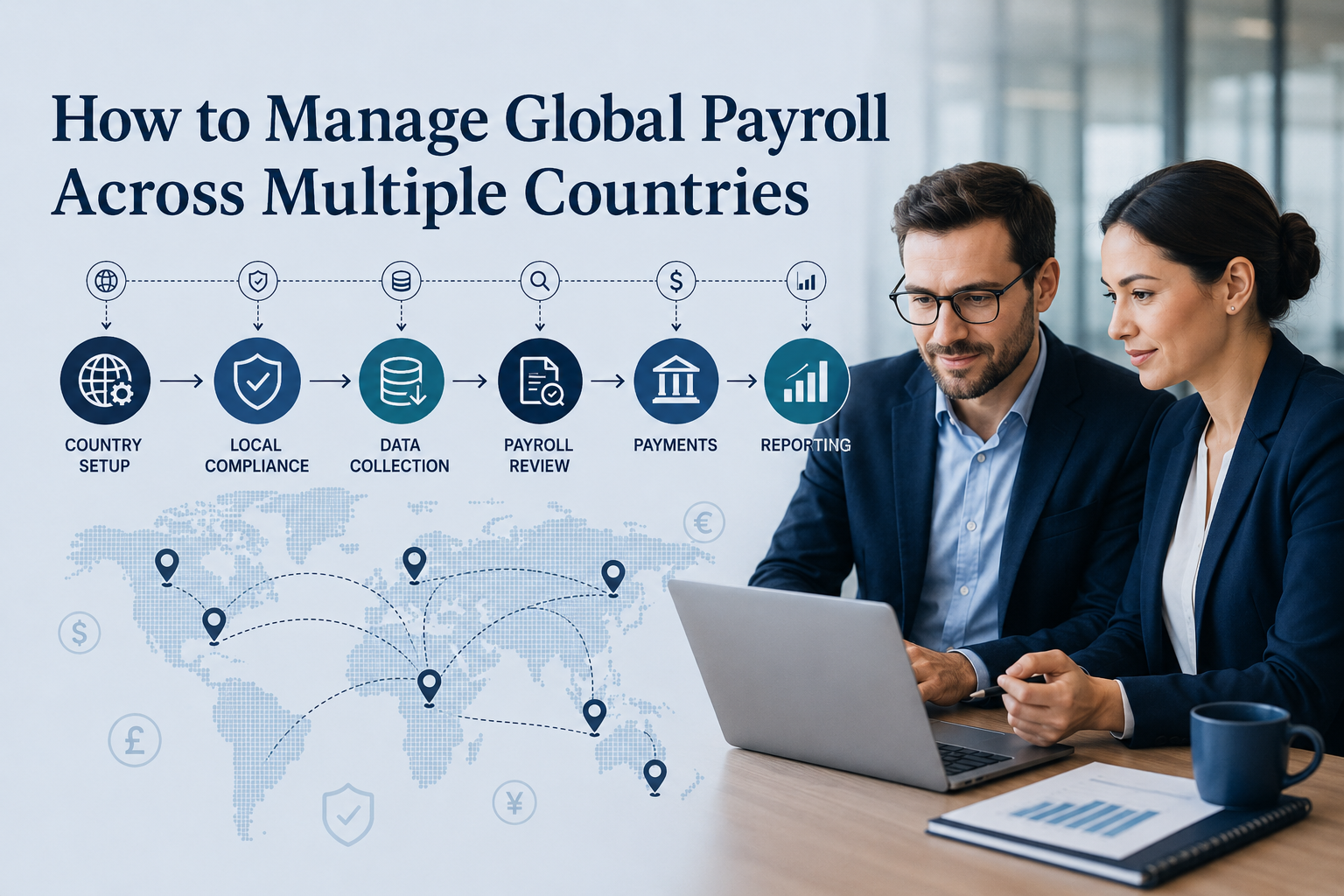
For multinational companies, maintaining strong payroll compliance is no longer simply a legal requirement. It has become a critical component of operational governance, workforce stability, financial accuracy, and long-term business scalability. As payroll ecosystems continue evolving globally, organizations need structured processes and strategic oversight to manage complexity effectively.
Why Global Payroll Is Becoming More Complex
Global expansion creates opportunities for growth, but it also introduces operational layers that many businesses underestimate during early scaling stages. Payroll environments become increasingly difficult to manage when organizations operate across different jurisdictions with separate legal obligations and reporting standards.
In many cases, companies grow through acquisitions, regional expansions, or decentralized operational structures. Over time, this often leads to multiple payroll vendors, disconnected technologies, inconsistent reporting methods, and fragmented governance models. What initially appears manageable can quickly become inefficient and expensive.
Another major challenge involves regulatory volatility. Labor laws and payroll requirements frequently change across different countries, forcing payroll teams to continuously adapt operational processes and reporting procedures. Without centralized oversight, these changes may not be implemented consistently.
To address these growing challenges, many organizations are investing in more scalable global payroll solutions that improve visibility, standardization, and operational coordination across multiple business units and countries.
Modern payroll transformation initiatives now focus not only on automation, but also on governance, operational resilience, vendor alignment, and strategic process design. Businesses that fail to modernize payroll structures often experience reporting inaccuracies, delayed payments, compliance exposure, and increasing operational inefficiencies.
The Biggest Challenges in International Payroll Operations
Managing payroll internationally requires coordination between HR teams, finance departments, local stakeholders, compliance specialists, external providers, and internal leadership. Without clear accountability structures, payroll operations can become fragmented very quickly.
One of the most common problems is the lack of standardized workflows between countries. Different teams may follow separate approval procedures, reporting formats, escalation paths, and operational timelines. This inconsistency increases the risk of payroll errors and makes centralized reporting significantly more difficult.
Another challenge involves technology integration. Many organizations still operate with disconnected systems that require manual intervention between HR platforms, payroll engines, finance tools, and compliance reporting environments. Manual processes increase the likelihood of delays and data inaccuracies.
For businesses managing large-scale international payroll operations, maintaining transparency across multiple jurisdictions requires far more than local payroll execution alone. Organizations must establish structured governance models that allow leadership teams to monitor performance, risks, compliance obligations, and operational efficiency globally.
Operational visibility is especially important during periods of rapid growth or organizational restructuring. Companies without standardized payroll governance often struggle to identify inefficiencies or respond quickly to emerging risks.
Why Governance Matters in Global Payroll
Governance is one of the most overlooked elements of payroll management. Many organizations focus heavily on payroll technology while neglecting operational ownership structures, escalation frameworks, and accountability processes.
Strong payroll governance ensures that responsibilities are clearly defined across vendors, internal teams, and regional stakeholders. It also helps businesses establish consistent operational standards that reduce confusion and improve reporting quality.
Organizations with mature governance frameworks are generally better positioned to manage vendor relationships, monitor service quality, and maintain regulatory alignment across different regions.
At the same time, governance creates greater operational resilience. Businesses that rely heavily on individual employees or undocumented processes often face serious continuity risks when teams change or operational disruptions occur.
This is one reason why many multinational companies are reassessing their existing global payroll services structures and implementing more centralized operational models designed for scalability and long-term sustainability.
Governance improvements also help organizations strengthen audit readiness and internal controls. Clear approval workflows, documented operational procedures, and standardized reporting structures reduce the likelihood of payroll discrepancies and compliance issues.
The Role of Technology in Payroll Transformation
Technology has transformed payroll operations significantly over the last decade. Automation, cloud-based platforms, workflow tools, and integrated reporting systems now allow organizations to manage payroll environments with greater efficiency and visibility than ever before.
However, technology alone cannot solve poorly designed payroll operations. Many organizations invest heavily in new systems without first addressing process fragmentation or governance gaps. As a result, they often automate inefficient workflows rather than improving operational design.
Successful payroll transformation requires businesses to evaluate both technology and operational structure simultaneously. Payroll systems should support broader business objectives while remaining flexible enough to adapt to local requirements.
Modern payroll platforms can support:
automated calculations and validations
centralized reporting dashboards
workflow approvals and audit trails
compliance monitoring capabilities
integration with HR and finance systems
workforce analytics and forecasting
These capabilities help organizations improve operational efficiency while reducing manual administrative workloads.
At the same time, businesses should avoid overcomplicating payroll ecosystems with unnecessary platforms or overlapping vendor solutions. Simplification often creates stronger long-term operational outcomes than excessive technological expansion.
Companies investing in scalable global payroll management strategies typically focus on operational consistency, governance visibility, and process alignment rather than technology implementation alone.
Vendor Management and Operational Alignment
Vendor management plays a major role in global payroll success. Many multinational organizations work with several regional providers across different countries, creating varying service standards and inconsistent operational experiences.
Without strong vendor governance, businesses may experience communication gaps, reporting inconsistencies, duplicated activities, or unclear accountability structures. These issues frequently increase operational costs while reducing service quality.
Organizations should regularly review provider performance, pricing structures, reporting quality, escalation procedures, and contractual terms. Vendor benchmarking exercises can help companies identify operational inefficiencies and improve commercial competitiveness.
However, changing payroll providers should never be treated as a quick solution. Vendor transitions involve significant operational risks if not carefully planned and governed. Businesses must evaluate not only cost structures, but also long-term scalability, compliance capabilities, and operational fit.
Strong operational alignment between vendors and internal stakeholders improves payroll consistency while reducing administrative friction. Clear communication frameworks and governance structures help organizations maintain stability during periods of growth and transformation.
Compliance Risks Across Multiple Countries
Every country has unique payroll regulations involving taxation, employee classification, statutory benefits, reporting requirements, and data protection standards. Managing these obligations across several jurisdictions simultaneously creates substantial operational complexity.
Compliance failures can result in financial penalties, legal exposure, reputational damage, and employee dissatisfaction. Even relatively small reporting errors may create broader regulatory consequences over time.
One major challenge for multinational companies is maintaining consistent compliance oversight across decentralized operations. Local teams may interpret regulations differently or follow inconsistent reporting practices, increasing operational risk.
Organizations managing complex international payroll services environments should therefore establish centralized compliance monitoring frameworks supported by local expertise and clearly documented operational procedures.
Proactive compliance management also improves organizational confidence during audits, acquisitions, and expansion initiatives. Businesses with strong governance frameworks are generally able to adapt more effectively to changing regulations and evolving workforce models.
Building a Scalable Payroll Strategy
Long-term payroll success depends on scalability. As businesses expand internationally, payroll operations must evolve alongside workforce growth, organizational restructuring, and changing market conditions.
A scalable payroll strategy begins with clear operational objectives. Organizations should define governance principles, reporting standards, vendor responsibilities, escalation procedures, and transformation priorities before implementing major operational changes.
Companies should also evaluate whether their existing payroll structures align with broader business goals. Many organizations continue operating with outdated models that no longer support current operational realities.
Key areas organizations should assess include:
payroll governance structures
operational standardization
vendor accountability
compliance visibility
reporting consistency
technology integration
scalability across regions
Businesses that invest in strategic payroll transformation are generally better positioned to control operational risks while supporting long-term growth initiatives.
Why Independent Payroll Advisory Is Valuable
One of the biggest challenges organizations face during payroll transformation projects is the lack of independent strategic guidance. Many payroll vendors naturally promote their own technologies or outsourcing models, which may not always align with the organization’s operational requirements.
Independent payroll advisors provide objective expertise focused on governance, operational effectiveness, process optimization, and long-term business alignment.
Experienced payroll consultants can support organizations with:
operational assessments
transformation roadmaps
vendor selection support
process optimization initiatives
contract benchmarking
governance framework design
compliance risk reviews
This independent perspective often helps organizations identify operational weaknesses and improvement opportunities that internal teams may overlook.
For large multinational companies, strategic payroll advisory becomes particularly valuable during mergers, acquisitions, global expansion projects, or major operational restructuring initiatives.
Conclusion
Managing payroll across multiple countries requires far more than processing employee payments accurately. Modern global payroll environments involve complex operational ecosystems shaped by evolving regulations, multiple vendors, fragmented technologies, and increasing governance expectations.
Organizations that approach payroll strategically are better positioned to improve compliance, reduce operational inefficiencies, strengthen reporting quality, and support long-term business scalability. Successful payroll transformation depends on strong governance, operational alignment, vendor management, and scalable process design.
As businesses continue expanding internationally, payroll will remain a critical operational function directly connected to compliance stability, employee experience, financial control, and organizational resilience.
Companies that invest in structured governance frameworks and strategic payroll optimization today will be significantly better prepared to navigate the increasing complexity of global workforce management in the future.
