
Payroll Process Optimization – Where Companies Lose Time and Money
Payroll operations have become significantly more complex over the last decade. Companies operating across multiple countries now face growing compliance pressure, fragmented technologies, disconnected operational models, and increasing employee expectations.
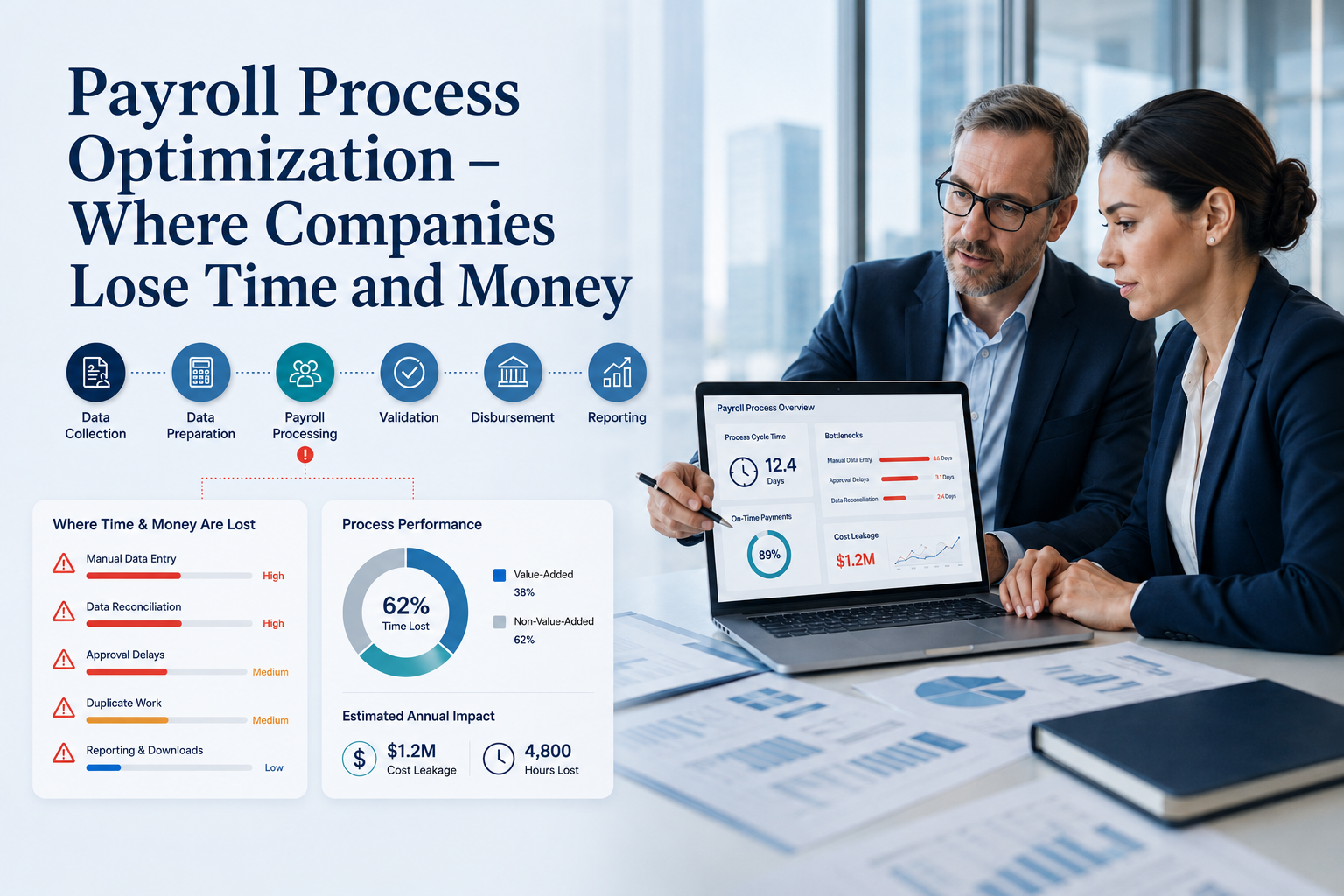
Many businesses still underestimate how much time and money is lost through inefficient payroll structures. Delayed approvals, manual reporting, duplicated workflows, and weak governance frameworks often create operational issues that remain hidden for years.
Experienced payroll experts regularly identify the same underlying problems across international organizations: fragmented processes, inconsistent reporting standards, multiple vendor environments, and limited operational visibility.
As organizations scale globally, payroll becomes more than an administrative function. It directly affects compliance management, employee experience, operational resilience, and financial reporting accuracy.
Businesses that fail to modernize payroll structures often struggle with rising operational costs and increasing complexity.
Why Payroll Inefficiencies Grow Over Time
Payroll inefficiencies rarely appear suddenly. In most organizations, operational complexity grows gradually as new markets, providers, systems, and reporting requirements are added over time.
Temporary solutions often become permanent processes.
Local teams may introduce country-specific workflows without aligning them with broader organizational standards. Over time, this creates fragmented operational structures that are difficult to manage centrally.
Many organizations continue relying on spreadsheets, email approvals, and manual reconciliations. These activities consume valuable resources while increasing operational risk.
Companies looking to improve efficiency are increasingly investing in more integrated global payroll solutions that provide better visibility, stronger governance, and improved process standardization.
The Cost of Manual Payroll Processes
Manual activities remain one of the largest hidden expenses inside payroll operations.
Many payroll teams still spend hours validating data manually, transferring information between systems, correcting reporting inconsistencies, and managing approval workflows through email chains.
Even small process inefficiencies become expensive when repeated every payroll cycle across multiple countries.
Manual processes also increase the likelihood of:
payroll errors
reporting delays
compliance issues
duplicated activities
inconsistent employee data
delayed issue resolution
These operational weaknesses affect both efficiency and employee trust.
Why Process Visibility Matters
One of the biggest payroll challenges is the lack of operational transparency.
Leadership teams often struggle to understand how payroll actually functions across countries, providers, and departments. Without visibility, it becomes difficult to identify inefficiencies or measure operational performance accurately.
This is why strategic payroll process optimization has become a major priority for multinational organizations seeking long-term operational improvement.
Process optimization allows businesses to evaluate workflows, governance structures, reporting standards, and operational ownership models in a more structured way.
Organizations that improve visibility are generally able to identify duplicated activities and unnecessary operational complexity much faster.
Fragmented Payroll Structures Create Hidden Costs
Many multinational businesses operate with fragmented payroll ecosystems.
Different countries may use separate payroll vendors, disconnected systems, independent approval workflows, and inconsistent reporting standards.
While these structures may initially appear manageable, they often become increasingly inefficient as organizations scale internationally.
Fragmentation creates multiple operational problems:
duplicated reporting tasks
inconsistent compliance controls
poor vendor coordination
reduced data accuracy
limited global visibility
increased administrative workloads
Over time, these inefficiencies generate significant hidden costs.
Organizations managing complex global payroll services environments often struggle to maintain consistency across regions because operational ownership is distributed across multiple stakeholders.
Vendor Complexity and Operational Risk
Vendor management is another major source of payroll inefficiency.
Many organizations maintain long-standing provider relationships without regularly reassessing service quality, pricing competitiveness, or operational alignment.
Different providers may follow inconsistent operational standards or maintain separate reporting structures.
Without strong governance, businesses often experience communication gaps and duplicated operational activities.
Poor vendor coordination also slows issue resolution and increases compliance exposure.
Why Payroll Transformation Is Becoming Essential
Payroll modernization is no longer optional for growing organizations.
Expanding compliance requirements, workforce mobility, and operational complexity are forcing companies to rethink how payroll operates across the business.
Strategic payroll transformation initiatives help organizations redesign operating models, simplify governance frameworks, improve scalability, and modernize reporting capabilities.
However, transformation should not focus only on technology implementation.
Successful payroll transformation also requires:
process redesign
governance alignment
operational standardization
vendor optimization
accountability improvement
Organizations that approach transformation strategically are generally able to reduce costs while improving operational resilience.
The Importance of Governance
Strong governance is critical for payroll efficiency.
Without clear operational ownership, payroll teams often struggle with inconsistent approvals, reporting delays, and weak accountability structures.
Governance frameworks help organizations define:
operational responsibilities
escalation procedures
reporting standards
compliance ownership
approval structures
Businesses with stronger governance models are usually better positioned to manage payroll complexity across multiple regions.
Governance also improves coordination between payroll, finance, HR, procurement, and external vendors.
Payroll and HR/admin Alignment
Payroll inefficiencies frequently originate from poor coordination between departments.
When HR/admin, finance, and payroll teams operate independently, organizations often experience duplicated work, inconsistent employee records, and reporting discrepancies.
Integrated HR/admin and payroll services structures help organizations improve operational alignment while reducing unnecessary administrative effort.
Better departmental coordination also improves employee experience by reducing delays and payroll-related issues.
As organizations scale internationally, cross-functional alignment becomes increasingly important.
Technology Alone Is Not Enough
Many organizations believe new software will automatically solve payroll inefficiencies.
In reality, technology alone rarely fixes operational problems.
If workflows remain inefficient or governance structures remain unclear, organizations simply automate existing inefficiencies instead of eliminating them.
Successful payroll optimization requires a balanced approach that combines:
operational redesign
governance improvement
process simplification
reporting standardization
technology integration
vendor alignment
Companies that focus only on software implementation often fail to achieve long-term operational improvements.
The Role of Independent Payroll Advisory
Independent payroll advisory support has become increasingly valuable for multinational organizations.
External specialists provide objective insight into operational weaknesses, vendor structures, governance gaps, and optimization opportunities.
This helps organizations make strategic decisions based on operational realities rather than vendor-driven recommendations.
Independent advisory support is especially useful during:
transformation programs
vendor evaluations
governance redesign
operational assessments
contract benchmarking initiatives
An external perspective often helps businesses identify inefficiencies internal teams may overlook.
Conclusion
Payroll inefficiency is rarely caused by one isolated problem.
Most organizations lose time and money through a combination of fragmented systems, manual processes, weak governance, inconsistent reporting standards, and poor vendor coordination.
As payroll complexity continues increasing globally, organizations need more structured and scalable operating models capable of supporting long-term growth.
Businesses that invest in payroll optimization initiatives are generally able to improve operational visibility, reduce administrative costs, strengthen compliance management, and create more resilient payroll environments.
Modern payroll is now a strategic operational function that directly impacts efficiency, compliance, workforce experience, and business scalability.
Organizations that modernize payroll proactively will be significantly better positioned to manage future operational complexity successfully.
