
How to Benchmark Your Payroll Providers and Contracts Effectively
Managing payroll across multiple countries has become increasingly complex. Rising compliance requirements, evolving technologies, and changing workforce models mean that organizations can no longer rely on legacy vendor relationships without regular evaluation. Many businesses work with several payroll outsourcing providers and assume their contracts remain competitive simply because payroll operations continue to run smoothly.
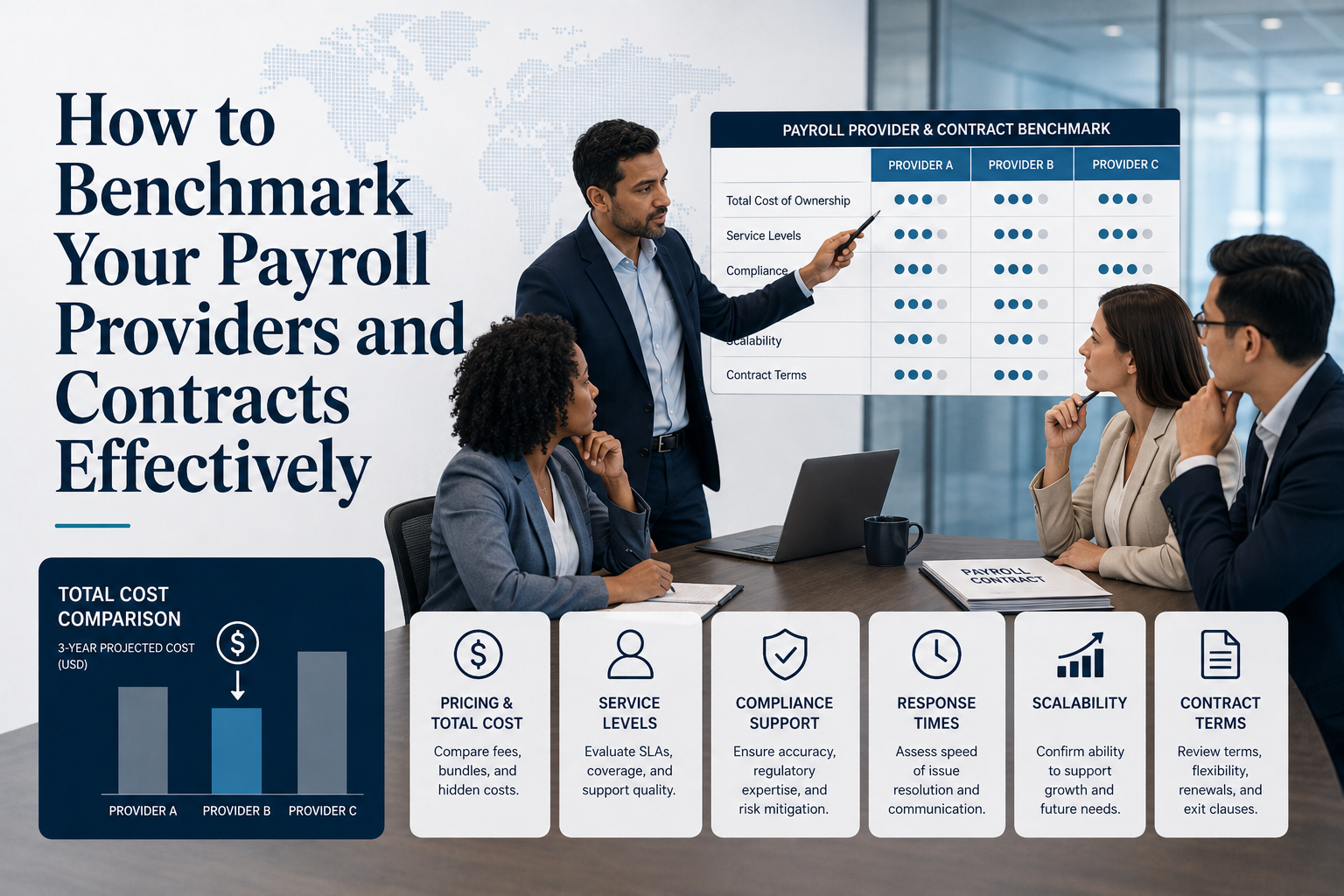
However, operational stability does not necessarily mean efficiency. Companies often discover hidden costs, duplicated services, outdated pricing structures, and inconsistent service quality only after conducting a detailed review of their payroll ecosystem. Benchmarking providers and contracts has therefore become an essential activity for organizations seeking long-term operational resilience and cost control.
As businesses expand internationally, payroll becomes a strategic business function that directly affects employee experience, compliance exposure, financial reporting, and operational efficiency. Organizations that regularly evaluate their providers are generally better positioned to adapt to market changes and support future growth.
Why Payroll Benchmarking Matters
Payroll contracts often remain unchanged for years despite significant changes in the market. New technologies, service delivery models, and pricing approaches continuously reshape the payroll industry.
Many companies are now investing in more scalable global payroll solutions that provide better visibility, stronger reporting capabilities, and improved governance across multiple countries and providers.
Without periodic benchmarking, organizations may continue paying for services that no longer reflect market standards or current business requirements. This can lead to unnecessary costs and operational limitations that become increasingly difficult to address over time.
Understanding the True Purpose of Benchmarking
Many leaders believe benchmarking is only about reducing vendor fees. In reality, effective payroll benchmarking goes much further.
The process helps organizations understand whether their current providers, technologies, governance frameworks, and contractual arrangements remain aligned with business objectives. Benchmarking can reveal:
pricing inefficiencies;
service gaps;
duplicated responsibilities;
weak governance models;
outdated service level agreements;
operational risks;
opportunities for process improvement.
A successful benchmarking exercise creates a fact-based foundation for future decision-making rather than relying on assumptions or historical relationships.
Signs That Your Payroll Contracts Need Review
Many organizations delay reviewing contracts because payroll appears to function adequately on a day-to-day basis. However, several indicators suggest that benchmarking should become a priority.
Rapid Business Growth
Expanding into new countries often increases operational complexity. Existing contracts may no longer support the organization's requirements or pricing expectations.
Mergers and Acquisitions
Acquisitions frequently create fragmented payroll environments with multiple vendors and overlapping systems.
Technology Changes
New technologies may offer capabilities that existing contracts do not cover, resulting in inefficiencies and additional manual work.
These challenges become even more significant for companies managing complex global payroll services environments across multiple regions.
End of engagement preparation
One year before termination notice is the right time ot trigger a benchmark and assess whether vendor is still competitive, and if so best negotiate the extension.
Areas to Evaluate During Provider Benchmarking
An effective benchmarking exercise should evaluate much more than service fees.
Service Scope
Determine whether your provider delivers services that remain relevant to your current business model.
Commercial Competitiveness
Compare pricing structures against current market standards.
Governance Framework
Review communication models, escalation procedures, and account management capabilities.
Technology Capabilities
Assess reporting tools, integrations, and automation functionality.
Compliance Support
Evaluate how providers manage regulatory changes and risk mitigation.
Service Quality
Organizations increasingly rely on independent payroll provider reviews to understand market perceptions and compare service capabilities across vendors.
External feedback can help identify recurring strengths and weaknesses that may not be immediately visible during internal assessments.
Contract Clauses That Are Frequently Overlooked
Many payroll contracts contain provisions that receive little attention during initial negotiations but later create significant challenges.
Examples include:
automatic renewal clauses;
restrictive termination periods;
price adjustment mechanisms;
unclear service-level definitions;
limited reporting obligations;
vague compliance responsibilities;
insufficient change-management procedures.
insufficient liability clauses
Organizations should review these provisions regularly to ensure contracts continue supporting business requirements.
Building an Effective Benchmarking Framework
Successful benchmarking requires a structured methodology.
Define Business Objectives
Determine what the organization wants to achieve:
lower costs;
improved service quality;
enhance compliance
stronger governance;
technology / IT security modernization;
increased scalability.
Collect Operational Data
Gather information regarding:
service levels;
pricing structures;
incident volumes;
reporting quality;
compliance performance.
users feedback
Compare Against Market Standards
Use independent market intelligence and peer comparisons whenever possible.
Develop an Action Plan
Create a roadmap that prioritizes both short-term improvements and long-term transformation opportunities.
Why Vendor Management Matters After Benchmarking
Benchmarking should never be treated as a one-time exercise. The payroll market evolves continuously, and organizations require ongoing payroll vendor management to maintain contractual competitiveness and service quality.
Regular reviews help businesses:
identify emerging risks;
monitor service performance;
improve governance;
adapt to changing business requirements;
maintain stronger commercial positioning.
Organizations that implement continuous vendor management practices generally achieve better long-term outcomes than those that review contracts only when problems arise.
Conclusion
Benchmarking payroll providers and contracts is no longer simply a procurement exercise. It has become an essential component of payroll governance and operational strategy.
It is a must-have periodic activity - Organizations that regularly assess provider capabilities, pricing structures, service quality, and contractual terms are better equipped to reduce risk, improve efficiency, and support future growth.
Effective benchmarking creates transparency, strengthens decision-making, and ensures that payroll operations remain aligned with both market realities and business objectives. In an increasingly complex global environment, companies that treat payroll as a strategic function rather than an administrative necessity will be far better positioned to achieve sustainable operational success.
