
Why Payroll Governance Matters More Than Payroll Technology
Organizations today are investing more money than ever in payroll technology. New platforms promise automation, real-time reporting, artificial intelligence capabilities, and seamless integrations across HR and finance functions. While technology can certainly improve efficiency, many organizations fail to achieve expected results because they overlook a more fundamental element of payroll success: governance.
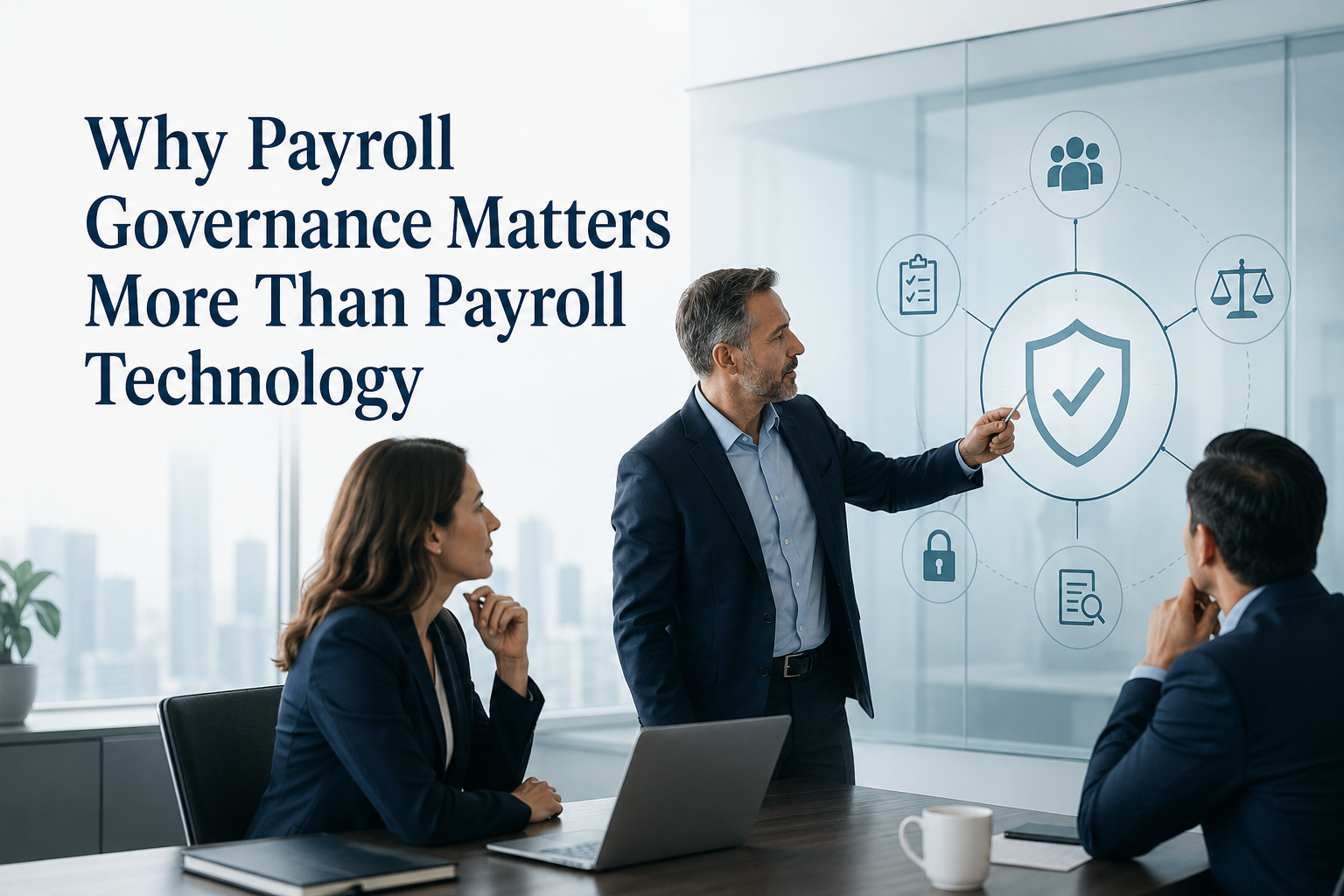
Strong governance creates the structure that allows payroll operations to function consistently, accurately, and compliantly across the organization. Without proper oversight, even the most advanced payroll systems can become sources of errors, compliance failures, and operational inefficiencies. Effective payroll risk management therefore remains one of the most important priorities for organizations seeking sustainable payroll excellence.
Technology can process transactions faster, but governance determines whether those transactions are accurate, compliant, and aligned with business objectives. This distinction becomes increasingly important as organizations expand globally and face growing regulatory complexity.
Understanding the Difference Between Technology and Governance
Payroll technology and payroll governance serve different purposes. Technology provides tools, automation, and system capabilities. Governance provides decision-making frameworks, accountability structures, policies, controls, and oversight mechanisms.
Many organizations mistakenly believe that implementing a new payroll platform will automatically resolve operational challenges. However, technology cannot compensate for unclear responsibilities, weak controls, poor vendor management, or inconsistent business processes.
A payroll system simply executes the processes designed around it. If those processes are flawed, automation may actually accelerate the creation of errors rather than eliminate them.
This is particularly evident in multinational organizations that implement new platforms without first establishing clear governance structures. Many businesses invest heavily in global payroll solutions expecting transformational improvements, only to discover that underlying operational problems remain unchanged.
Successful payroll environments require both technology and governance, but governance must come first. Without a clear operating model, even the most sophisticated software cannot deliver its full value.
Why Governance Creates Long-Term Stability
Payroll operates at the intersection of human resources, finance, compliance, tax, and workforce management. This complexity creates numerous opportunities for breakdowns if responsibilities are not clearly defined.
Governance establishes who owns specific processes, how decisions are made, how risks are managed, and how performance is monitored. These frameworks provide consistency across departments, countries, and operational teams.
Organizations with strong governance typically experience fewer payroll errors, faster issue resolution, better compliance outcomes, and greater operational transparency. They also adapt more effectively to regulatory changes and business growth.
One of the most important governance components involves the establishment of payroll internal controls that help prevent errors before they occur. These controls create structured approval workflows, validation procedures, segregation of duties, and monitoring activities that strengthen operational reliability.
Without such controls, organizations often rely too heavily on individual expertise or manual reviews, increasing operational risk and reducing scalability.
The Hidden Risks of Technology-First Payroll Strategies
Many payroll transformation projects begin with technology selection rather than operational assessment. Leadership teams focus on software features, implementation timelines, and integration capabilities without fully evaluating existing processes and governance structures.
This approach often creates disappointment because technology alone cannot solve structural weaknesses.
For example, if payroll data originates from multiple disconnected sources, a new platform may still receive inaccurate information. If roles and responsibilities remain unclear, errors may continue despite automation. If governance processes are weak, compliance failures can still occur regardless of technological sophistication.
Technology should support governance – not replace it.
Organizations that prioritize governance first are better positioned to evaluate technology objectively. They understand what business problems need solving and can select solutions that align with strategic objectives rather than simply following market trends.
This becomes especially important for enterprises managing complex global payroll services across multiple jurisdictions, providers, and workforce populations.
As payroll ecosystems become more interconnected, governance serves as the foundation that enables consistent execution across all participating stakeholders.
Governance Supports Better Vendor Management
Vendor relationships play a significant role in modern payroll operations. Many organizations rely on multiple service providers, technology vendors, implementation partners, and local specialists to support payroll delivery.
Without governance, managing these relationships becomes increasingly difficult.
Organizations often struggle with overlapping responsibilities, inconsistent service levels, poor communication, and limited accountability. These issues can increase costs while reducing operational effectiveness.
Strong governance frameworks establish clear expectations for vendors, define escalation paths, monitor performance metrics, and create accountability structures. This allows organizations to maintain control over payroll outcomes even when services are outsourced or distributed across multiple providers.
Effective vendor governance also supports contract management, service benchmarking, and strategic decision-making. Organizations gain greater visibility into operational performance and can identify improvement opportunities before problems become significant.
The most successful payroll organizations view governance as a continuous discipline rather than a one-time project.
The Role of Controls in Payroll Accuracy
Accuracy remains one of the most critical payroll objectives. Employees expect correct and timely compensation, while regulators expect compliance with applicable laws and reporting obligations.
Strong governance helps achieve both objectives through systematic control frameworks.
Organizations should implement multiple layers of review, validation, and monitoring throughout the payroll lifecycle. These mechanisms reduce dependency on manual intervention while strengthening accountability.
Examples include:
segregation of duties between payroll preparation and approval
automated exception reporting
reconciliation procedures
approval hierarchies
compliance monitoring activities
documented escalation processes
Well-designed payroll controls reduce operational risk while improving consistency and transparency. They also support business continuity by ensuring that critical knowledge is embedded within processes rather than relying on individual employees.
As organizations scale, these controls become increasingly important because operational complexity grows alongside workforce size and geographic expansion.
Governance and Regulatory Compliance
Regulatory requirements continue to evolve rapidly around the world. Tax regulations, labor laws, reporting obligations, and data privacy requirements frequently change, creating ongoing challenges for payroll teams.
Technology can help organizations process information efficiently, but governance ensures that regulatory changes are properly assessed, communicated, and implemented.
Compliance failures often occur not because systems are inadequate, but because organizations lack structured governance processes for monitoring legal developments and updating operational procedures.
Strong governance frameworks establish clear ownership for compliance activities, ensuring accountability throughout the organization. This creates a proactive approach to risk management rather than a reactive response to problems after they occur.
Organizations with mature governance practices are generally more resilient when facing regulatory changes because they already have structured decision-making processes in place.
Why Audits Strengthen Payroll Governance
Payroll audits provide valuable insight into operational effectiveness, risk exposure, and compliance performance. Unfortunately, many organizations view audits only as compliance exercises rather than strategic improvement opportunities.
A well-executed payroll audit process can identify inefficiencies, control weaknesses, documentation gaps, and governance issues before they result in significant business consequences.
Audits help organizations answer critical questions:
Are payroll policies being followed consistently?
Are controls functioning as intended?
Are vendors meeting contractual obligations?
Are compliance requirements being satisfied?
Are risks being managed effectively?
The findings generated through audits often provide a roadmap for continuous improvement. Organizations that embrace regular reviews typically maintain stronger governance frameworks and more stable payroll operations.
Rather than viewing audits as disruptive events, leading organizations incorporate them into broader governance strategies designed to strengthen operational performance over time.
Building a Governance-First Payroll Strategy
Organizations seeking sustainable payroll excellence should adopt a governance-first mindset. This does not mean technology is unimportant. On the contrary, technology remains a critical enabler of efficiency and scalability.
However, governance determines how technology is selected, implemented, managed, and monitored.
A governance-first strategy typically includes:
clearly defined operating models
documented policies and procedures
structured accountability frameworks
risk management protocols
performance measurement standards
vendor governance mechanisms
compliance oversight structures
continuous improvement processes
These elements create a stable foundation upon which technology investments can generate meaningful business value.
When governance is strong, technology becomes a powerful accelerator. When governance is weak, technology often amplifies existing problems.
Conclusion
Payroll technology continues to evolve rapidly, offering organizations new opportunities to improve efficiency, reporting, and automation. Yet technology alone cannot guarantee payroll success.
The organizations that achieve the strongest long-term results are those that prioritize governance first. Governance provides the accountability, controls, oversight, and strategic direction necessary to manage payroll effectively in increasingly complex business environments.
By establishing clear ownership structures, strengthening controls, managing risks proactively, and maintaining rigorous oversight, organizations can create payroll operations that are both efficient and resilient.
Ultimately, payroll technology may process transactions, but payroll governance determines whether those transactions support compliance, operational excellence, and long-term business success.
